Buying Guide
The best adjustable dog vest harnesses should be chosen by measurements and construction, not by appearance alone. Start with the dog’s neck and chest girth, using the widest part of the chest and the sizing information supplied for the specific model. A harness that is adjustable in several places can accommodate body shape more precisely, but more straps also mean more setup. Leave enough room for comfortable movement and follow the manufacturer’s chart rather than relying only on breed or weight.
Match the entry style to your dog
There are three documented entry patterns in this comparison. Overhead models, including SlowTon, Yintrest, and the large rabbitgoo standard harness, slide over the head and then fasten around the body. They can offer broad adjustment, but some dogs may resist head entry. Side-entry designs such as PHOEPET use a neck buckle so the harness does not need to pass over the dog’s head. The Voyager Flex is a step-in style: the dog steps into the vest before the quick clip is secured. IVY&LANE also documents neck-side buckles.
Entry style is a handling decision rather than a universal quality ranking. If your dog is comfortable with overhead equipment, the additional adjustment points may matter more. If your dog is restless during dressing, a side-entry or step-in design may be easier to manage. Always confirm that buckles are fully closed before attaching a leash.
Prioritize adjustment points
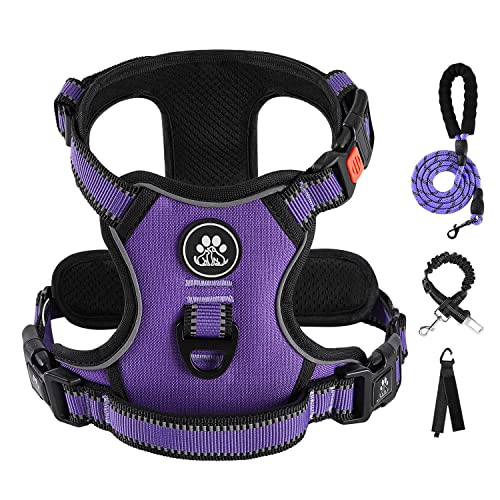
Adjustment should correspond to the areas that affect stability. SlowTon documents neck and chest adjustment, while Yintrest lists two neck and two chest straps. The rabbitgoo large models and AUROTH also specify four adjustment points. RunFido adds neck, chest, and belly strap adjustment. These arrangements provide more ways to tune the fit than a vest with only one adjustment area.
More adjustment does not guarantee a fit on every body shape. Straps should lie flat and should not sit across the throat. Check that the vest remains centered when the dog walks and that the dog can move its shoulders freely. Recheck fit after changing layers, grooming, or moving between sizes. The supplied listings repeatedly recommend measuring, so that step should come before ordering.
Choose the right leash-control layout
A front attachment point can help redirect the dog’s direction during training, while a rear point is commonly intended for regular walks. SlowTon, PHOEPET, Yintrest, the rabbitgoo models, AUROTH, RunFido, JSXD, and IVY&LANE document front and rear attachment options or equivalent dual points. This flexibility is useful when walking needs change, but the listing evidence does not establish that any harness eliminates pulling.
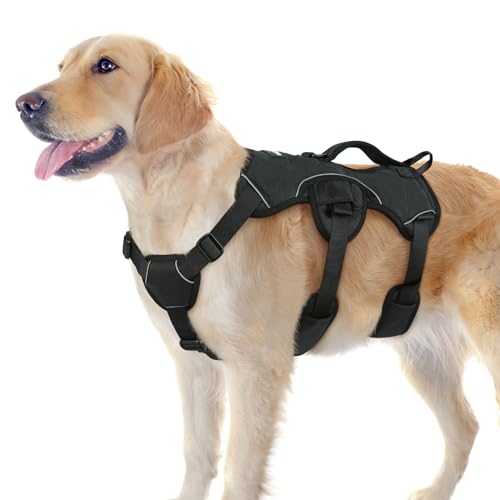
Handles are another practical feature. SlowTon has a top and center handle, RunFido lists horizontal and vertical handles, and PHOEPET, rabbitgoo, Yintrest, JSXD, and AUROTH document a top or control handle. A handle can provide a closer hold in a crowded area or during loading, but it is not a substitute for a correctly fitted leash connection or training plan.
Consider material and comfort details
Breathable mesh appears across several selected products. Voyager Flex uses soft air mesh, while Yintrest, JSXD, rabbitgoo, and RunFido describe mesh or soft padding. SlowTon lists fleece padding beneath the neck, back, and handle. Tactical products such as AUROTH and the rabbitgoo large tactical vest use reinforced nylon or Oxford-style materials and padded pressure areas.
These specifications help describe construction, but they do not prove how a particular dog will react. A heavily featured tactical harness may be appropriate for hiking, training, patches, or carrying small accessories, yet a lightweight mesh vest may be more suitable for a simple daily walk. Inspect the contact areas regularly for rubbing, twisting, or trapped fur.
Use visibility features appropriately
Reflective material is documented on every selected product except the rabbitgoo large standard harness, whose listing emphasizes other safety and control details instead. Voyager Flex specifically lists 3M Scotchlite reflective straps. PHOEPET, JSXD, AUROTH, Yintrest, and RunFido describe reflective material or strips, while the tactical rabbitgoo vest lists all-around reflective stripes.
Reflective elements can make a dog easier to notice in low light, but they are not a complete lighting system. Use a leash and walking route appropriate for the conditions, and do not assume reflective fabric replaces a light or other visibility aid.
Decide whether tactical features are useful
MOLLE panels and patch areas are documented on the rabbitgoo tactical large vest and AUROTH. Tactical features can support patches, identification, or small outdoor accessories. They may add structure and weight, so they are most relevant for hiking, training, or working-style use. For ordinary neighborhood walks, a simpler vest may be easier to handle.
Final recommendation
SlowTon No Pull Dog Harness with Front Clip ranks first overall in this specification-based comparison under the published weighted criteria.
SlowTon No Pull Dog Harness with Front Clip is the first overall specification-based choice among these best adjustable dog vest harnesses. It combines neck-and-chest adjustment, front and rear leash points, two handles, padding, reflective strips, and a quick-release buckle. The large rabbitgoo standard vest is a strong alternative for large dogs that need four sliders and a lockable neck buckle, while PHOEPET is the better documented choice for side entry. For small dogs, Voyager Flex emphasizes step-in handling and reflective straps, and IVY&LANE adds four adjustment points plus transport accessories. These top adjustable dog vest harnesses are not interchangeable: select based on measurements, entry style, control layout, and intended activity.
Frequently Asked Questions
How should I measure for the best adjustable dog vest harnesses?
Measure the dog’s neck and chest according to the product’s sizing instructions. For chest measurement, use the widest part of the rib cage. Compare both measurements with the selected listing’s chart, especially when choosing a large tactical vest or a small step-in model. Do not select only by breed or general weight.
Is a front clip better than a back clip?
They serve different documented purposes. A front clip is commonly described for redirecting or training a dog that pulls, while a back clip is generally intended for relaxed walking, jogging, or everyday use. Models such as SlowTon, Yintrest, rabbitgoo, AUROTH, and RunFido provide both options. The listing evidence does not support a guarantee that either clip will stop pulling.
Are step-in harnesses suitable for large dogs?
The selected Voyager Flex listing is specifically a small size and the Voyager Air listing says it is not for large dogs. The supplied evidence therefore supports step-in use here for small dogs, not as a general large-dog recommendation. Large-dog shoppers should compare the listed size range and construction of models such as the rabbitgoo, AUROTH, or RunFido vests.
What is the benefit of reflective material?
Reflective strips or threads can help a dog stand out when illuminated in low light. Voyager Flex lists 3M Scotchlite straps, while several other selected products describe reflective nylon, strips, or threads. Reflective material should be treated as one visibility feature, not as a replacement for suitable lighting, supervision, or a safe route.
Do I need a tactical harness with MOLLE panels?
Only if the documented panel and patch features match your use. The rabbitgoo tactical large vest and AUROTH include MOLLE systems for patches or small gear. Those features may be useful for outdoor, training, or working-style activities, but they can add bulk compared with a simpler mesh walking vest.