Buying Guide
Choosing among the best air dryers blowers blades options means matching the tool to your workspace, the objects you dry, and the power sources you already have. Below is a practical breakdown of the factors that separate a unit you will use daily from one that sits in the corner.
Sizing and Capacity
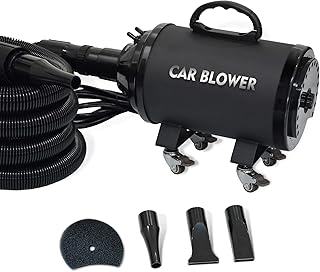
Start by measuring the largest surface you plan to dry regularly. If you detail full-size trucks or RVs, a wheeled unit with a long flexible hose lets you circle the vehicle without dragging the motor over paint. For motorcycles, ATVs, and compact cars, a handheld or mini cannon is easier to maneuver and stores in a standard cabinet.
Air volume and velocity matter together. A high CFM figure indicates how much air moves per minute, while FPM tells you how fast it exits the nozzle. Flat panels benefit from broad, high-CFM sweeps; tight gaps around taillights and grilles respond better to concentrated, high-FPM streams. If your work involves industrial conveyor lines or wide sheet stock, an air blade with a long linear slot creates an even curtain of air that standard round nozzles cannot replicate.
Feature Tradeoffs
Filtered intakes are common on automotive dryers for good reason: they reduce the chance of blowing microscopic grit onto wet paint. If you work mostly indoors in a clean shop, filtration is less critical, but for driveway detailers, it is a worthwhile safeguard.
Corded units deliver uninterrupted runtime and typically higher wattage, which translates to faster drying. Cordless blowers add mobility and eliminate trip hazards, yet they depend on battery charge cycles and may produce slightly less sustained output. Compressor-driven air guns fall into a different category entirely; they require a separate tank and regulator, but they generate exceptional pressure for blasting water out of mirror housings and door jambs.
Hose length is another tradeoff. Longer hoses add reach but can kink or reduce effective pressure if the diameter is too small. Look for reinforced walls and swivel fittings if you expect to coil and uncoil the hose frequently.
Installation and Setup Considerations
Most consumer car dryers are plug-and-play: unbox, attach the nozzle, and connect to a standard outlet. Check your garage circuit capacity if you are running multiple tools; a 1300-watt blower can approach the limit of a 15-amp circuit when paired with overhead lights and a vacuum.
Industrial air blades and compressor accessories need more planning. An air blade must be mounted level and at the correct distance from the passing surface, or the airflow will stripe rather than dry evenly. Compressor guns need a quick-connect coupler, a water separator, and sometimes a regulator to keep pressure within the tool’s safe range. If you do not already own a compressor, factor that current Amazon listing detail and floor space into your decision.
Maintenance and Reliability Signals
Maintenance on filtered dryers is straightforward: inspect the intake foam or screen after every few uses, tap out debris, and replace the filter when airflow drops. Store the unit in a dry location to prevent motor corrosion, especially if you work in humid climates.
For aluminum air blades, check the slot for buildup that can disturb the laminar flow. A soft brush and compressed air usually restore performance. Compressor lines should be drained daily to keep moisture from entering the tool and contaminating the surface you are trying to dry.
Reliability signals in listings include detailed wattage or horsepower claims, specific hose lengths, and mentions of thermal protection. Vague marketing language without numbers often correlates with lower-grade motors. We also favor listings that show sustained sales over time; a product with hundreds of reviews accumulated across multiple years usually indicates replacement parts or warranty support is available.
How to Compare Reviews
When reading owner feedback on air dryers blowers blades, look beyond the star average. Recent reviews reveal whether the current production batch maintains the same motor or filter quality as earlier units. Pay attention to comments about hose durability, caster stability on wheeled models, and the length of the power cord; these are practical pain points that star ratings alone can hide.
For cordless blowers, note how many reviewers mention battery longevity after months of use. For compressor tools, check whether users highlight consistent performance at standard shop pressures or if the tool requires an unusually high PSI to function well. Industrial air blades have fewer reviews overall, so prioritize feedback that includes photos of the mounting setup and describes the uniformity of the airflow curtain.
Final Recommendation
If you run a professional detailing operation and need a proven, high-velocity tool, the Tornador blow-out tool offers the strongest combination of review depth, sales momentum, and gap-drying precision. For mobile detailers or enthusiasts short on storage, the Adam’s Polishes Mini Air Cannon delivers filtered airflow in a package that fits under a workbench. Those covering large vehicles regularly should look at the SHELANDY wheeled unit or the full-size Adam’s Air Cannon for extended reach and broad panel coverage.
When you already have a shop compressor and want maximum force for crevices, the dual-nozzle air cleaning gun is the logical addition. If your tasks lean toward industrial drying or conveyor setups, the FluidXpert aluminum air blade provides a linear airflow pattern that round nozzles cannot match. Finally, if freedom from cords matters most, the battery-powered turbo jet blower adapts to both patio cleanup and light vehicle drying without tethering you to a wall outlet.
Match the tool to your power source, your typical surface area, and the level of filtration you need. Any of the ranked models above will outperform a basic leaf blower or damp towel once they are paired with the right workflow.