Buying Guide
Choosing the right aquarium waterfall setup requires more than picking the highest flow rate. You need to match capacity to tank volume, consider how the feature will be installed, and plan for ongoing maintenance. Whether you want a decorative sand-fall ornament or a pump-driven rock cascade, the sections below break down what matters most.
Sizing and Capacity
Flow rate is the first number to check. Small desktop tanks and nano aquariums usually need only 80–200 GPH to create a gentle trickle without blasting sensitive fish or plants. Medium community tanks around 40 to 75 gallons often pair well with pumps in the 700–1800 GPH range, especially if the waterfall must push water up more than a few feet. For large show tanks, pond-style setups, or paludariums with significant head height, pumps rated at 2200 GPH and above provide the pressure needed to maintain a visible, audible cascade.
Head height—the vertical distance water must travel from pump outlet to waterfall lip—directly reduces effective flow. A pump rated at 1600 GPH at zero lift may deliver noticeably less at a 10-foot rise. Always compare the manufacturer’s lift chart to your actual setup. If your waterfall sits inside a tall tank or an overhead sump, prioritize models that specify high lift performance or include an adjustable nozzle to direct pressure exactly where it is needed.
Feature Tradeoffs
Adjustable flow control is one of the most useful features for an aquarium waterfall. Stepless dials let you tune the cascade from a quiet ripple to a brisk tumble, which is helpful when keeping species that prefer calm water or when you need to reduce evaporation and splash. Fixed-flow pumps current Amazon listing detail less but offer no flexibility if you rescape the tank or change livestock later.
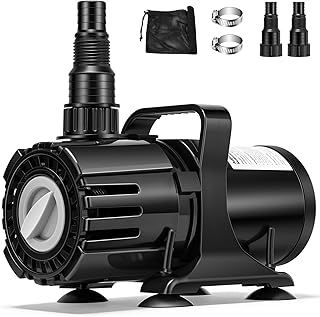
Nozzle design matters too. A 180-degree rotatable outlet makes it easier to route tubing behind rockwork or aim the stream across a specific section of the tank. Barrier bags and intake sponges are valuable in planted or sandy aquariums because they prevent debris, gravel, or shrimp from clogging the impeller chamber. If you are running the pump in a sump rather than the display, these protections become less critical.
Decorative waterfall ornaments trade raw performance for aesthetics. Integrated sand-fall or mountain-view models hide the pump inside sculpted resin, so you sacrifice some flow control and filtration capacity in exchange for a self-contained visual feature. These work best as supplemental circulation rather than primary filtration.
Installation and Setup Considerations
Submersible pumps are the simplest to install: place them on a flat surface, attach tubing, and route the outlet to the waterfall entry point. In a bare-bottom sump, use a pre-filter sponge or barrier bag to keep the intake clear. In a display tank, conceal the pump behind hardscape or inside an ornament so only the cascade is visible.
Hang-on-back filters with waterfall returns require level tank rims and adequate clearance behind the aquarium. They are excellent for small setups where an internal pump would consume too much swimming space, but the cascade width is fixed by the filter outflow, so you cannot widen or narrow the stream without modifying the unit.
For sand-fall ornaments, follow the manufacturer’s guidance on media size. Too fine a grain can jam the mechanism, while overly coarse gravel may not travel smoothly up the intake tube. Rinse the sand thoroughly before adding it to the system to reduce clouding.
Maintenance and Reliability
All waterfall pumps need periodic cleaning. Calcium and biofilm accumulate on impeller shafts and housings, especially in hard water. Plan to disassemble the pump every four to eight weeks, rinse the parts in tank water or dechlorinated tap water, and clear the intake grate. Models with tool-free housings save time and reduce the risk of losing small clips.
Listen for changes in pitch. A rattling or grinding sound usually indicates debris in the impeller or worn bearings. Addressing the noise early can prevent motor burnout. If the pump sits in a warm tank or a poorly ventilated cabinet, thermal stress may shorten its lifespan, so ensure some ambient airflow around the power unit.
UL-listed motors offer an extra layer of confidence for continuous operation. While listing is not a guarantee against failure, it signals that the design has been tested to recognized electrical safety standards—a worthwhile consideration for pumps that run 24 hours a day.
How to Compare Reviews
When reading owner feedback, focus on comments that mention longevity under continuous use, noise levels in quiet rooms, and actual flow at height. A reviewer who ran the pump for six months in a 55-gallon tank with a 4-foot lift provides more useful data than someone who unboxed it and tested it in a bucket. Look for patterns rather than isolated complaints: one report of a leaky seal may be a fluke, but five similar reports suggest a design weakness.
Pay attention to context. A 95 GPH mini pump will receive poor marks if buyers expected it to power a backyard pond waterfall, just as a 4500 GPH giant will be criticized as too loud in a bedroom betta tank. Match the review scenario to your own aquarium waterfall goals before letting a single rating sway you.
Final Recommendation
If you need a reliable, mid-capacity pump for a standard home aquarium waterfall, the VIVOSUN 1600 GPH model offers the best balance of flow, lift, and owner-proven durability. For smaller tanks or discrete rock features, the AQUANEAT 80 GPH or PULACO 95 GPH mini pumps provide gentle circulation without dominating the aquascape. Budget-conscious builders who still want UL-listed safety should look at the WaterRebirth PS-1700, which delivers strong output at moderate wattage.
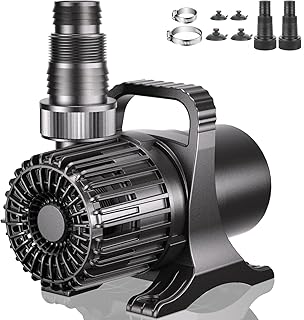
When precise control matters—such as in a paludarium with both aquatic and terrestrial zones—the VIVOHOME adjustable-flow pump lets you dial in the exact cascade width. If your priority is visual impact rather than filtration, the Underwater Sand Waterfall ornament creates a mesmerizing centerpiece with minimal plumbing. Finally, for large custom installations or pond-style aquariums, the high-capacity WaterRebirth and VIVOHOME 4500 GPH pumps supply the head pressure needed to drive tall, dramatic falls. Choose based on your tank volume, desired maintenance routine, and whether the waterfall is meant to filter, decorate, or both.