Buying Guide
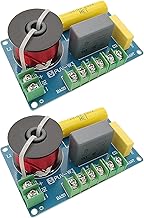
Selecting the right audio video crossover parts starts with understanding how a passive frequency divider fits into your signal chain. A crossover sits between your amplifier and your speakers, routing low frequencies to woofers, midrange frequencies to dedicated drivers, and high frequencies to tweeters. Without this division, drivers receive signals they cannot reproduce accurately, which increases distortion and risks physical damage. Whether you are repairing vintage cabinets, building DIY bookshelf speakers, or upgrading a car audio system, the correct crossover ensures each driver operates within its optimal range.
Sizing and Capacity
Power handling is the first specification to match. Crossovers are rated for a maximum wattage, and that figure should exceed the continuous power your amplifier delivers to the speaker. If you run a 100-watt-per-channel receiver, a crossover rated for 200 watts or more provides comfortable headroom. For professional stage or conference systems, parts rated at 400 watts and above are more appropriate. However, bigger is not always better in small home or car environments. An 800-watt stage crossover inside a compact bookshelf cabinet is unnecessary and may introduce a larger physical board than the enclosure can accommodate. Always measure internal cabinet space and verify the crossover dimensions before ordering.
Impedance compatibility is equally important. Most home audio speakers operate at 4, 6, or 8 ohms, while some car audio setups can dip lower or fluctuate. Many of the best audio video crossover parts support a 4 to 8 ohm range, which covers the majority of consumer drivers. If you are mixing driver types or working with exotic vintage units, look for crossovers that explicitly list a 4 to 12 ohm range to avoid mismatches that can skew frequency curves.
2-Way vs. 3-Way Tradeoffs
A 2-way crossover divides the signal into two paths: one for the low-frequency driver and one for the high-frequency tweeter. This design is simpler, often more compact, and generally sufficient for two-driver speakers or basic car audio upgrades. Because there are fewer components in the signal path, 2-way networks can offer slightly lower insertion loss and easier wiring.
A 3-way crossover adds a midrange band, which is essential if your speaker cabinet contains a woofer, midrange driver, and tweeter. Three-way designs deliver more accurate imaging and reduce the workload on each individual driver. The tradeoff is increased complexity, larger physical size, and more wiring connections inside the cabinet. For home theater towers or studio monitors with three or more drivers per channel, 3-way audio video crossover parts are the better fit. For a simple coaxial car speaker or a two-driver bookshelf build, a quality 2-way unit keeps the project straightforward.
Installation and Setup Considerations
Passive crossovers do not require external power, but they do need proper placement inside the speaker enclosure. Mount the board securely to prevent vibration-induced solder joint fatigue. Keep crossover components away from the rear of woofers where air pressure and excursion are highest. If the crossover includes an adjustable feature, test the speaker before finalizing the cabinet interior so you can tweak the treble or bass output to match the room acoustics.
In car audio installs, heat becomes a factor. Door panels and trunk locations can experience wide temperature swings, so crossovers marketed with heat-dissipating properties are worth considering for automotive use. Use appropriately gauged speaker wire and ensure polarity is consistent across both channels. Reversing polarity on one side of a crossover will collapse the stereo image and reduce bass response.
Maintenance and Reliability Signals
Passive crossovers contain capacitors, inductors, and resistors. Over many years, electrolytic capacitors can drift in value, which shifts the crossover frequency. If you are restoring older speakers, replacing the original crossover with a modern network often restores the intended frequency response. For new builds, look for crossovers that use quality components and sturdy PCB or module boards. Products with a high number of detailed reviews mentioning longevity or consistent performance after months of use are generally safer choices than listings with perfect ratings but only a handful of reviews.
How to Compare Reviews
When evaluating audio video crossover parts, prioritize reviews that mention specific setups. A reviewer who notes the crossover model, amplifier power, driver types, and resulting sound quality provides more actionable insight than a generic star rating. Look for patterns across multiple reviews. If several buyers mention easy wiring, accurate frequency splitting, or improved clarity, those are reliable signals. Conversely, repeated complaints about blown tweeters or bass roll-off may indicate the unit is mismatched to certain drivers or overrated in power handling. Pay attention to review dates as well; recent reviews reflect current manufacturing batches and component revisions.
Final Recommendation
If you need a safe, well-tested starting point for a car or home stereo build, the 300-watt two-pack with the highest review volume offers proven performance and broad compatibility. For HiFi enthusiasts assembling three-driver bookshelf or tower speakers, the 3-way options with defined frequency points and strong recent sales provide the cleanest channel separation. Professional installers and stage technicians should gravitate toward the high-wattage stage crossover explicitly built for demanding audio video crossover parts applications. Car audio upgraders will benefit most from compact, heat-resistant two-way units designed to fit tight spaces. Match the crossover type to your driver count, verify that impedance and wattage ratings align with your amplifier, and choose a unit with enough documented user feedback to confirm long-term reliability.