Buying Guide
Choosing the best bamboo plant labels starts with matching the tag format to the planting space. A short T-shaped marker can be sufficient for seed trays and small pots, while a taller stake is easier to spot in raised beds or around mature foliage. The products above are compared from listing specifications and feature descriptions, not from hands-on testing or customer sentiment.
Match label height to the planting location
Height affects how quickly a label can be found and how much of the stake remains visible after insertion. The 3.9- to 4-inch formats from HOMENOTE, Elsjoy, YXGOOD, and Chunsvia are compact choices for seed trays, herbs, flowers, and potted plants. Their T-shaped heads provide a readable area without creating a large visual element beside a small plant.
Seven-inch options offer more reach. EssenZiell+, KINGLAKE, and FYSUIMU are suited to deeper pots, garden beds, and situations where foliage may surround a shorter label. BENECREAT also provides a roughly 7-inch rectangular format. Jingmore reaches 8 inches, while Hicarer documents an approximately 9.4-inch overall height and a 5-inch width for prominent signs.
Consider writing area, not just total height
A tall stake is not automatically the right choice for detailed notes. Look for a broad head or a stated writing surface if you need to record more than a plant name. Hicarer is the most spacious documented format, with room described for care requirements, sowing dates, harvesting windows, and observations. EssenZiell+ similarly emphasizes space for species, planting dates, and care instructions.
HOMENOTE provides one of the clearest compact-label specifications by documenting a 1.4-inch writing area. KINGLAKE, YXGOOD, and Chunsvia use T-type designs with widths around 2.36 to 2.4 inches, while Elsjoy lists a 2.3-inch-wide head across its various shapes. For simple identification, these formats provide a practical amount of space. For a nursery inventory or a garden with many varieties, a longer or wider marker may reduce the need for abbreviations.
Check whether writing can go on both sides
Double-sided writing can add useful space without increasing the label footprint. KINGLAKE, YXGOOD, and Jingmore document double-sided designs, while KINGLAKE specifically describes blank surfaces on both sides. This can allow a plant name on one side and a sowing date, cultivar, or care note on the other. The advantage depends on the writing instrument and the amount of information required, so treat it as added surface area rather than a guarantee of long-term legibility.
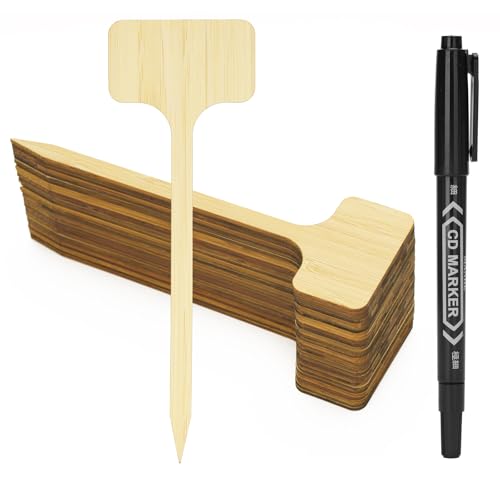
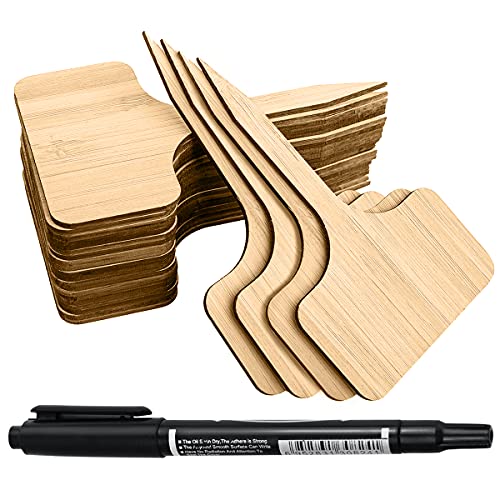
Several sets include a marker, making them ready for immediate labeling. Hicarer, KINGLAKE, HOMENOTE, YXGOOD, Chunsvia, FYSUIMU, and Jingmore document included markers or pens. Elsjoy describes compatibility with markers or oil-based pens, while BENECREAT describes a smooth surface suitable for a variety of pens but does not list a pen in the supplied evidence.
Writing-performance claims vary. Chunsvia gives a clear limitation, describing water-resistant ink for regular watering and light rain while noting that prolonged outdoor exposure may cause gradual fading. HOMENOTE describes its included ink as waterproof and fade-resistant, and FYSUIMU specifies a waterproof oil-based marker. These statements describe the listings, not independently verified durability. For any bamboo tag, write on a clean, dry surface and consider whether the label will be exposed to continuous moisture or sunlight.
Compare bamboo and label construction details
The selected products are presented as bamboo or natural wood-based plant labels, but construction evidence differs. Elsjoy describes natural bamboo that is sanded and smooth. YXGOOD specifies carbonized side-pressed bamboo, giving shoppers a more detailed construction description than a generic material statement. HOMENOTE documents a thickness of 1/16 inch, while BENECREAT documents 2 mm thickness. Hicarer describes a substantial construction intended to resist cracking and splintering during insertion.
These details can help with selection, but they should not be treated as laboratory performance results. Bamboo is a natural material, and outdoor exposure can affect both the stake and the writing over time. If a label will be moved repeatedly, a pointed design and an adequately broad head may be more useful than decorative styling.
Choose pack quantity for the project
Pack size changes the practical fit. Hicarer supplies 15 large labels, which suits a smaller number of prominent plants. KINGLAKE’s tall format supplies 30, and EssenZiell+ offers 50 longer tags. YXGOOD provides 50 compact labels, while Chunsvia and HOMENOTE provide 60 and 100 respectively. FYSUIMU and Jingmore also target larger labeling jobs with 100-piece packs.
A larger pack is useful for succession planting, greenhouse organization, classroom activities, or replacing labels as plants are moved. A smaller pack may be preferable when you need oversized signs and do not want unused markers. Do not compare quantity alone: a 15-piece extra-large set and a 100-piece compact set solve different labeling problems.
Decide whether decoration matters
Most plant labels in this comparison use a conventional T-type or rectangular shape. Elsjoy documents nine styles such as hearts, leaves, flowers, and mushrooms. That variety can make plant groups easier to distinguish visually and can work well for indoor displays, family projects, or classroom gardens. Standard T-tags remain the straightforward choice when consistent writing area and uniform placement matter.
Final recommendation
Hicarer Extra-Large Bamboo Garden Labels ranks first overall in this specification-based comparison under the published weighted criteria.
Hicarer Extra-Large Bamboo Garden Labels is the highest-scoring returned product and the first overall specification-based choice.
The final choice among the best bamboo plant labels depends on the documented features that match your intended use. Hicarer’s dimensions, broad writing surface, and stated support for detailed garden information make it a clear fit for visible signs and extensive notes. Jingmore is a practical alternative when you need many tall labels, while FYSUIMU is suited to deep planters and raised beds.
For compact bulk labeling, HOMENOTE combines a 100-piece pack with a specified writing area and included pen. Choose Elsjoy when decorative variety is important, YXGOOD when double-sided writing and carbonized bamboo construction are priorities, or Chunsvia when you want a balanced set with a dual-tip marker. These are among the top bamboo plant labels for different documented use cases, so the best match depends on height, writing detail, quantity, and exposure.
Frequently Asked Questions
What size bamboo plant label should I choose?
Choose a compact 3.9- to 4-inch label for seed trays, herbs, and small pots. A 7- to 8-inch marker is easier to see in deeper containers, raised beds, and fuller plantings. Hicarer offers the largest documented format here at approximately 9.4 inches tall and 5 inches wide for visible notes.
Are bamboo plant labels suitable for outdoor use?
The selected listings describe their labels for gardens, greenhouses, pots, raised beds, or other outdoor applications. However, natural bamboo and marker ink can experience wear with ongoing moisture and sunlight. Chunsvia specifically notes that prolonged outdoor exposure may cause writing to fade gradually, so outdoor suitability should not be interpreted as permanent performance.
Which best bamboo plant labels include a marker?
The supplied evidence lists an included marker or pen with Hicarer, KINGLAKE, HOMENOTE, YXGOOD, Chunsvia, FYSUIMU, and Jingmore. BENECREAT is described as compatible with various pens but does not list one as included. Check the package details before buying if a ready-to-write kit is important.
Are double-sided bamboo labels useful?
Yes. A double-sided label can hold a plant name on one side and a date, variety, or care note on the other. KINGLAKE, YXGOOD, and Jingmore document double-sided designs. This feature is useful when the label head is large enough for legible writing and when both sides remain visible or can be read after removal.
What should I write on a bamboo plant label?
For basic organization, write the plant name or variety. Larger formats such as Hicarer and EssenZiell+ can also accommodate planting dates, care instructions, harvesting windows, or observations according to their listings. On compact tags, prioritize the name and use abbreviations for dates or care notes to keep the writing readable.