Buying Guide
The best breathable tarps are not all made for the same job. Some are open-knit shade cloths intended to let air and rain pass through. Others are woven canvas covers that exchange air while offering water resistance. Start by deciding whether the main requirement is shade, condensation control, or a more protective cover for equipment.
Choose mesh or canvas first
Mesh is the clearest choice when airflow and drainage are central. TARPONIX, Vocray, MVPNET, Sibosen, Mklsit, Kesfitt, and the 95% black shade cloth all describe open or breathable mesh designs. These products are suited to gardens, patios, greenhouses, animal areas, fences, and other locations where trapped heat or standing water would be undesirable. Their openness also means they should not be treated as waterproof rain covers.
Canvas is a different design category. WHITEDUCK and Winpull use cotton canvas, while Gempler’s listing identifies a Weather Tough breathable tarp. Canvas can provide a more substantial surface for equipment, wood piles, camping gear, or pergola coverage, but the supplied descriptions identify water resistance or water-resistant seams rather than a completely sealed barrier. Gempler’s listing makes the limitation especially clear by describing its seams as water resistant, not waterproof.
Match shade percentage to the site
Shade percentage is one of the most useful specifications for mesh products. Among the selected products, Kesfitt and Mklsit specify approximately 70% shade, while MVPNET specifies 90% and the compact black mesh specifies 95%.
Higher shade figures may be preferable for intense sun over patios, chicken coops, or sensitive plants, but they also reduce the amount of direct light beneath the cover. For a general garden or patio application, a 70% option can be a middle-ground specification. If the priority is reflecting heat rather than simply darkening the area, Vocray and Sibosen use reflective aluminum or aluminized material. Their listings describe reflected solar exposure and breathable mesh construction.
Check the finished dimensions
Measure the area and the available attachment points before choosing a size. The listed dimensions vary substantially, from Gempler’s compact 4 x 4 feet and the 95% mesh at 8 x 9 feet to TARPONIX at 12 x 24 feet. Several shade cloths use a 10 x 20-foot format, including Vocray, MVPNET, Mklsit, and Kesfitt.
Do not assume that every stated size is interchangeable. WHITEDUCK distinguishes between cut size and finished size, and some listings warn that manual measurements may vary. A large mesh tarp also needs enough posts, fence sections, or other support points to distribute its load. That example reinforces the importance of checking the specific package details before purchase.
Inspect the edges and attachment points
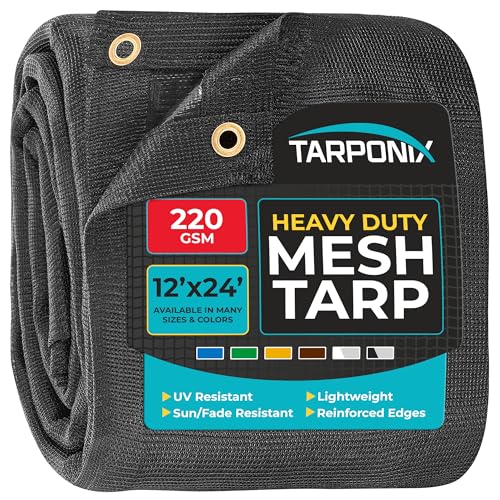
Reinforced edges help distribute tension, but the design and spacing of attachment points still matter. TARPONIX uses brass grommets every 2 feet. MVPNET and Vocray also document 2-foot or 20-inch spacing, while Mklsit lists grommets every 20 inches plus two at each corner. Kesfitt lists spacing of about 3.3 feet, and the 95% mesh includes built-in grommets with ball bungees.
Canvas products use different reinforcement strategies. WHITEDUCK lists rustproof grommets and polypropylene loops for all-around tensioning. Winpull identifies reinforced corners, strengthened grommet areas, and double-stitched seams. Gempler’s supplied evidence focuses on fabric performance and seam water resistance but does not provide the same level of tie-down detail, which is reflected in its scoring.
Use compatible ropes, bungees, or ties and avoid excessive tension unless the product instructions say otherwise. A breathable tarp can still be damaged when pulled unevenly against a frame or fence. Frequent grommets may make it easier to distribute tension, but they do not remove the need for suitable supports.
Consider reflective fabric for heat-focused shade
Dark shade cloth and reflective mesh address sun differently. Dark HDPE mesh is documented across several selected models and is often positioned for gardens, patios, and animal shelters. Reflective designs such as Vocray and Sibosen use aluminum or aluminized material and are described as reflecting solar radiation or heat away.
Reflective mesh can be a useful specification match for RVs, camping, carports, or hot garden areas. It remains breathable and water permeable according to the supplied listings, so it should be planned as a shade cover rather than a rain shelter. The silver color may also be more visible in a residential setting than black or olive canvas.
Understand water behavior
“Breathable” does not mean waterproof. Open mesh products intentionally allow air and water through. That helps reduce pooling and heat buildup, but it will not keep the covered items dry during rain.
Canvas can offer a better compromise when the goal is to reduce moisture buildup while providing some rain resistance. Winpull describes water-resistant cotton canvas, WHITEDUCK describes water-repellent fabric, and Gempler’s specifies water-resistant seams. These statements support cautious expectations, not a guarantee of dry contents in prolonged or heavy rain.
How the ranking was calculated
The editorial ranking uses five category-specific criteria: breathability and drainage, fabric and construction, reinforcement and tie-downs, coverage and size options, and application versatility. The criteria scores are based only on the supplied public listing features and specifications. No hands-on testing, customer sentiment, review information, purchase activity, or marketplace labels were used in the published scores. The ranking favors products whose construction, dimensions, attachment details, and intended uses are clearly documented.
Final Recommendation
TARPONIX Heavy Duty Mesh Tarp 12 x 24 ft ranks first overall in this specification-based comparison under the published weighted criteria.
The final choice among the best breathable tarps depends on the documented features that match your intended use.
TARPONIX Heavy Duty Mesh Tarp 12 x 24 ft is the highest-scoring returned product and the first overall specification-based choice. Its large finished coverage, double-stitched polypropylene hems, brass grommets every 2 feet, and documented use across gardens, patios, trailers, and construction settings give it the broadest combination of features in this group.
Choose WHITEDUCK if woven canvas, water repellency, and all-around tensioning loops are more important than open drainage. Choose Vocray for reflective 10 x 20-foot shade with included tie-down accessories, or MVPNET for a high-shade mesh design. Mklsit and Kesfitt are practical 70% shade options for common garden and patio layouts, while Sibosen offers a smaller reflective format.
For small covers, Gempler’s emphasizes breathable weather-tough fabric and condensation control, and the 95% black shade cloth includes ball bungees for a compact high-shade setup. Across the top breathable tarps, the deciding factor is not a single universal feature: match the material and water behavior to the site, then confirm finished dimensions and attachment points.
Frequently Asked Questions
Are the best breathable tarps waterproof?
No. The selected mesh products are designed to allow airflow and generally let rain pass through. Canvas options may be water resistant or water repellent, but the supplied descriptions do not establish that they are fully waterproof. Gempler’s specifically identifies water-resistant seams rather than waterproof seams.
What is the best breathable tarp material for shade?
HDPE mesh is the most consistently documented shade material in this comparison. Kesfitt, Mklsit, MVPNET, Sibosen, Vocray, TARPONIX, and the 95% black shade cloth use mesh or HDPE-based constructions. Reflective aluminum or aluminized mesh, as used by Sibosen and Vocray, is a separate option when reflected solar exposure is a priority.
How much shade should a mesh tarp provide?
The answer depends on the space and the amount of light you want beneath it. The selected products range from approximately 70% shade to 95% shade. A 70% product may suit general garden and patio coverage, while the 90% and 95% options are specified for heavier sun reduction. Higher shade levels may also mean less direct light for plants.
What should I check before installing a breathable tarp?
Confirm the finished dimensions, the number and spacing of grommets, the condition of the reinforced edges, and the strength of the support points. Also verify whether the fabric is mesh or canvas and whether the listing describes it as water permeable, water resistant, or water repellent. Use compatible ties or bungees and avoid excessive tension.
Can a breathable tarp be used over a chicken coop or kennel?
Yes, several selected listings document those applications. MVPNET, Mklsit, Kesfitt, Sibosen, Vocray, and the 95% black mesh identify animal enclosures or chicken coops among their uses. Because these are breathable shade materials, they can provide sun coverage and airflow, but they should not be selected as a substitute for a waterproof rain roof.