Buying Guide
The best milk thistle capsule supplements are not interchangeable on paper. Product listings may describe seed powder, a concentrated extract, a standardized silymarin formula, a full-spectrum preparation, or a specialized phospholipid complex. Those terms identify different designs, so the first step is deciding which label information matters most to you.
This guide ranks the selected products using six public, category-specific criteria: silymarin standardization, extract and dose transparency, formula simplicity, capsule-format clarity, quality documentation, and delivery or supporting-formula design. The ranking is specification-based. It does not represent laboratory testing, medical advice, or a hands-on comparison.
Silymarin is the flavonoid complex most often highlighted in milk thistle listings. A percentage such as 80% provides a standardization reference, while a statement such as 600 mg of silymarin gives a direct amount to compare. These details are not presented consistently across brands, so read the title, features, and Supplement Facts panel together.
Oregon’s Wild Harvest, Zazzee, FarmHaven, Nutricost, and Herbal Roots publish an 80% silymarin specification. NOW Foods’ maximum-strength listing states both a milk thistle extract amount and a silymarin amount. By contrast, Gaia Herbs describes a full-spectrum extract without publishing a numeric percentage in the supplied listing, and THORNE identifies a silybin phytosome without giving a conventional percentage.
A higher number should not automatically be treated as a better fit. Concentration, serving size, and the type of material being measured all matter. If a listing does not clearly explain whether the stated milligrams refer to powder, extract, or silymarin, treat that ambiguity as a reason to verify the label before comparing it with another product.
Compare extract type and delivery design
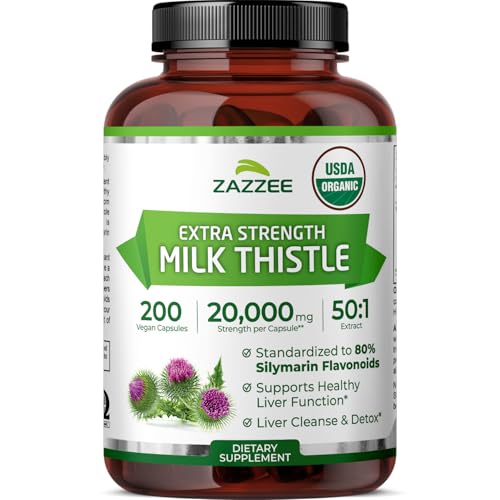
A plain powder is the most direct format, but several selected products use more specific approaches. Zazzee and FarmHaven describe 30:1 extracts, while Zazzee also offers a selected 50:1 design outside this ranking. A ratio communicates how much starting botanical material was used in relation to the extract, but it does not replace a stated active-compound standardization.
THORNE Milk Thistle Phytosome uses a silybin phospholipid complex with sunflower phospholipids. That is a different design from a conventional extract and may appeal to shoppers specifically looking for a phospholipid delivery format. Gaia Herbs describes a full-spectrum extract and a European extraction process. NOW Foods combines milk thistle with artichoke and dandelion, while Oregon’s Wild Harvest also includes dandelion.
These formulas should be compared according to purpose. A single-botanical product makes ingredient review simpler. A combination product may be preferable when the listed supporting botanicals are intentional parts of your routine. A specialized delivery format may matter more to someone comparing formulation technology than to someone who simply wants a quantified standardization.
Check the capsule and serving details
Capsule count is only one part of format clarity. The selected products range from 60 to 200 capsules, while other listings in the wider candidate pool use 300 or 360 capsules. That number does not establish how long a bottle lasts unless the serving size is also clear.
FarmHaven states 375 mg of extract per capsule. Pure Encapsulations lists 250 mg of milk thistle extract per capsule. The two NOW Foods products provide different presentations: the maximum-strength product lists 750 mg of extract and 600 mg of silymarin, while the artichoke-and-dandelion formula lists 300 mg per capsule. Nutricost states 300 mg per serving but does not clarify the capsule count within that serving in the supplied evidence.
Look for the relationship between capsule count, serving size, and active amount. Also note whether the capsule is described as vegan or vegetarian. Oregon’s Wild Harvest, FarmHaven, Zazzee, Gaia Herbs, and Nutricost provide plant-based capsule information in the supplied evidence. If dietary exclusions matter, review the entire label rather than relying only on a front-panel claim.
Formula simplicity can make a label easier to evaluate. Oregon’s Wild Harvest lists organic milk thistle seed, standardized organic milk thistle extract, and a vegan organic pullulan capsule.
Herbal Roots emphasizes no binders, fillers, or additives. Pure Encapsulations lists common allergen exclusions, artificial-ingredient exclusions, and non-GMO status. FarmHaven lists vegan, non-GMO, gluten-free, and several additional exclusions. NOW Foods’ combination formula lists vegan, non-GMO, nut-free, gluten-free, dairy-free, egg-free, halal, and kosher classifications.
“Clean” is not a universal technical category, so use the specific exclusions and certifications that are actually documented. USDA Organic, non-GMO, vegan, gluten free, and dairy free describe different attributes. A product may meet one without meeting all the others.
Look for quality documentation
Quality language is most useful when it names a certification, test, or manufacturing standard. Oregon’s Wild Harvest lists independent third-party testing and USDA Organic verification. Nutricost lists GMP compliance and third-party testing. Herbal Roots lists a cGMP facility and third-party testing. NOW Foods’ combination formula identifies NPA A-rated GMP certification and testing methods.
Zazzee and FarmHaven describe US manufacturing and organic status. Pure Encapsulations says its products are manufactured and tested to verify potency and purity. These statements differ in specificity, but each supplies more useful comparison information than a general promise of quality alone.
A listing is not a substitute for the current product label or professional guidance. If you take medication, have a diagnosed condition, are pregnant or nursing, or have allergies to botanical ingredients, ask a qualified healthcare professional whether a milk thistle product is appropriate.
How to use this comparison
Choose the criterion that reflects your priorities, then narrow the list. For quantified standardization, start with Oregon’s Wild Harvest, Zazzee, FarmHaven, Nutricost, or Herbal Roots. For a specialized delivery design, consider THORNE. For a combination formula, compare the two-botanical approaches from Oregon’s Wild Harvest or the artichoke-and-dandelion design from NOW Foods. For a full-spectrum approach, Gaia Herbs provides the clearest documentation among the selected entries.
The top milk thistle capsule supplements in this comparison differ more in formulation detail than in capsule format. Confirm the current label, serving directions, ingredient exclusions, and any professional advice before making a final selection.
Final Recommendation
Among the top milk thistle capsule supplements, the ranked products differ under documented silymarin standardization, extract and dose transparency, formula simplicity and dietary fit, capsule and serving clarity, certifications and testing details, and delivery or supporting formula design.
Oregon’s Wild Harvest Milk Thistle Dandelion ranks first overall in this specification-based comparison under the published weighted criteria.
Oregon’s Wild Harvest Certified Organic Milk Thistle Dandelion is the highest-scoring returned product and the first overall specification-based choice. Its 80% silymarin standardization, USDA Organic status, three-ingredient list, vegan capsule, and independent third-party testing create the most complete evidence profile in this comparison.
Choose THORNE Milk Thistle Phytosome if the phospholipid delivery design is your priority. Choose Pure Encapsulations Silymarin for clearly stated extract information and extensive ingredient exclusions. Zazzee and FarmHaven are strong candidates for readers who specifically want 30:1 organic extracts with 80% silymarin. NOW Foods’ combination formula is the clearest fit for a multi-botanical design, while Gaia Herbs is the selected full-spectrum option.
The best milk thistle capsule supplements depend on what you want the label to document. Before use, compare the current package directions with your dietary needs and any advice from a qualified healthcare professional.
Frequently Asked Questions
What should I compare when choosing the best milk thistle capsule supplements?
Start with the silymarin percentage or stated silymarin amount, then check whether the milligram figure refers to powder or extract. Next review the serving size, capsule type, ingredient list, dietary exclusions, certifications, and testing statements. A product with a clear 80% standardization may be easier to compare than one that only uses broad potency language, while a phytosome or full-spectrum product should be evaluated as a different formulation type.
No. An 80% statement describes standardization to silymarin, while 30:1 describes an extraction ratio. They answer different questions. Zazzee and FarmHaven document both, which makes their labels more detailed. When comparing products, consider both figures if supplied, but do not assume the extraction ratio alone establishes the final silymarin content.
Yes. NOW Foods Silymarin with Artichoke and Dandelion and Oregon’s Wild Harvest Milk Thistle Dandelion document additional botanicals, while the selected single-botanical products focus more narrowly on milk thistle preparations. Combination formulas may be appropriate for shoppers who intentionally want the listed ingredients together, but they can make it harder to compare milk thistle alone.
What does a milk thistle phytosome mean?
A phytosome is a delivery design in which the listing identifies a plant compound complexed with phospholipids. THORNE Milk Thistle Phytosome documents a silybin phospholipid complex with sunflower phospholipids. That differs from a standard powder or ordinary extract, so compare it by its named formulation technology rather than by an 80% silymarin claim that the supplied listing does not provide.
How should I interpret organic and third-party testing claims?
Treat them as separate label attributes. USDA Organic describes the certified organic status presented in listings such as Oregon’s Wild Harvest, Zazzee, and FarmHaven. Third-party testing refers to additional testing language supplied by products such as Oregon’s Wild Harvest, Nutricost, and Herbal Roots. Check the current package and certification details for the exact scope of each claim.