Buying Guide
Choosing the best vitamin a capsules from a listing requires more than comparing the largest number on the front label. The useful questions are: What amount is supplied per serving? Is the source or chemical form identified? Does the listing explain the intended support areas? Are testing and dietary details documented? This guide uses those specification-based questions rather than hands-on testing or customer opinion.
Compare the labeled amount
The selected products span several labeled amounts. Spring Valley lists 2,400 mcg, while Pure Encapsulations and Nature’s Way list 3,000 mcg per serving. The 10,000 IU group includes NOW Foods, Nutricost, Bronson, 365 by Whole Foods Market, and BulkSupplements. Carlson and the higher-potency NOW Foods formula list 25,000 IU; Carlson also supplies a 7,500 mcg RAE conversion.
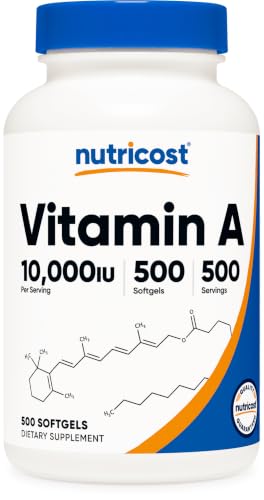
IU and mcg are not interchangeable by simply changing the number. Carlson’s listing is helpful because it presents both units together. Other entries use either IU or mcg, so shoppers should compare the exact label format and serving information instead of assuming that similarly named products have identical amounts. A supplement label may also distinguish the amount per capsule from the number of capsules in the bottle. Nutricost explicitly lists 500 softgels and 500 servings, while BulkSupplements lists 365 softgels and one softgel per serving.
Source transparency is one of the clearest differences in this category. Pure Encapsulations identifies Norwegian cod liver oil and palmitate. BulkSupplements identifies retinyl palmitate. The two NOW formulas and 365 by Whole Foods Market identify fish liver oil, while Nature’s Way says its product contains cod, saithe, haddock, and pollock. Spring Valley, Bronson, and Nutricost provide potency information but do not identify the form or source in the supplied evidence.
A source statement matters for dietary screening. Fish-liver-oil and cod-based products may not fit someone avoiding fish ingredients. Conversely, a listing with a named form but no source still leaves a different question unanswered. Review the complete ingredient label before using a product, especially when fish, soy, dairy, egg, or gelatin matters to your diet.
Most selected products are softgels, including the 100-softgel NOW Foods product, the 500-softgel Nutricost product, and the 120-softgel Pure Encapsulations product.
Form affects how precisely a listing can be compared. A softgel may be paired with an oil-based source such as fish liver oil or cod liver oil. A dry form may be presented as a tablet or vegetable capsule. Do not infer a product’s form from the brand or dose alone; use the title and specifications together.
Look for quality and testing statements
Quality language varies from a general laboratory-tested statement to more detailed facility documentation. NOW Foods lists NPA A-rated GMP certification and says its manufacturing process, laboratory methods, stability, potency, and formulation have been examined. BulkSupplements cites third-party testing and a cGMP-compliant facility. Nutricost lists third-party testing and a GMP-compliant, FDA-registered facility. Bronson says it is laboratory tested in a cGMP-registered New York facility.
Pure Encapsulations says its products are manufactured and tested to verify potency and purity. Carlson states that potency and quality are addressed in its listing, while Nature’s Way supplies dietary and use information but less specific testing detail in the supplied evidence. These statements are useful documentation, not hands-on test results. The comparison therefore rewards clear evidence without claiming that one product was tested by this guide.
Dietary fit is not just a Non-GMO or gluten-free line. NOW Foods’ 10,000 IU formula lists Non-GMO, Kosher, and soy-free classifications. Nutricost lists Non-GMO and gluten-free status. Nature’s Way lists gluten-free status and says the product contains soy and fish. The 25,000 IU NOW product lists Kosher, Non-GMO, corn-free, dairy-free, egg-free, gluten-free, and soy-free classifications, while noting that it contains gelatin.
Pure Encapsulations provides one of the broader free-from statements in this group, including common allergens, artificial ingredients, and GMOs. 365 by Whole Foods Market lists no artificial preservatives. These details can narrow the field, but they should not replace checking the current package label for the complete ingredient list.
Use the serving direction as a comparison point
Several entries state one softgel daily, preferably with a meal. That appears in the NOW Foods 10,000 IU listing, the higher-potency NOW listing, and Nature’s Way information. A daily direction makes the product easier to compare, but it does not establish that the same amount is appropriate for every person.
Vitamin A supplements can differ substantially in dose, source, and form. Anyone considering a high-potency product should review the label with a qualified healthcare professional, particularly when already using other supplements or when dietary restrictions affect ingredient selection.
Final Recommendation
Pure Encapsulations Vitamin A ranks first overall in this specification-based comparison under the published weighted criteria.
The final choice among the best vitamin a capsules depends on the documented features that match your intended use.
Pure Encapsulations Vitamin A is the highest-scoring returned product and the first overall specification-based choice. Its 3,000 mcg amount, Norwegian cod liver oil and palmitate sources, documented support claims, testing language, and broad exclusions create the most complete evidence record in this comparison.
NOW Foods Vitamin A 10,000 IU is a useful alternative for shoppers prioritizing GMP documentation and a clearly stated one-softgel serving. Nature’s Way is notable for its 3,000 mcg label and detailed fish and soy disclosure. BulkSupplements and Nutricost offer especially clear count information, with BulkSupplements naming retinyl palmitate and Nutricost documenting third-party testing. Carlson and NOW Foods Vitamin A Fish Liver Oil 25,000 IU are high-potency options whose amounts deserve careful label review.
Among these top vitamin a capsules, the right specification match depends on the amount, source, form, and dietary exclusions that matter to you. Use the published label as the final reference, and seek professional guidance when a high-potency formula is under consideration.
Frequently Asked Questions
How should I compare the best vitamin a capsules by dose?
Start with the amount per serving and the unit used. The selected products list either IU or mcg, while Carlson supplies both 25,000 IU and 7,500 mcg RAE. Compare like units when possible, and check whether the serving is one softgel or another quantity. A larger bottle count does not change the amount in each serving.
Are fish-liver-oil vitamin A softgels different from other capsules?
They are different in documented source, not necessarily in the purpose of the product. NOW Foods and 365 by Whole Foods Market identify fish liver oil, while Pure Encapsulations lists Norwegian cod liver oil and palmitate. Nature’s Way identifies several fish ingredients. This information is important for people avoiding fish, but the complete package label should be checked for all ingredients.
Which selected product identifies retinyl palmitate?
BulkSupplements explicitly identifies retinyl palmitate. Pure Encapsulations describes a dual-source formula using Norwegian cod liver oil and palmitate. Several other selected products provide an amount and support claims without identifying the chemical form in the supplied listing. Do not infer the form when it is not stated.
No. Testing and manufacturing statements help describe the documentation supplied by a listing, but they are not hands-on test results and do not establish comparative effectiveness. This guide uses testing information as one specification criterion and does not make performance claims beyond the evidence provided.