Buying Guide
Choosing among the best ceramic serving platters starts with the way you actually serve food. A single large oval platter can be ideal for a holiday roast, while a multi-size set is more adaptable for salads, appetizers, desserts, and main courses. The products here are compared from supplied listing evidence, including stated dimensions, material descriptions, appliance compatibility, storage details, and design features. They were not hands-on tested, and this guide does not summarize customer opinions.
Choose a set size that matches your service pattern
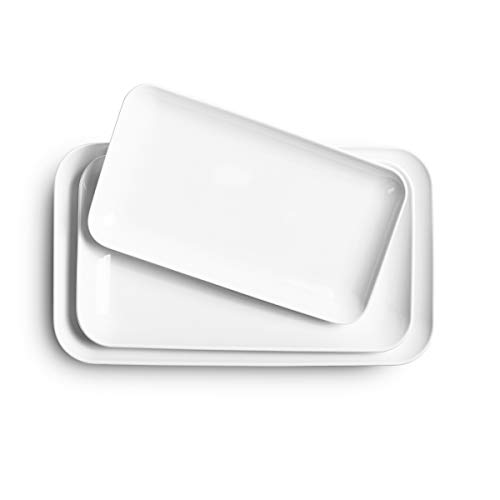
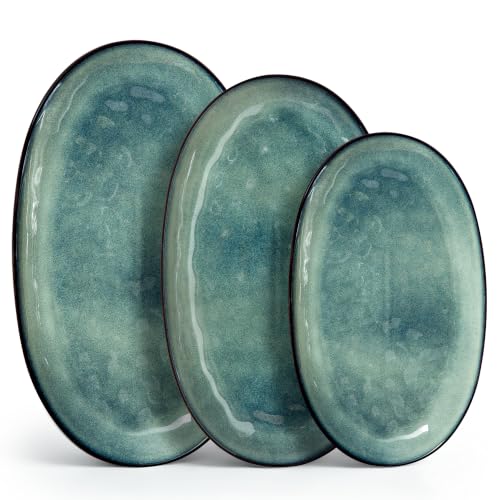
Three-piece sets offer the widest range of serving dimensions in this comparison. DELLING lists 16-, 14-, and 12-inch rectangular platters, while DOWAN lists approximately 15.8-, 14-, and 11.8-inch oval pieces. These graduated formats let you reserve the largest dish for a turkey or roast and use the smaller ones for fruit, bread, dessert, or appetizers. theterra, vancasso, and famiware also document three-size sets, giving buyers several ways to combine capacity with table style.
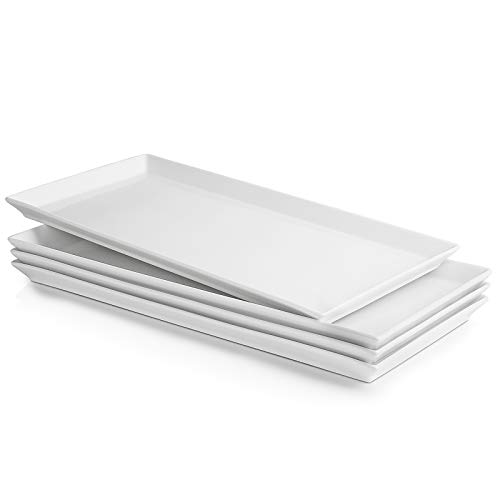
A four-piece set can be more useful when you often serve several small dishes at once. Sweese supplies four matching rectangular platters, and Home Beets supplies four narrower 14-by-6-inch trays. The former is better suited to repeated broad presentations, while the latter is shaped for parallel appetizer, sushi, cheese, or dessert arrangements. A two-piece set is a sensible middle ground for smaller households or limited storage. Bico provides two patterned platters, and DOWAN’s handled pair emphasizes transport rather than size variety.
Match the shape to the food
Oval platters generally create a traditional centerpiece profile and can work well for poultry, roasts, fish, salads, and desserts. The oval options from DOWAN, theterra, vancasso, and famiware document uses across both everyday meals and gatherings. Their curved outlines may also help food appear contained within the central presentation area.
Rectangular platters provide long, organized surfaces for appetizers, sliced meats, sandwiches, pastries, and side dishes. DELLING, Sweese, Home Beets, Bico, and the handled DOWAN model all use rectangular formats. Narrow trays such as Home Beets can separate ingredients visually, whereas the wider DOWAN handled design can accommodate dishes, bowls, or drinks according to its listing.
If your priority is one centerpiece dish, Everyday White documents a 16-by-12.5-inch oval platter designed for a full turkey, roast, or large charcuterie spread. It avoids the need to store multiple pieces, but it cannot provide the serving flexibility of a graduated set.
Check appliance compatibility carefully
Microwave and dishwasher safety are common convenience features, but the evidence is not identical across products. DELLING documents oven use up to 600°F as well as microwave, dishwasher, and freezer compatibility. Everyday White specifies oven use up to 450°F. Home Beets specifies oven use up to 400°F. Those stated limits should guide reheating decisions rather than assuming all ceramic platters have the same heat range.
Theterra and vancasso document microwave, oven, and dishwasher use, while DOWAN’s three-piece set lists microwave, dishwasher, and oven safety. Famiware’s oval set documents microwave and dishwasher safety but does not provide oven-use evidence in the supplied listing. Bico and Sweese also document microwave and dishwasher compatibility, with Sweese additionally listing freezer safety. When a product page does not state a particular appliance use, treat that feature as unconfirmed.
Compare material and finish claims
The listings use ceramic, porcelain, or stoneware terminology. DELLING, DOWAN, Sweese, and Everyday White describe porcelain; vancasso, Famiware, and theterra describe ceramic or stoneware-related construction. Several listings provide additional material claims, such as lead-free or cadmium-free glazes, high-temperature firing, smooth glazed surfaces, or stated resistance to chipping and scratching.
A smooth, non-porous surface can be useful for foods with sauces, oils, or strong colors when the listing specifically describes that characteristic. DELLING says its glaze will not absorb food stains, while Home Beets describes a smooth non-porous surface. Reactive glazes from theterra, vancasso, Famiware, and other selected designs create visual variation; that variation is part of the finish and may mean pieces do not look completely identical.
Consider edges, handles, and storage
Raised edges can make a platter more practical for saucy dishes or carrying food. DOWAN’s three-piece set identifies a thickened edge, Sweese describes a lip around each tray, and Home Beets also lists a lip. The handled DOWAN pair goes further with wide built-in grips and a 1.9-inch rim, making it the clearest choice when moving loaded platters is a recurring concern.
Storage details matter because large ceramic pieces occupy considerable cupboard space. DOWAN documents stacking and zero-tilting storage, while Bico describes its pair as stackable. Sweese, Home Beets, and the decorative sets may still stack depending on the actual shapes, but that is not explicitly stated in the supplied evidence. Check cabinet width, shelf height, and the weight of a full platter before choosing the largest design.
Prioritize presentation style
Plain white porcelain from DELLING, DOWAN, Sweese, Home Beets, and Everyday White is versatile against many table settings. Patterned Bico platters add botanical detail, while theterra, vancasso, and Famiware use reactive glazes or textured surfaces for a more artisanal look. These decorative finishes can make the platter part of the table setting, not just a serving tool.
The best ceramic serving platters are therefore not necessarily the largest or most decorative. The right choice depends on the intersection of capacity, appliance needs, storage, carrying comfort, and the food you present. Use the documented features as a checklist and avoid treating an unstated safety feature as included.
Final recommendation
DELLING Porcelain Serving Platter Set of 3 ranks first overall in this specification-based comparison under the published weighted criteria.
The final choice among the best ceramic serving platters depends on the documented features that match your intended use.
DELLING Porcelain Serving Platter Set of 3 is the highest-scoring returned product and the first overall specification-based choice. Its three sizes, high-fired porcelain description, broad appliance compatibility, and rectangular serving surfaces make it the most adaptable option in this comparison. DOWAN is a close alternative for buyers who prefer oval shapes and stackable storage, while theterra is the stronger presentation-led choice for handcrafted reactive-glaze styling.
Among the top ceramic serving platters, choose Sweese when four matching pieces are more useful than multiple sizes, Home Beets for narrow appetizer layouts, or Everyday White when one large centerpiece platter is enough. Select the handled DOWAN pair when carrying loaded dishes is the main concern. Bico suits smaller, patterned presentations, and vancasso or Famiware suit buyers who want textured, colorful tableware. Always confirm the current manufacturer instructions before exposing ceramic to an appliance or sudden temperature change.
Frequently Asked Questions
Among the best ceramic serving platters, what size ceramic serving platter is best for a turkey?
A large platter around 16 inches is the most directly supported choice in this comparison. DELLING includes a 16-inch piece, DOWAN includes a platter listed at approximately 15.8 inches, and Everyday White provides a single 16-by-12.5-inch oval platter specifically described for turkey and roasts. The correct choice also depends on the turkey’s actual dimensions and the space available around it for carving or side garnishes.
Are ceramic serving platters microwave and dishwasher safe?
Several selected products document both features, including DELLING, DOWAN, vancasso, Famiware, Sweese, Home Beets, Everyday White, theterra, and Bico. However, appliance claims vary by model. Famiware’s supplied listing confirms microwave and dishwasher use but not oven use, while Home Beets gives a specific 400°F oven limit. Check the individual listing and care instructions instead of generalizing across ceramic tableware.
Are reactive-glaze platters supposed to look different from one another?
The selected theterra, vancasso, and Famiware listings describe reactive glazing or naturally varied patterns. They explicitly frame variation as part of the firing or handcrafted process. Buyers seeking a completely uniform white appearance should consider DELLING, Sweese, Home Beets, or Everyday White instead. Color variation should not be interpreted as a defect without consulting the product’s care or quality guidance.
What is the easiest platter style to carry?
The DOWAN serving platter set with handles is the clearest documented option for carrying. Its rectangular trays have wide built-in loop handles, a 1.9-inch rim, and dimensions of 15.4 by 10 inches. DOWAN’s three-piece oval set also describes a thickened edge that is easier to hold, but it does not include dedicated handles. A loaded ceramic platter can still be heavy, so use two hands when appropriate.
How should I choose between one platter and a set?
Choose one platter when you mainly need a centerpiece for a turkey, roast, or large charcuterie spread; Everyday White is designed around that use. Choose a set when you serve multiple courses or want separate dishes for appetizers, sides, and desserts. Three-size sets provide the greatest range, four-piece sets provide more matching surfaces, and two-piece sets can reduce storage demands while still covering everyday service.