Buying Guide
The best corner house paint rollers are designed for different jobs. Some use rounded or V-shaped heads to work directly into an angle. Others are compact mini rollers intended for trim, pipes, furniture, or narrow gaps. Larger painting kits may include a small roller or edger as one component, which can help when a room needs both broad wall coverage and detail work.
Choose a dedicated corner head
A dedicated corner tool is the direct choice when the main problem is the angle where two surfaces meet. Axrivonte and Loyanger list double-headed designs that can be combined for inner or outer corners. Nichiyo supplies separate covers for interior and exterior corners and a V-shaped hub intended to direct drywall mud into the joint. These designs are more specifically aligned with corner application than a flat roller.
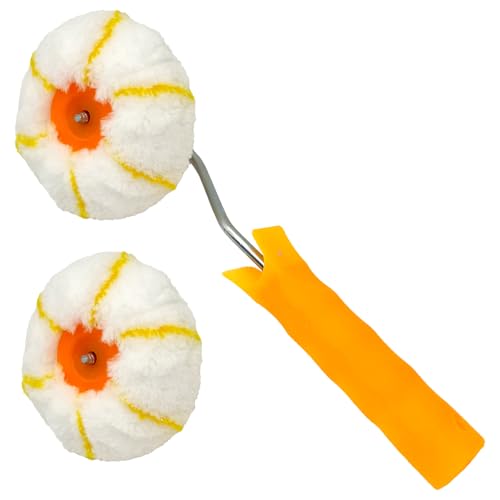
Rounded heads are another documented design. KUPOO and Hubaow describe corner rollers with rounded coverage, while Hubaow also identifies narrow spaces, gutters, and eaves. These tools may help where a standard cylindrical roller is difficult to position. The supplied descriptions do not establish a particular finish on every wall texture or corner shape.
Match the coating
Check listed compatibility before choosing. KUPOO and Hubaow name water-based, oil, and enamel paints, stains, drywall compound, and cleaning fluids. Nichiyo identifies drywall mud use, and PinStone is specifically oriented toward joint compound, mud, putty, and texture. Those options are more relevant to drywall finishing than a foam mini roller intended for flat surfaces.
For broader painting work, HAUTMEC lists water- and oil-based paints, stains, and varnishes. CRAFTZONE and Rhibak list latex, primer, varnish, lacquer, stain, and oil- or water-based products. Compatibility language is not a performance test, so follow the coating manufacturer’s application and cleanup instructions.
Consider reach and control
Reach can matter as much as roller shape. KUPOO and Hubaow list threaded broom-handle compatibility, while PinStone specifies a threaded frame compatible with standard extension poles. CRAFTZONE includes a pole adjustable from 2 to 4 feet, and Rhibak lists a 23-to-47-inch adjustable pole. These features may help with upper corners and high walls, although the evidence does not establish that a ladder will be unnecessary in every room.
Compact handles can offer closer control. Loyanger and Axrivonte list handles around 25 cm long. Leumoi lists a 12-inch handle paired with a 3-inch roller. Choose a short tool for maneuverability or an extension-compatible design when reach is the priority.
Check sleeve supply
Replacement covers can be useful for multiple rooms, color changes, or longer drywall projects. Axrivonte and Loyanger list replaceable heads, while Leumoi includes nine polyester sleeves. PinStone includes three covers, and HAUTMEC includes six 2-inch sleeves. Quantity can reduce interruptions, but it does not by itself establish better coverage or durability.
Reusable construction is also documented. Axrivonte and Loyanger describe washable polyester heads, PinStone describes washable nylon covers, and Hubaow advises cleaning covers before use. KUPOO recommends washing the roller with solvent and rinsing with water to prolong service life. Use a cleaning method suitable for the coating and roller material.
Decide whether you need a complete kit
A dedicated corner roller is practical when you already own a tray, extension pole, and standard rollers. A complete kit may be more useful for a first-time room refresh. CRAFTZONE includes an edger roller brush, general rollers, an adjustable pole, a tray, drop cloth, and other supplies. Rhibak combines 4- and 9-inch rollers, brushes, trays, and an extension handle. Their corner components are less specialized than the dedicated corner tools, but they cover more of the surrounding job.
How these picks were evaluated
This comparison uses listed titles, features, and specifications. The criteria are corner coverage design, handle control and reach, material and coating compatibility, sleeve quantity and reusability, and frame or connection build. The results are specification-based, not hands-on test results, and do not summarize customer opinions or volatile marketplace information.
Final Recommendation
Axrivonte Corner Edger Paint Roller Kit ranks first overall in this specification-based comparison under the published weighted criteria.
Axrivonte Corner Edger Paint Roller Kit is the first overall specification-based choice because its listed features combine double-headed coverage, a round-tip corner design, four included heads, washable polyester material, an ergonomic handle, and a reinforced connector. These details give it a broad dedicated-corner feature set without relying on unsupported performance claims.
KUPOO is a good fit when coating compatibility and extension-handle use matter, while Nichiyo is focused on separate interior and exterior corner covers and drywall mud. Hubaow also offers extension compatibility and rounded covers. Buyers planning repeated work may prefer Leumoi’s nine sleeves, and PinStone is especially relevant for compound and texture applications.
Among the top corner house paint rollers, HAUTMEC is a compact general-purpose option for narrow areas and trim. CRAFTZONE and Rhibak make more sense when corner work is only one part of a larger painting project. The best corner house paint rollers choice depends on whether the priority is dedicated corner geometry, compound work, compact detail painting, or a complete room-painting kit.
Frequently Asked Questions
What are the best corner house paint rollers for inside and outside corners?
Axrivonte and Loyanger list double-headed heads designed to combine for inner or outer corners. Nichiyo supplies separate covers for interior and exterior corners. These are the clearest dedicated options in this comparison based on the supplied specifications.
Can corner rollers be used with drywall compound?
Yes, several selected products list drywall compound or mud compatibility. KUPOO and Hubaow name drywall compound among supported materials, Nichiyo identifies a V-shaped hub for drywall mud, and PinStone is specifically described for joint compound, mud, putty, and texture. Follow the compound maker’s application and cleaning guidance.
Which selected roller includes the largest listed sleeve supply?
Leumoi lists nine polyester sleeves with its iron frame and 12-inch handle. HAUTMEC lists six 2-inch sleeves, while Axrivonte and Loyanger list replaceable corner heads. Sleeve quantity is useful for longer projects, but it does not by itself prove a better finish or longer service life.
KUPOO and Hubaow list threaded broom-handle compatibility, and PinStone lists compatibility with standard extension poles. CRAFTZONE includes a 2-to-4-foot adjustable pole, while Rhibak lists a 23-to-47-inch pole. Compact dedicated tools may be easier to control close to the corner, while pole-compatible kits are more suitable for elevated areas.
Are complete painting kits suitable for corner work?
CRAFTZONE and Rhibak include smaller rollers or edger tools alongside full-size rollers, brushes, trays, and extension poles. They can support a whole-room project, but their listed corner components are less specialized than the dedicated inner- and outer-corner designs from Axrivonte, Loyanger, or Nichiyo.