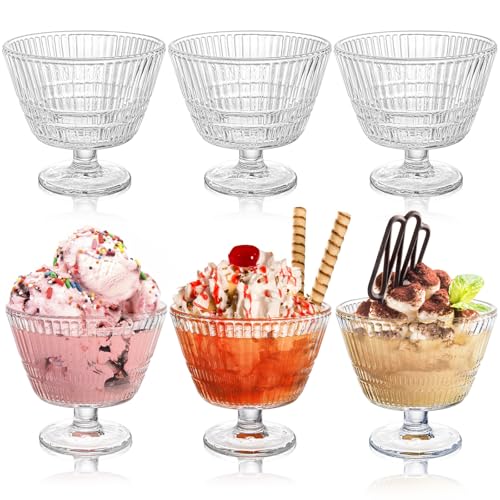
Buying Guide
Choosing the best crystal dessert bowls starts with matching the bowl’s documented format to the way you serve dessert. The listings in this comparison describe clear or transparent glass, footed silhouettes, vintage textures, and capacities from compact tasting portions to larger servings. Since this guide uses public specifications rather than hands-on testing, treat claims such as durability, stability, and ease of care as listing-based features to verify against the current product page before ordering.
Start with serving capacity
Capacity is the clearest way to separate these products. QAPPDA’s 4-ounce bowls are designed for compact single servings, sample tastings, condiments, appetizers, and mini desserts. They make sense when presentation and portion control matter more than space for several scoops or toppings.
At the middle of the range, Kingrol’s 6.5-ounce set is described as fitting a large scoop with room for toppings. Ferrochef’s 8-ounce bowls and Red Co.’s approximately 9.87-fluid-ounce cups offer more flexibility for everyday ice cream, parfaits, pudding, fruit, and snacks. The 9-ounce formats from DNIENKGE and wangsdjy occupy a similar practical range, while the 10-ounce sets from Peohud, Kingrol, and Nagpew provide more space for layered desserts or additional toppings.
Lawei reaches a documented 12-ounce maximum capacity. That makes it the most suitable selected option when a dessert includes multiple components or when a larger serving is preferred. The trade-off is that larger bowls can require more cabinet room and may feel less appropriate for petite courses.
Footed bowls create visual separation between the dessert and the table. They can also provide a grip point below the food area. Kingrol, Red Co., Nagpew, QAPPDA, and several other selected sets describe raised or footed construction. For a more noticeable vintage profile, QAPPDA uses a tulip silhouette, Nagpew uses a short foot with fluting, and DNIENKGE adds a dotted beaded surface.
A footed design is not automatically interchangeable with every table setting. Taller or more decorative shapes may suit formal entertaining, while a lower short-footed profile can feel more relaxed for daily use. If you want an understated appearance, Ferrochef’s clean lines and clear construction may be easier to coordinate with existing serveware. If texture is a priority, Peohud’s plaid body, Kingrol’s embossed exterior, Nagpew’s fluted design, or DNIENKGE’s beaded surface provide documented decorative details.
Look for stability features
Dessert bowls are often filled with cold, slippery, or layered foods, so base design deserves attention. Lawei describes a wide base bottom and thick, weighted construction. Ferrochef specifies a wide heavy base. Kingrol documents a sturdy stem and foot, while QAPPDA describes a weighted footed base. wangsdjy and DNIENKGE also describe thickened or weighted glass and stable bottoms.
These features indicate design intent, but they do not replace careful handling. The supplied evidence does not provide independent tipping measurements or breakage testing. Shoppers should therefore interpret “stable,” “weighted,” or “sturdy” as manufacturer or listing descriptions rather than verified test results.
Consider material and clarity wording
Many selected products specify lead-free glass, including Ferrochef, Peohud, Nagpew, DNIENKGE, and QAPPDA. Kingrol’s 6.5-ounce listing specifically calls out thick crystal and crystal-clear clarity, while several other products use “crystal” as a style or appearance descriptor in their titles. Those terms should not be assumed to describe identical manufacturing processes.
For dessert presentation, transparent glass helps show layers, colors, fruit, sauces, and toppings. Clear construction is documented for every selected product, with QAPPDA, wangsdjy, Red Co., and Nagpew using clear or transparent color specifications.
Care details vary. Lawei, Peohud, Ferrochef, Red Co., and Nagpew explicitly include dishwasher-safe language. Lawei and Peohud also document freezer safety, which is useful for chilled dessert preparation. DNIENKGE, wangsdjy, and QAPPDA emphasize smooth surfaces, stacking, or simple cleaning directions but do not provide the same dishwasher-specific detail in the supplied evidence.
Storage is another practical distinction. DNIENKGE and wangsdjy describe stackability, and QAPPDA’s compact dimensions may be easier to fit into a small cabinet. Footed designs can occupy more vertical space than low bowls, so compare the listed height with your shelf clearance. The listings provide dimensions, but they do not establish nesting efficiency beyond the products that specifically mention stacking.
Match the set size to your table
Most selected options come in six-piece sets, which suits a household or a modest dinner party. DNIENKGE, wangsdjy, and QAPPDA provide eight pieces, giving them an advantage for larger groups or dessert stations. A four-piece set was not required for this ranking, but the selected products cover both regular place settings and larger gatherings through their six- and eight-piece configurations.
Also consider whether you want a single-purpose dessert bowl or a more flexible serving piece. Ferrochef lists use with condiments and cocktails, Red Co. includes beverages among its possible applications, and QAPPDA is designed for tasters, appetizers, and condiments as well as sweets. Lawei, Peohud, and Kingrol similarly document use for fruit, snacks, parfaits, or pudding. Broader utility can help a set earn cabinet space between special occasions.
Final Recommendation
Kingrol 6.5 oz Crystal Glass Dessert Bowls ranks first overall in this specification-based comparison under the published weighted criteria.
Kingrol 6.5 oz Crystal Glass Dessert Bowls is the first overall specification-based choice among the best crystal dessert bowls because it combines thick crystal construction, a useful portion size, a sturdy footed base, and a wide mouth. It is a balanced fit for shoppers who want a classic clear presentation without moving to the largest format.
For more capacity, Lawei is the stronger documented fit, with 12-ounce bowls, weighted glass, and freezer- and dishwasher-safe claims. Peohud and Nagpew are better matches for decorative textured tables, while Ferrochef offers a versatile 8-ounce middle ground. Red Co. is a traditional option with near-10-ounce capacity and dishwasher-safe documentation.
The top crystal dessert bowls are not identical: QAPPDA is purpose-built for petite portions, wangsdjy and DNIENKGE provide eight-piece formats, and each textured design changes the visual character of the table. Review the capacity, base style, care instructions, and storage needs before choosing.
Frequently Asked Questions
Which of the best crystal dessert bowls is suited to small portions?
QAPPDA’s 4-ounce footed tulip bowls are the most clearly suited to small portions, tastings, mini desserts, condiments, and appetizers. Their weighted foot and wide mouth are also documented features.
Are the best crystal dessert bowls dishwasher safe?
Some selected products explicitly state dishwasher safety, including Lawei, Peohud, Ferrochef, Red Co., and Nagpew. Other listings emphasize hand rinsing, smooth surfaces, or simple cleaning without making the same dishwasher claim. Check the current care instructions for the exact set.
What capacity works for ice cream sundaes?
The suitable size depends on toppings and serving style. Kingrol’s 6.5-ounce bowl is described as fitting a large scoop with room for toppings, while the 8-, 9-, 10-, and 12-ounce options provide progressively more space for layered or heavily topped desserts.
Which selected set provides eight bowls?
DNIENKGE, wangsdjy, and QAPPDA are the selected eight-piece sets. DNIENKGE and wangsdjy offer approximately 9-ounce formats, while QAPPDA focuses on compact 4-ounce servings.
Not necessarily. Some listings document stackability, particularly DNIENKGE and wangsdjy, but footed shapes can still require more vertical clearance than low bowls. Compare the listed dimensions with your cabinet space before buying.