Buying Guide
The best dining room storage cabinets should be selected by matching the cabinet’s footprint and internal layout to the items you actually need to store. A sideboard can hold dinnerware, serving pieces, linens, small appliances, or bar accessories, but doors, drawers, shelves, and open compartments each work differently. The products above are compared from public listing specifications and feature descriptions rather than hands-on testing.
Start with the wall and walking space
Measure the available wall width, depth, and height before comparing finishes. Most selected buffet cabinets are roughly 47 to 66 inches wide and about 15 to 16 inches deep. That depth can provide useful storage without projecting too far into a dining area, but chairs and serving traffic still need clearance. The JXQTLINGMU is 66 inches wide, while the HOSTACK reaches 60 inches. Both suit larger walls better than the BVIUNTWO at 47.2 inches or the JASIWAY at 48.4 inches.
Height also affects the visual balance of the room. The HOSTACK is listed at about 36 inches high, whereas many other sideboards are near 32 inches. A taller cabinet may provide a more substantial profile, but it can alter sightlines and may sit differently beneath artwork or a wall mirror. The IFGET arrangement is a special case: its three pieces span 92.63 inches and should be treated as a large modular installation rather than a small accent cabinet.
Choose the right storage mix
Drawers are useful for flatware, napkins, bottle openers, and other small objects that can become scattered inside a large cupboard. The VASAGLE Siren, HORSTORS, Shintenchi, and JXQTLINGMU all document drawer storage, though their exact configurations differ. Cabinets with doors are better for larger or less frequently used items such as platters, serving bowls, coffee machines, and extra glassware.
Open storage changes the role of a sideboard. Shintenchi documents a combination of an open compartment and enclosed storage, making it suitable for displaying baskets or decorative pieces while keeping other items concealed. Fully enclosed designs such as SUNLEI may create a cleaner visual appearance, especially when the cabinet is used to store mixed household supplies. The best dining room storage cabinets are not necessarily the ones with the most doors; they are the ones whose compartments fit your daily habits.
Look for shelf adjustability
Adjustable shelves are important when storage contents vary in height. Bottles, small appliances, tall vases, and stacks of plates rarely occupy the same vertical space. RoyalCraft documents adjustable thickened shelves, while BVIUNTWO provides four compartments with two adjustable shelves. VASAGLE’s Siren model also specifies adjustable lower shelves.
Check how much adjustment the listing actually documents. Some products mention adjustable shelves without giving positions or spacing. The VASAGLE LIRY design, which is not selected here, documents five positions, but it should not be used as a recommendation in this comparison. Among the selected products, IFGET specifies three shelf heights. That level of detail is more useful than a general adjustability claim because it helps shoppers anticipate how much interior customization is available.
Consider surface use and cable routing
A buffet top may function as a serving station, coffee bar, display shelf, or media surface. If you plan to keep an espresso machine, microwave, or other appliance on top, confirm the cabinet’s listed capacity and allow room for cords and ventilation. Shintenchi lists a 180-pound tabletop capacity, JASIWAY lists the current price, and HOSTACK lists a 450-pound capacity. These are published specifications, not independent load tests, so they should be treated as product-listing guidance.
Cord routing is particularly useful when a sideboard supports a coffee station or electronics. The VASAGLE Siren includes a rear opening for cable management and an anti-tip kit. That makes it more suitable for appliance-focused use than a cabinet whose listing does not mention cord access. A clean top is easier to maintain when cables can pass behind the unit rather than across the front.
Review stability and safety details
Freestanding furniture should be placed on a suitable surface and secured according to the manufacturer’s instructions when an anti-tip kit is supplied. Several selected cabinets document anti-tip hardware, including VASAGLE Siren, Shintenchi, and IFGET. Other stability-related details include JASIWAY’s metal legs and central support column, RoyalCraft’s solid wood legs, and HOSTACK’s thickened base.
Construction descriptions vary. Many cabinets use engineered wood, MDF, particleboard, or manufactured wood. That does not by itself determine how a cabinet will perform in a particular home, but it does help set expectations about material type. These statements are listing specifications rather than guarantees against all damage.
Match the design to the room
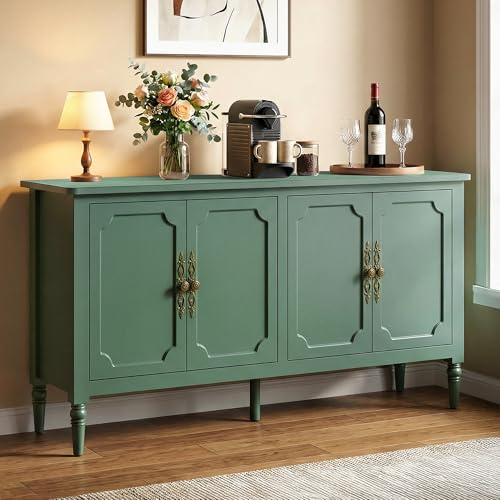
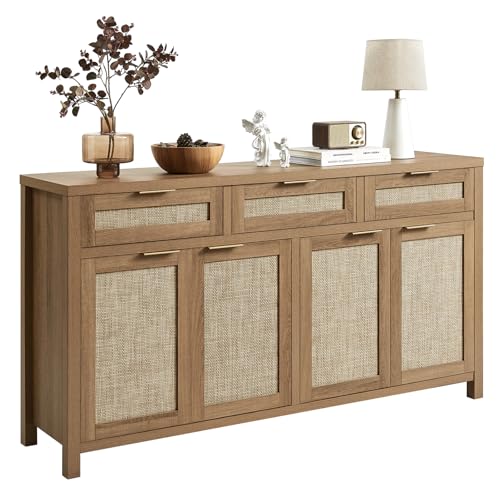
The selected range covers farmhouse, vintage, modern, rattan, fluted, and natural styles. Farmhouse designs include framed or recessed doors and painted finishes, as seen on VASAGLE, SUNLEI, Shintenchi, and JXQTLINGMU. RoyalCraft adds carved handles and rounded-corner details. JASIWAY uses rattan fronts for a natural textured appearance, while BVIUNTWO uses grille-striped doors and a metal base. IFGET’s arched fluted panels create a more architectural look.
When comparing the top dining room storage cabinets, prioritize a finish that works with the room’s existing table, flooring, and hardware. A visually distinctive front can become the focal point, while a simpler white, black, or natural finish may be easier to coordinate with changing decor. Also consider whether the top will be visible from adjacent rooms, since many of these cabinets are designed for use beyond the dining room.
Final Recommendation
VASAGLE Siren 55-Inch Buffet Cabinet ranks first overall in this specification-based comparison under the published weighted criteria.
VASAGLE Siren Collection Buffet Cabinet is the first overall specification-based choice among these best dining room storage cabinets. Its combination of four doors, two drawers, adjustable shelves, a 55.1-inch top, cord routing, and anti-tip hardware gives it the most balanced documented feature set for typical dining-room use.
Choose JXQTLINGMU when a 66-inch serving surface and multiple storage zones matter more than a compact footprint. HOSTACK is a sensible alternative for shoppers prioritizing a taller 60-inch cabinet and a prominently stated load capacity. RoyalCraft suits rooms where adjustable shelves and vintage styling are central, while HORSTORS is especially practical for separating smaller utensils from larger stored items.
For a mixed open-and-closed layout, Shintenchi is the better fit. JASIWAY and BVIUNTWO provide more compact ways to add textured or modern style. SUNLEI is oriented toward coffee-station organization, and IFGET is the specialist choice for a very wide modular wall. These top dining room storage cabinets differ considerably in width and layout, so room measurements should decide the final shortlist.
Frequently Asked Questions
Among the best dining room storage cabinets, what size dining room storage cabinet should I choose?
Choose a width that leaves comfortable circulation around the cabinet and does not conflict with dining chairs, doors, or serving paths. The selected products range from about 47 inches to 92.63 inches wide. Compact rooms may suit BVIUNTWO or JASIWAY, while JXQTLINGMU and IFGET require substantially more wall space.
Are adjustable shelves important in a sideboard?
They are useful when you plan to store items with different heights, such as plates, bottles, appliances, and vases. RoyalCraft, VASAGLE Siren, BVIUNTWO, SUNLEI, and IFGET document adjustable shelving. Compare the number of shelves and the stated adjustment positions when that flexibility is important.
Can a dining cabinet also work as a coffee bar?
Yes. Several selected listings specifically describe coffee-bar use, including VASAGLE Siren, JXQTLINGMU, SUNLEI, HORSTORS, and JASIWAY. Look for a sufficiently broad top, appropriate load information, internal shelf flexibility, and cable routing if an appliance will remain plugged in.
Should a freestanding buffet be secured to the wall?
Follow the supplied instructions and use included anti-tip hardware where provided. VASAGLE Siren, Shintenchi, and IFGET document anti-tip features. Wall type, placement, and installation conditions vary, so the product instructions should control the final installation method.
What is the difference between a sideboard and a buffet cabinet?
In this category, the terms often describe similar low storage furniture used for dining, serving, or display. The practical differences are usually the cabinet’s width, door and drawer layout, shelf adjustability, height, and intended styling rather than a strict product boundary.