Buying Guide
Choosing among the best dishwasher-safe countertop blenders starts with the parts that actually enter the dishwasher. Listing language varies: some models identify every removable component, while others document only the pitcher or a smaller set of accessories. That distinction matters when cleanup convenience is a primary reason to shop this category.
Check exactly what is dishwasher safe
The Gourmia GPB3125 documents dishwasher safety for its pitcher, lid, blade, sealing rings, tamper, and tamper handle. The Gourmia GPB3128 lists the jar, lid, tamper, and measuring cap as top-rack dishwasher safe. Those are more detailed cleaning disclosures than models that name only a pitcher.
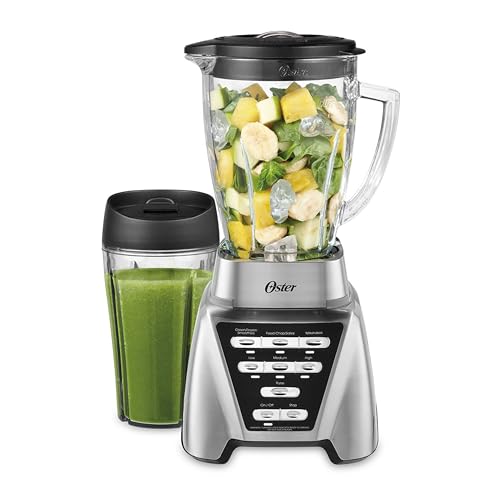
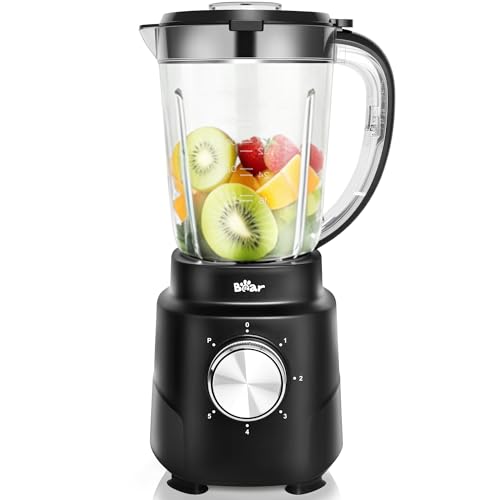
The Oster Pro 1200 lists a dishwasher-safe Boroclass glass jar, while the Ninja BL610 identifies its pitcher as dishwasher safe. The Bear 800W model documents a dishwasher-safe container, and OLIXIS identifies its glass jar, lid, and measuring cup. Read these statements literally: a dishwasher-safe pitcher does not automatically establish that the motor base, seals, or every accessory belongs in the dishwasher.
Match pitcher capacity to your routine
Capacity affects how many servings you can prepare in one cycle. The Gourmia GPB3128 has a documented 2L, or 8-cup, pitcher. The Ninja BL610 lists a 72oz pitcher with a 64oz maximum liquid capacity, while OMMO’s OM-200 provides 68oz and the COZII model provides 64oz.
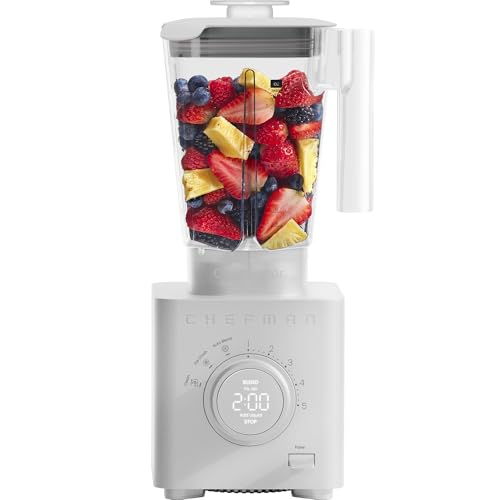
Mid-size choices can be easier for everyday use. The Gourmia GPB3125 has a 56oz glass pitcher, OLIXIS provides 54oz, and Martha Stewart lists 50oz. A 48oz jar, such as the Chefman Obliterator, may suit regular smoothies and sauces without the footprint of an extra-large vessel. Capacity claims should still be compared with any stated maximum liquid line before filling the jar.
Compare controls, not just motor claims
The top dishwasher-safe countertop blenders in this comparison use several control styles. Preset-led models are useful when you want a named program for smoothies, soup, ice crush, or cleaning. The Gourmia GPB3128 lists four presets and a variable speed dial; the Gourmia GPB3125 lists eight programs and four manual speeds. COZII documents seven smart programs and eight speed adjustments.
Manual control is useful when texture needs to change during a recipe. Chefman provides five speeds and pulse with a countdown timer, while OMMO’s OM-200 combines variable speed, pulse, and a six-minute timer. Simpler models still have a place: the Ninja BL610 emphasizes crushing technology and a straightforward pitcher configuration, while the OLIXIS blender uses four speeds and pulse.
Consider blade and ingredient evidence
Motor wattage, speed claims, blade construction, and recipe language should be read together rather than treated as a guarantee of results. Gourmia’s GPB3128 lists a 1500W motor and up to 45,000 RPM, while COZII lists a 2000 peak-watt motor. OMMO’s OM-200 lists a 1400W motor and up to 28,000 RPM. These are supplied listing specifications, not independent measurements.
Blade details also help describe intended use. Chefman lists a stainless steel blade and a blunt-blade design. Bear documents a removable 10-blade stainless steel assembly, OLIXIS lists six SUS304 stainless steel blades, and Oster Pro 1200 describes dual-direction blade technology. The Ninja BL610 specifically names Total Crushing Technology for ice, whole fruits, and vegetables. Use those statements to compare documented design intent, not to assume identical performance across recipes.
Measure the counter and storage area
Countertop practicality includes height, footprint, stability, and accessories. Models such as Bear and Gourmia GPB3125 list suction or non-slip feet, which may help keep the base positioned during use, though the supplied data does not provide independent stability testing.
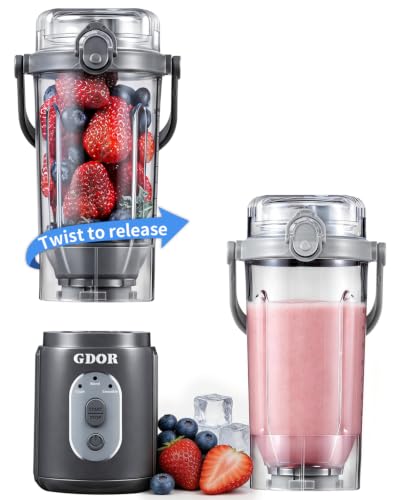
The Oster Pro 1200 includes a 24oz smoothie cup, and COZII includes a 21oz to-go cup that can be blended directly on the base. These accessories support smaller portions without replacing the main pitcher. Chefman’s included tamper and scraper are aimed at thick mixtures, while Gourmia’s GPB3128 has a built-in tamper. If storage space is tight, also account for the lid, tamper, cup, and cord rather than measuring only the motor base.
How this comparison was scored
This is a specification-based comparison using public listing data, not a hands-on test and not a summary of customer opinions. We first screened for full-size countertop blenders with documented dishwasher-safe parts, excluding personal-only designs and listings without an explicit dishwasher-safe claim. The editorial criteria assess dishwasher cleanup design, batch capacity, controls, ingredient-handling specifications, and countertop practicality. Each selected model scored at least 7.0 on the weighted editorial scale. No score represents an independent laboratory measurement.
Final Recommendation
Gourmia GPB3128 2L Commercial Blender ranks first overall in this specification-based comparison under the published weighted criteria.
Gourmia GPB3128 is the highest-scoring returned product and the first overall specification-based choice among the best dishwasher-safe countertop blenders. Its 2L pitcher, 1500W motor claim, variable speed dial, four presets, built-in tamper, and top-rack dishwasher-safe parts give it the broadest documented combination of capacity and control.
The top dishwasher-safe countertop blenders are not identical, however. Choose the Ninja BL610 or OMMO OM-200 when a very large pitcher is the priority. Select the Oster Pro 1200 or OLIXIS when a glass jar is preferred. Chefman is a strong fit for auto blend and timer features, while Martha Stewart emphasizes presets and auto-clean. Bear adds suction feet and a removable blade assembly, and COZII combines a large pitcher with a direct-blend cup.
Before choosing, verify the dishwasher instructions for the exact parts you intend to wash, measure the blender against your cabinets, and compare the stated pitcher capacity with your normal batch size. Those checks can matter as much as motor and blade claims for daily countertop use.
Frequently Asked Questions
Among the best dishwasher-safe countertop blenders, what makes a countertop blender dishwasher safe?
A listing must identify one or more removable food-contact parts as dishwasher safe. For example, Gourmia GPB3125 documents safety for the pitcher, lid, blade, sealing rings, and tamper, while the Ninja BL610 specifically identifies its pitcher. These statements do not mean the motor base can be washed in a dishwasher.
Are glass pitchers a good choice for these blenders?
Glass can be useful if you prefer the documented Boroclass or glass-pitcher construction found on the Oster Pro 1200, Gourmia GPB3125, and OLIXIS models. Glass may also be heavier than Tritan or BPA-free plastic. Check the listed dimensions and handling needs before selecting a glass jar for frequent use.
Which selected model is suited to large batches?
The Gourmia GPB3128 lists a 2L, or 8-cup, pitcher. Ninja BL610 lists a 72oz pitcher, OMMO OM-200 lists 68oz, and COZII lists 64oz. Compare those figures with each model’s stated maximum liquid capacity and the amount you usually prepare.
Do presets replace manual speed control?
Not necessarily. Presets provide named programs, but manual speeds and pulse allow more direct texture adjustments. Gourmia GPB3128, Gourmia GPB3125, Chefman, COZII, and OMMO OM-200 document both automated or preset functions and manual controls. Simpler designs such as OLIXIS still provide four speeds and pulse without as many named programs.
What should I measure before placing one under a cabinet?
Measure the available height with the pitcher and lid installed, then check width and depth around nearby appliances. Also allow room to remove the pitcher and add ingredients through the lid opening.