Buying Guide
The best down throw pillows are usually inserts rather than finished pillow covers. That distinction matters because the insert determines the shape, loft, and support inside the cover you already own or plan to use. The selections above are all documented as decorative pillow inserts with feather, down, or a feather-and-down blend. They vary substantially in size, fill composition, cover construction, and care instructions, so the right choice depends on the cover and the way you use the pillow.
Match the insert to the cover
Start with the cover’s finished seam-to-seam dimensions. A correctly sized insert should fill the corners without forcing the zipper or stressing the seams. Several listings recommend an insert one or two inches larger than the sham for a fuller decorative appearance. SNUG&COZY, ComfyDown, puredown, and SAVORI all provide some form of this guidance. That approach is especially relevant when you want a plump square shape instead of loose corners.
For an 18-inch cover, an 18x18 insert is the most direct size match, while using it in a smaller cover can create a fuller look if the construction allows. The 20x20 options offer a common sofa-and-bed format, and 22x22 versions work better for broad arrangements. SAVORI’s 28x28 pair is a specialty choice for very large covers, floor arrangements, or expansive beds. It should not be treated as a universal size because a cover must be large enough to accommodate it.
The MIULEE 12x20 insert is not selected in this comparison, so it is not discussed as a recommendation here. Among the selected products, the smallest documented format is 18x18, while the largest is 28x28. Measure before choosing rather than relying only on a cover’s label, since compressed or loosely filled inserts can have different finished profiles.
Compare feather and down proportions
A feather-and-down blend can balance softness and structure, but the proportions help explain how an insert may behave. Most selected models specify a feather-heavy blend. ROSE FEATHER, SNUG&COZY, ComfyDown, puredown, and MIULEE’s 18x18 model identify blends ranging from 95% feather and 5% down to 5% down and 95% feather. These descriptions indicate that feathers provide much of the structure, while down contributes softness and loft.
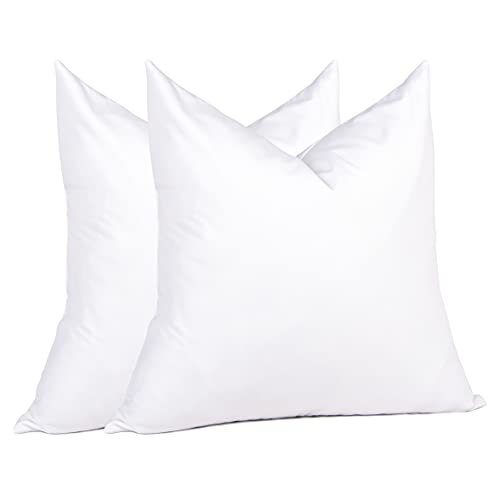
MIULEE’s 20x20 and 22x22 listings state goose feather-and-down filling and provide fill weights, but they do not give a down percentage in the supplied evidence. SAVORI identifies white goose down and feather without stating a ratio. These models can still be compared as down-and-feather inserts, but their exact composition should not be assumed to match the products with a published percentage.
DWR takes a different approach by combining 80% feathers and down with 20% shredded foam. The listing says the feathers help maintain fluffiness and the foam adds softness and bounce. That makes it a useful option when you want a mixed-material backrest or cushion rather than a strictly feather-filled insert. The trade-off is that its feel may differ from a traditional feather-and-down construction.
Examine the cover and containment details
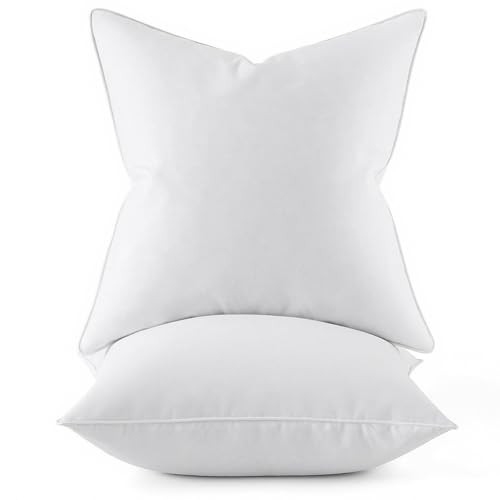
Cover construction is central to a feather insert. Look for a tightly woven or layered shell, down-proof fabric, reinforced seams, piping, or an inner liner. MIULEE’s 20x20 model uses a double-layer cotton cover with piping and double sewing edges. ROSE FEATHER documents a 100% organic cotton cover with double-layer construction and reinforced piping. SNUG&COZY also specifies double-layered fabric intended to keep filling in place.
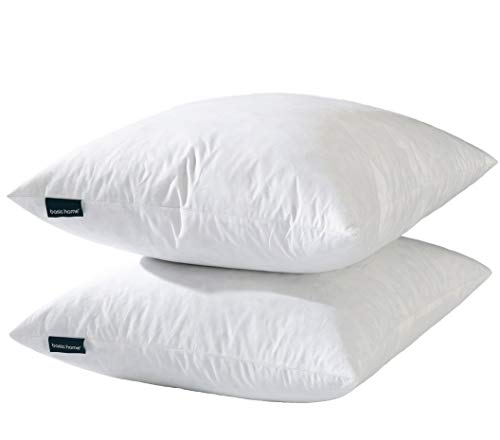
ComfyDown lists a 100% cotton, 233-thread-count cover with downproof stitching. basic home describes a 233-thread-count cotton cover with an inner liner. puredown specifies a tightly woven breathable cover intended to help prevent feather poking. SAVORI documents double-layer breathable down-proof cotton fabric. These details do not prove a particular real-world result, but they are meaningful construction evidence when comparing inserts.
A layered cover can also influence the profile and handling of the pillow. Piping may help define the perimeter, while an inner liner adds another containment layer. If minimizing feather escape is a priority, favor models that explicitly document these features rather than assuming every feather insert uses the same shell.
Decide how you will use the pillow
Decorative sofa and bed use is common across this category, but the listings describe different levels of support. ComfyDown is intended for indoor shams and covers. puredown mentions couches, beds, floor use, offices, and reading nooks. DWR specifically positions its insert as a backrest or cushion and adds foam for bounce.
For a styled sofa arrangement, the 18x18 MIULEE model is explicitly designed to hold a chop shape, while basic home describes a chopped look for sofa or bed styling. For a broad bed or floor arrangement, the 22x22 and 28x28 products provide more surface area. For one lumbar-style location, a square insert may not be the right geometry; choose a cover whose dimensions match the intended support area.
Do not treat decorative inserts as automatically equivalent to sleeping pillows. The supplied listings describe uses such as leaning, lounging, decorating, reading, and back support, but they do not establish standardized sleeping performance. Select based on the documented use and the cover dimensions.
Plan for unpacking and care
Several inserts are vacuum packed. That helps with shipping but means the pillow may need patting, shaking, drying, or resting before it reaches its listed shape. MIULEE’s 20x20 and 18x18 models recommend a warm dryer cycle with dryer balls for 20–30 minutes. ROSE FEATHER gives a low-heat dryer-ball routine. puredown suggests low heat for approximately 10–15 minutes, while basic home suggests about 15 minutes.
SNUG&COZY recommends hand patting and allowing time after unpacking. SAVORI says a dryer can restore fullness. ComfyDown advises fluffing before first use and as needed.
Always follow the product’s own instructions and consider the cover material, available dryer settings, and the insert’s filling. A refresh routine is not a performance guarantee; it is simply the preparation method documented in the listing. Also note that some listings describe drying as a way to restore loft, while others rely on patting or resting.
Weigh size against handling
Larger inserts can create a fuller visual arrangement, but they also occupy more space and may be harder to fit into a cover. The 28x28 SAVORI pair is best reserved for large shams. The 22x22 MIULEE and puredown pairs are more suitable for broad square covers. The 20x20 options provide a middle format, while the 18x18 products are easier to place in compact sofa or bed settings.
Fill weight is useful when it is supplied, but it should be read alongside dimensions. MIULEE lists 1140g for its 20x20 pair and 1160g for its 22x22 pair; the 18x18 MIULEE pair lists 900g. Those figures support comparison within the supplied listings, but they do not by themselves establish firmness or finished loft. Cover size, fill distribution, and post-packing recovery also affect the final appearance.
Final Recommendation
MIULEE Goose Feather Down 20x20 Set of 2 ranks first overall in this specification-based comparison under the published weighted criteria.
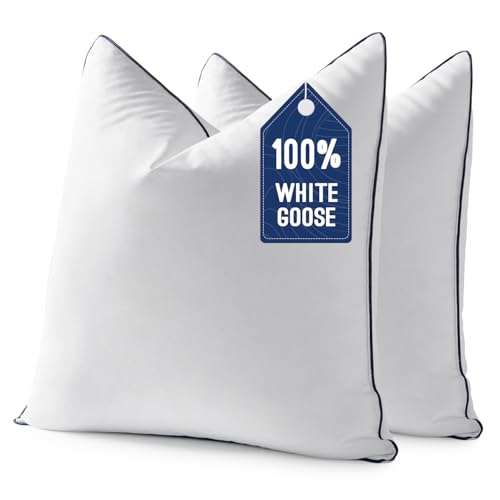
MIULEE Goose Feather Down 20x20 Set of 2 is the first overall specification-based choice among the best down throw pillows in this comparison. Its documented 1140g fill weight, double-layer cotton cover, piping, double-sewn edges, and 20-inch square format create a balanced specification profile for sofa and bed shams. The MIULEE 22x22 pair is a better fit for larger covers, while ROSE FEATHER is compelling when organic cotton and reinforced piping matter. Choose DWR if a foam-blended backrest construction suits your use, or SAVORI when a very large 28-inch format is required. These top down throw pillows are not interchangeable: confirm the cover dimensions, review the listed fill composition, and follow the model-specific recovery instructions before use.
Frequently Asked Questions
What should I look for in the best down throw pillows?
Check the insert dimensions, fill composition, cover layers, seam or piping details, intended use, and care instructions. A model with a down-proof or layered cover is easier to evaluate for containment, while a documented fill weight can help compare fullness within similar sizes. The cover should also be measured rather than selected solely by its label.
Should a down throw pillow insert be larger than the cover?
Several selected listings recommend an insert one or two inches larger than the sham to fill the corners and create a fuller appearance. ComfyDown and SNUG&COZY provide this type of guidance, while SAVORI recommends a two-inch difference. The correct choice still depends on the cover’s construction and closure, so avoid forcing an insert into a cover that cannot accommodate it.
Which selected insert is suited to a chopped decorative look?
The MIULEE Feather Down 18x18 Set of 2 specifically describes a design intended to hold a chop shape. basic home also documents styling for a chopped look, although its exact down percentage is not supplied. Both are feather-heavy or goose-feather constructions, so they may provide more structure than a down-dominant insert.
Are feather-and-down inserts machine washable?
Care varies by model. DWR explicitly documents machine washing and drying, and puredown also identifies machine-washable construction. Other selected listings focus on patting, resting, low-heat drying, or dryer balls after vacuum packing. Follow the instructions for the exact insert rather than applying one care method to every product.
Which size works for a large floor pillow arrangement?
SAVORI’s 28x28 pair is the largest selected format and is documented for sofa, bed, and couch decoration, making it the clearest fit for very large square arrangements. The 22x22 MIULEE and puredown pairs are smaller alternatives for broad covers. In every case, verify that the cover dimensions and closure can accommodate the insert before choosing it.