Buying Guide
Choosing the best driver-side tie rod ends is primarily a fitment exercise. A tie rod end is a steering linkage component, so the correct side, location, design, and reference number matter more than a general description such as “fits many vehicles.” The products above are ranked from listing evidence, not hands-on testing. Use the vehicle application, OE number, and component position together before ordering.
Confirm the exact vehicle application
Start with year, make, model, engine or trim where listed, and drivetrain when relevant. The A-Premium Super Duty part, for example, specifies four-wheel-drive Ford applications and separates F-250, F-350, F-450, and F-550 coverage. It also calls out an exclusion for certain F-350 versions with the extended axle, identified as the Fatboy option. That kind of qualification should not be ignored.
European applications can require the same care. The A-Premium Volkswagen and Audi listing covers Jetta, Golf, GTI, Passat, Tiguan, A3, Q3, and other models, but the year and submodel ranges differ. MOOG ES80667 also spans Volkswagen and Audi applications, while the A-Premium listing documents a different product. Do not treat similar model coverage as proof that two parts interchange.
For Ford and Lincoln trucks, MOOG ES800515 and SYKRSS ES800515 share the ES800515 reference and list Expedition, F-150, and Navigator applications. That makes the reference useful for cross-checking, but the complete vehicle details should still match the listing. The SYKRSS product explicitly says to check vehicle and OE information before purchase.
Check driver-side and outer-end wording
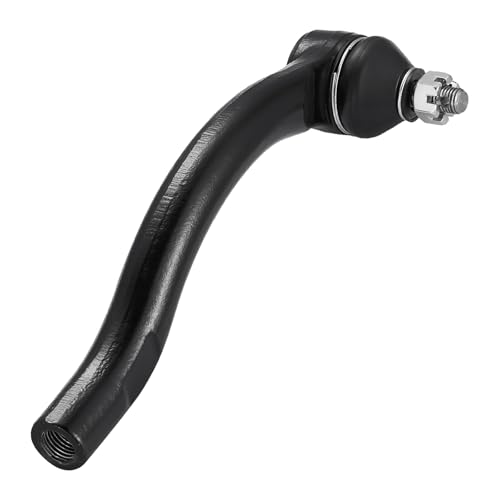
“Driver side” generally means the left side when sitting in the vehicle, but listings may say left, front left, or driver side. The Dorman TO74031, BDFHYK ES80288, A-Premium Super Duty part, TRQ single, and SYKRSS product all make the side position clear. The two-piece TRQ and X AUTOHAUX sets identify separate driver- and passenger-side pieces inside the package.
Also verify whether you need an outer end, an inner-and-outer assembly, or a complete set. This guide emphasizes products that explicitly include a driver-side outer end. The TRQ two-piece set and X AUTOHAUX set are appropriate only when the paired passenger-side component also matches the repair plan. A set can be convenient, but it may include a part you do not need.
Construction evidence varies considerably among listings. Dorman documents a factory-sealed, precision-forged housing designed to resist future corrosion. BDFHYK provides the most specific material statement among the selected products, naming AISI 1045 steel and targeted induction heat treatment. These are factual design descriptions, not independent durability test results.
Several products identify a steel ball stud. Both A-Premium listings state that the ball stud is steel and that the assembly is pre-greased. They also state that no greased fitting is included. That distinction matters during installation and maintenance because a pre-greased component is not the same as one with a serviceable grease fitting.
MOOG ES800515 describes protection against road debris, moisture, and contaminants. That is useful specification information, but the listing does not provide a material grade or explicitly identify the side in the supplied title. It therefore deserves careful application verification before being selected for a left-side repair.
Installation details range from minimal to comparatively developed. TRQ describes its selected products as pre-assembled direct replacements and points users to DIY video resources. X AUTOHAUX supplies a basic sequence involving the pinch nut, cotter pin, castle nut, boot, and replacement steps, while also noting that a manual is not included.
BDFHYK specifically states that a four-wheel alignment is mandatory after installation. Alignment is an important post-repair consideration for steering components, and this instruction should be followed rather than treated as optional. Even where a listing does not state an alignment instruction, the vehicle’s service procedure and the installer’s requirements should control.
Before removal, compare the replacement part with the original component, including stud, thread, taper, and connection arrangement when those details are available from the vehicle or OE documentation. Do not rely on appearance alone. If the part is difficult to remove or the steering linkage has other worn components, consult a qualified technician.
Use references and package contents together
OE and aftermarket reference numbers help narrow the match. BDFHYK lists ES80288 and 53560SDAA01; SYKRSS lists ES800515 and 7L1Z3A130L; and X AUTOHAUX lists ES800357 and ES800358 for the two sides. A reference number is useful only when it agrees with the vehicle application and side position.
Package quantity is another practical check. Most selected items are single units, while the TRQ and X AUTOHAUX products are two-piece sets. The A-Premium Hyundai/Kia and Volkswagen/Audi listings cover both left and right positions, but the supplied listing does not clearly state whether one order contains one unit or a pair. Confirm the package contents before finalizing a repair plan.
Warranty terms can help document the seller’s stated support, but they do not replace fitment verification or independent inspection. Dorman lists a limited lifetime warranty, TRQ lists two years, and A-Premium lists one year. MOOG ES800515 lists 30 days, while other MOOG entries use limited-warranty wording. Read exclusions and installation-related limitations where supplied.
Final Recommendation
BDFHYK ES80288 Driver-side Outer Tie Rod End ranks first overall in this specification-based comparison under the published weighted criteria.
Dorman TO74031 is the highest-scoring returned product and the first overall specification-based choice among these best driver-side tie rod ends. Its explicit front driver-side outer designation, factory-sealed precision-forged housing, corrosion-resistance description, direct-replacement positioning, and detailed support documentation give it the most specification-aligned overall evidence profile.
BDFHYK ES80288 is the most compelling alternative when the listed Honda Accord or Acura TSX application matches, particularly because its AISI 1045 steel and heat-treatment details are unusually specific. A-Premium’s Super Duty part is better suited to the listed Ford truck applications, while TRQ’s single end offers a well-documented direct-fit and DIY-support approach.
For repairs involving both sides, the TRQ two-piece set or X AUTOHAUX Nissan set may be more appropriate than a single component, but only when the complete application and package contents match. The top driver-side tie rod ends are not interchangeable by brand reputation alone; the vehicle, side, OE reference, and outer-end design must agree.
Frequently Asked Questions
What should I verify before choosing the best driver-side tie rod ends?
Verify the vehicle year, make, model, trim or drivetrain where applicable, front position, driver-side or left-side designation, outer versus inner design, and OE reference number. Listings such as the Dorman, BDFHYK, A-Premium Super Duty, TRQ, SYKRSS, and X AUTOHAUX products provide different levels of those details, so compare all available fields rather than relying on the product title alone.
Are a driver-side outer end and a two-piece tie rod set the same thing?
No. A single outer end supplies one component for the specified position. The TRQ two-piece outer-end set includes one driver-side and one passenger-side part, while the X AUTOHAUX set similarly includes separate left and right components for listed Nissan applications. A paired set may be unsuitable if only one side requires replacement or if the vehicle needs a different inner-end design.
Do pre-greased tie rod ends have grease fittings?
Not necessarily. The selected A-Premium listings state that the parts are pre-greased and that a greased fitting is not included. Those are separate specifications. Do not assume a serviceable fitting exists unless the listing or the part itself confirms it.
Is alignment needed after replacing a driver-side tie rod end?
The BDFHYK listing explicitly says a four-wheel alignment is mandatory after installation. Alignment requirements can vary by vehicle and repair procedure, so follow the vehicle service information and qualified installer guidance. A replacement steering component should not be considered complete merely because it is physically installed.
Which documentation is most useful for matching a replacement?
The most useful combination is exact vehicle fitment, side and position, OE or reference numbers, and package contents. Material details, sealing, pre-greased status, installation instructions, and warranty information help compare otherwise eligible listings, but they cannot compensate for a mismatch in vehicle application.