Buying Guide
Choosing among the best dual-sided makeup mirrors starts with identifying what each side is meant to do. A 1X side generally provides the normal, undistorted view used for an overall makeup check, while the second side enlarges facial details. The listings in this comparison range from 3X on the GOODY, Diane, YEAKE, and LFOYOU models to 30X on the LSNDRG mirror. Higher magnification is not automatically more useful: the supplied product notes for several high-power mirrors require close viewing distances, and some warn that the image can appear blurred or distorted when the user is too far away.
Match magnification to the task
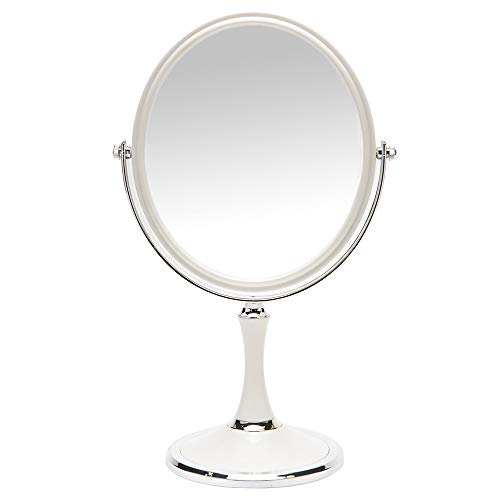
For everyday makeup and grooming, a standard side plus moderate magnification may be enough. The Diane Double-sided Hand Mirror and YEAKE Vintage Table Mirror document 1X and 3X views, which can work for ordinary touch-ups while keeping the design relatively simple. LFOYOU uses the same 1X/3X pairing but adds a bamboo stand and swivel movement.
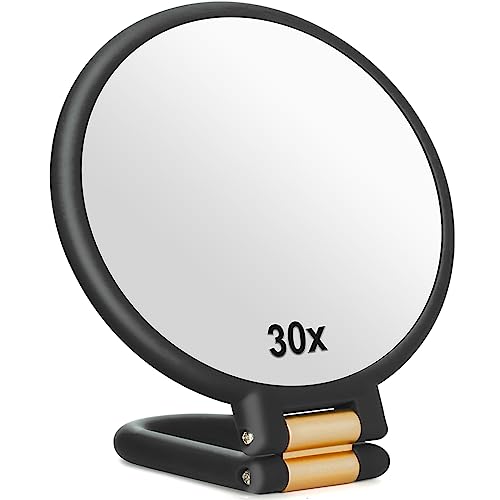
If your routine involves eyeliner, eyebrow shaping, false lashes, or contact lenses, the 10X, 20X, and 30X models provide more enlargement on paper. The Conair and IMIKONA mirrors use 10X sides; eeuuty and MOMOKUBA use 20X; and DEXHOM, LSNDRG, and other documented models use 30X. Treat these figures as specification differences, not as a guarantee of easier application. The actual useful distance depends on the mirror design and the user’s eyesight.
Decide whether lighting is necessary
Lighting is a major dividing line in this category. The GOODY, Diane, YEAKE, and LFOYOU listings do not document built-in illumination, so they depend on the room or nearby lighting. That can be appropriate for a simple mirror used in a bright bathroom or for portable checks.
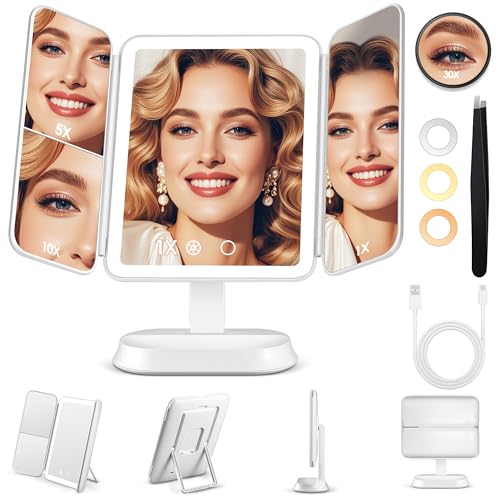
Lighted models add more control. eeuuty documents three light modes, 56 LEDs, and CRI 95+ lighting. MOMOKUBA lists 64 LEDs and a CRI above 95. Conair provides three color modes and three brightness levels, while DEXHOM lists 96 LEDs with cool, warm, and natural settings. IMIKONA and LSNDRG also document three color choices with dimming controls. These features are useful when your surroundings vary, but they add switches, charging requirements, or a cord to the setup.
Compare tabletop, handheld, wall, and suction designs
A tabletop mirror is the most common format in the selection. Conair uses a weighted base, YEAKE has a detachable base, and MOMOKUBA adds a storage tray and phone holder. These details matter if you want both hands free and have a dedicated vanity or bathroom counter.
Handheld and convertible formats are more flexible in small spaces. The Diane mirror can be held, hung, or used as a tabletop stand. The MOMOKUBA mirror is described as tabletop, handheld, or hanging, and eeuuty folds for travel. Check the stated dimensions as well as the weight: a compact mirror may pack easily, but its viewing area may be smaller.
Wall-mounted designs save counter space but require a suitable installation surface. IMIKONA uses an extendable, multi-joint arm, while the LSNDRG mirror documents a reusable suction cup for smooth, clean surfaces. Suction mounting is not equivalent to a permanently installed arm; its suitability depends on the surface and attachment conditions described by the listing. The IMIKONA model also documents a nickel frame and moisture- and rust-resistance claims in its supplied features.
Check rotation, height, and viewing position
Rotation helps you switch between sides without lifting the entire mirror. Many selected models document 360-degree movement, including MOMOKUBA, Conair, DEXHOM, IMIKONA, LSNDRG, YEAKE, and LFOYOU. The eeuuty travel mirror documents 180° and 270° movement and a lift to a stated 5.9-inch height. MOMOKUBA adds up to 1.57 inches of stand adjustment, while DEXHOM and Conair emphasize their larger standing formats.
Height and arm reach can be especially important if you tend to lean toward a small mirror. IMIKONA’s extendable arm and MOMOKUBA’s adjustable stand address positioning in different ways. For a fixed countertop, look for a base description such as Conair’s weighted base or MOMOKUBA’s wide base. For travel, prioritize a detachable or foldable structure and confirm that the mirror can stand, hang, or be held in the way you expect.
Consider charging and power
Rechargeable mirrors reduce dependence on disposable batteries and can be moved around the room. Runtime statements also vary by model and usage conditions, so compare the documented figures without treating them as universal results.
A corded option such as Conair may be preferable when the mirror stays in one place and you want to avoid charging. A non-lighted mirror such as YEAKE, Diane, GOODY, or LFOYOU removes power management entirely. The right choice depends on whether lighting mobility or a simpler setup matters more.
Final recommendation
eeuuty Gen 3 Travel Makeup Mirror ranks first overall in this specification-based comparison under the published weighted criteria.
The final choice among the best dual-sided makeup mirrors depends on the documented features that match your intended use.
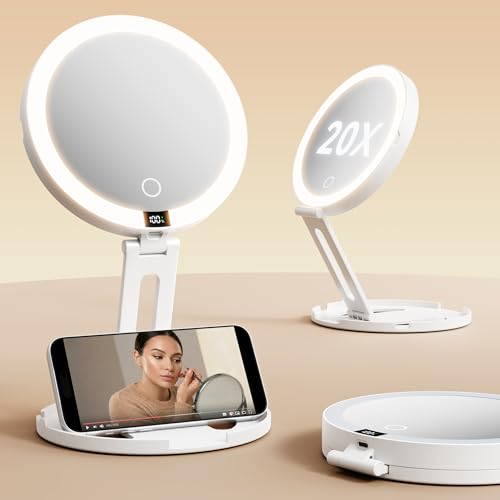
The eeuuty Gen 3 Travel Makeup Mirror is the highest-scoring returned product and the first overall specification-based choice. Its 1X/20X pairing, CRI 95+ lighting, three modes, rechargeable 2000mAh battery, Type-C port, foldable structure, and digital display give it the broadest documented feature mix for a portable routine.
Among the top dual-sided makeup mirrors, Conair is the clearest corded tabletop alternative because its weighted base, 8.5-inch viewing area, 10X side, and adjustable three-mode lighting are all specifically documented. Choose DEXHOM when a large viewing area matters most, MOMOKUBA when storage and height adjustment are useful, or IMIKONA when wall mounting is the central requirement. For a no-power design, the Diane and YEAKE mirrors offer flexible placement, while GOODY and LFOYOU keep the feature set more basic.
Frequently Asked Questions
What magnification should I choose in a dual-sided makeup mirror?
Choose based on the detail level and viewing distance documented for the mirror. A 1X/3X model such as Diane or YEAKE is suited to general touch-ups. A 1X/10X model such as Conair or IMIKONA provides more enlargement, while 20X and 30X models are intended for very close detail work. High magnification can require positioning your face close to the glass, so follow the supplied viewing guidance rather than assuming the highest number is always preferable.
Are the best dual-sided makeup mirrors usually lighted?
No. Selected models such as GOODY, Diane, YEAKE, and LFOYOU do not document built-in lighting, while eeuuty, MOMOKUBA, Conair, DEXHOM, IMIKONA, and LSNDRG do. A lighted mirror can offer color modes and brightness adjustment, but it also introduces charging or cord considerations. A non-lighted model can be appropriate when the mirror will be used near dependable room lighting or when portability and simplicity are more important.
Is a tabletop or wall-mounted mirror better for a bathroom?
A tabletop model is easier to move and usually needs only a counter. A wall-mounted model such as IMIKONA keeps the counter clear and uses an adjustable arm, but installation is part of the setup. LSNDRG offers suction-cup mounting for suitable smooth surfaces. Consider the available surface, required reach, and whether you want a removable design before selecting the format.
What should I check before buying a rechargeable mirror?
Check the listed battery capacity, charging connector, stated runtime, controls, and whether the mirror can operate while positioned away from an outlet. eeuuty documents a 2000mAh battery and Type-C charging; MOMOKUBA lists a 2000mAh battery with a stated 5–8 hours of use; and DEXHOM lists a 3000mAh battery with a stated 5–10 hours. These are listing specifications, so actual use can vary with brightness and operating habits.
Do all dual-sided mirrors rotate 360 degrees?
No. Many selected tabletop and wall designs document 360-degree rotation, including Conair, MOMOKUBA, IMIKONA, LSNDRG, YEAKE, and LFOYOU. The eeuuty travel mirror documents 180° and 270° movement instead. GOODY and Diane describe stand or handheld use but do not document 360-degree rotation. Check the individual movement description if angle adjustment is important to your routine.