Buying Guide
Choosing among the best easy-clean cooking skimmers starts with the food you want to lift and the liquid you want to leave behind. A tool for fried chicken or noodles has different requirements from one used to remove foam from broth. The products above fall into three practical design families: fine mesh, open slots, and silicone slotted heads.
Match the head design to the food
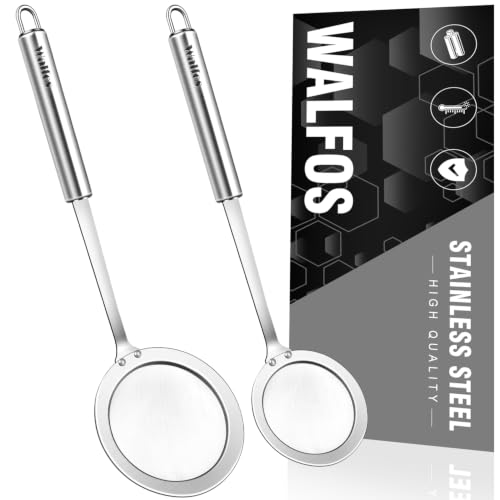
Fine mesh is the most specialized option for small particles. The Anaeat 4.7-Inch Fine Mesh Skimmer, i Kito 4.75-Inch Stainless Steel Mesh Skimmer, HTBMALL 9-Inch 304 Stainless Steel Fine Mesh Skimmer, and Walfos Two-Piece Fine Mesh Fat Skimmer Set all document mesh construction. These designs are intended for foam, grease, scum, crumbs, gravy, or other small material that could pass through broad slots. They are sensible choices for broths, soups, hot pots, and oil where separation is the main task.
Mesh size still matters. The HTBMALL has a compact 4-inch head and a 9-inch overall length, making it easier to position in smaller cookware. The i Kito uses a slightly larger 4.75-inch head with a 13.8-inch handle. The Anaeat has a 4.7-inch head, while the Walfos set supplies two smaller diameters. Multiple sizes can be useful when you regularly switch between a small saucepan and a larger pot.
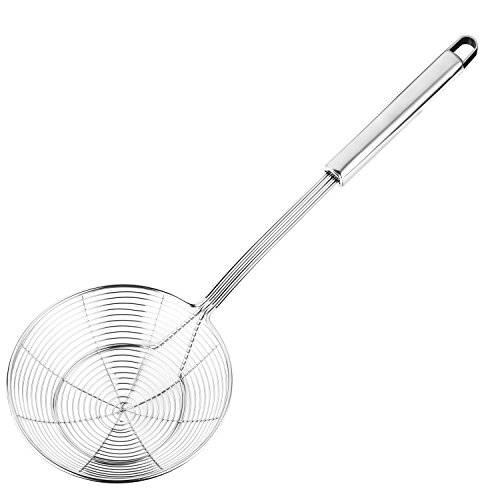
Open slotted spoons are generally better for larger pieces of food. The Swify, Hiware, TBWHL, and Walfos two-tool set document slotted or spider-style heads for fried foods, pasta, vegetables, eggs, seafood, and similar items. The Hiware has a 5.4-inch bowl, while the Walfos set adds a 7-inch spider strainer. Larger heads can lift more food, but they may be cumbersome in small pans and are usually less precise for fine foam.
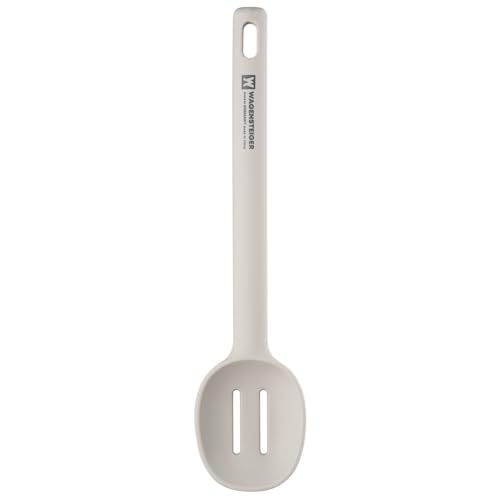
The Wagensteiger uses a slotted silicone head. Its documented non-stick cookware compatibility makes it the clearest choice for cooks who want a softer contact surface. Silicone is also useful when a metal utensil could scratch a coating, but this particular tool has a narrower 2.56-inch head than the large stainless steel options.
Stainless steel dominates this comparison because many listings describe it as food grade, rust resistant, heat resistant, or durable. The Berglander uses stainless steel and documents a 2.5 mm thickness claim. The Swify and TBWHL identify 304 stainless steel, while Hiware and i Kito specify 18/8 stainless steel. These material details are useful for shoppers seeking a metal utensil for hot oil or boiling water.
Heat claims are not identical across products. Walfos documents a 600°F operating temperature, and Wagensteiger documents a 450°F limit. Other listings use general heat-resistant language without supplying a numerical limit. Do not assume all stainless steel or silicone tools share the same tested temperature range; follow the product’s stated guidance and your cookware manufacturer’s instructions.
A wooden handle may feel different from an all-metal tool, but the supplied listing is the basis for that distinction—not a hands-on comfort conclusion. For metal tools, an integral or firmly attached head can be attractive when you want fewer visible connection points to clean.
Evaluate reach and head capacity
Long handles help place your hand farther from hot oil and boiling water. The Walfos set reaches 17 inches, the Hiware reaches 15.5 inches, the Swify reaches 15 inches, and TBWHL is listed at about 15 inches. These lengths can be useful with deep pots, fryers, and large stockpots. They also take more room to store, so measure a drawer or consider hanging storage before choosing a very long model.
Shorter tools can be easier to control in a small saucepan. The HTBMALL is listed at 9 inches overall, and the Berglander listing provides less dimensional detail but describes a conventional kitchen skimmer form. Short reach is not automatically a disadvantage when the cookware is shallow and the task is removing foam from a nearby broth.
Head depth and diameter influence how much food stays in the utensil. The Hiware listing provides a 5.4-inch diameter and 1.6-inch depth, while the Walfos larger tool is described as 7 inches in diameter and 2.5 inches deep. These larger, deeper forms are aimed at substantial portions. Fine-mesh heads and narrower silicone heads generally favor controlled skimming over maximum capacity.
Make cleanup part of the decision
For this category, easy cleanup depends on both the material and the head geometry. Dishwasher guidance is documented for the Walfos set, Wagensteiger, Berglander, Swify, Hiware, Anaeat, i Kito, TBWHL, HTBMALL, and Walfos fine-mesh set. That makes these options easier to compare for routine maintenance than products without supplied dishwasher information.
Mesh can trap fine particles in its wiring, even when a listing says it is dishwasher safe. If you use mesh for grease, foam, or grains, rinse it soon after use and check the openings before storage. Slotted heads may release larger food pieces more readily, while silicone is described as non-stick and stain resistant in the Wagensteiger listing. Smooth stainless steel surfaces, such as the Berglander mirror finish and TBWHL’s smooth surface, are also presented as cleaning aids.
Hanging holes or loops appear across many of the selected products. They can help the utensil dry and keep a long handle out of a crowded drawer. Storage is especially relevant for the 15- to 17-inch models and for the Walfos two-piece set.
Check cookware compatibility
If you use non-stick cookware, prioritize a product whose supplied evidence explicitly addresses that surface. Wagensteiger is the most specification-aligned documented fit because its silicone head is described as non-stick cookware safe. Berglander’s title also mentions non-stick cookware, but its head is stainless steel, so the most suitable practical approach is to follow the cookware maker’s care instructions and avoid scraping.
For stainless steel, cast iron, or frying applications where surface contact is less sensitive, a slotted or mesh metal tool may offer the reach and high-temperature utility you need. Choose based on whether you need fine filtration, larger food capacity, or a longer handle rather than assuming one design is best for every pan.
How to use the ranking
This list is a specification-based comparison, not a hands-on test. Editorial scoring considers documented cleanability, material and heat information, drainage design, reach and handling details, and cookware compatibility. It does not use customer sentiment or volatile marketplace claims. If you mostly fry large foods, start with a broad slotted or spider head. If you remove foam or grease from broth, start with fine mesh. If protecting non-stick cookware is the priority, start with silicone.
Final Recommendation
Walfos 7-Inch Spider Strainer and 4-Inch Skimmer Set ranks first overall in this specification-based comparison under the published weighted criteria.
Walfos 7-Inch Spider Strainer and 4-Inch Skimmer Set is the highest-scoring returned product and the first overall specification-based choice. Its two head sizes, 17-inch reach, stainless steel construction, documented 600°F heat rating, dishwasher guidance, and hanging storage cover the broadest range of cooking tasks in this comparison. It is especially suitable when one skimmer must handle both large fried foods and smaller portions.
For non-stick cookware, Wagensteiger Light Gray Slotted Silicone Spoon is the more targeted pick because the supplied evidence explicitly identifies a soft silicone head, 450°F heat resistance, stain resistance, and dishwasher cleaning. For soups, foam, and grease, Anaeat 4.7-Inch Fine Mesh Skimmer or i Kito 4.75-Inch Stainless Steel Mesh Skimmer offers more focused particle control. For compact cookware, HTBMALL provides a shorter 9-inch format.
The top easy-clean cooking skimmers are not interchangeable in practice: large spider heads prioritize capacity, fine mesh prioritizes separation, and silicone prioritizes surface protection. Select the design that matches your most common food and cookware, then verify the maker’s cleaning and temperature instructions before use. That approach makes the best easy-clean cooking skimmers easier to narrow down without relying on unsupported performance claims.
Frequently Asked Questions
Among the best easy-clean cooking skimmers, which skimmer is best for removing foam and grease from soup?
A fine-mesh model is the most suitable documented design for that task. Anaeat, i Kito, HTBMALL, and the Walfos Two-Piece Fine Mesh Skimmer Set are all described for foam, grease, or fine materials. Choose the head size based on the pot and the amount you usually skim.
Which selected skimmer is intended for non-stick cookware?
Wagensteiger Light Gray Slotted Silicone Spoon is the clearest match because its supplied features specifically describe a soft silicone head that is safe for non-stick cookware. Berglander’s listing also mentions non-stick cookware, but it uses a stainless steel head, so follow the cookware manufacturer’s care guidance.
Are fine-mesh skimmers harder to clean than slotted spoons?
They may require more attention because fine particles can lodge in the mesh. The selected fine-mesh models are documented as dishwasher safe, but rinsing soon after use can help prevent residue from drying in the wiring. Slotted spoons generally have larger openings and are designed for bigger food pieces.
Do longer handles make a cooking skimmer better?
Not in every kitchen. Longer handles, such as those listed for Walfos, Hiware, Swify, and TBWHL, can keep hands farther from hot oil or deep pots. A shorter tool such as HTBMALL may be easier to control and store with small cookware. Match length to pot depth and available storage.
Should I choose a mesh skimmer or a spider strainer?
Choose mesh when you need to capture foam, grease, or small particles. Choose a spider or open slotted head when lifting larger foods such as pasta, vegetables, fried items, or seafood. The Walfos two-piece set includes both larger and smaller formats, making it the most flexible selected option for cooks who use both methods.