Buying Guide
The best easy-clean garlic presses are defined by what happens after the garlic is crushed. A press can be dishwasher safe and still leave pulp around a hinge, plate, or chamber. For this comparison, the key questions are whether the working area opens, whether residue can be pushed or scraped out, and whether the handles and chamber support repeated use.
Look for direct chamber access
A swing-out basket, flip handle, detachable handle, or separating body can expose the surfaces that collect garlic. Kuhn Rikon documents a stainless steel basket that swings out. COKORA specifies a 180-degree flip handle. TheDOM identifies a detachable handle, and Full Circle says its press separates for cleanup. These designs address the same practical issue: making residue-holding areas easier to reach.
Integrated removal tools are another distinction. OXO has a built-in cleaner that pushes out garlic peels. Joseph Joseph CleanForce uses a trigger-operated wiper and stores a cleaning tool inside the handle. KITCHENDAO lists both a scraper and a cleaning pusher, while Full Circle uses the handle as an integrated scraper. These features may reduce the need to find a separate brush, although the press still needs washing.
Compare dishwasher claims with design details
Dishwasher-safe construction is helpful, but it should be considered alongside physical access. Amazon Basics, ORBLUE, Alpha Grillers, and the other selected models document dishwasher compatibility. A dishwasher claim tells you one available care route; it does not describe how easily fresh pulp leaves the holes before loading.
If you usually rinse immediately, an openable chamber may be more important than an included accessory. If you prefer loading tools into the dishwasher after cooking, dishwasher-safe materials and a design without difficult-to-reach areas may be more convenient. The supplied evidence supports these feature comparisons, but not claims about measured cleaning time.
Consider handle comfort and leverage
Handle design matters when a recipe calls for several cloves. OXO lists soft, non-slip handles that absorb pressure. Joseph Joseph describes its press as easy squeeze, while KITCHENDAO specifies extended ergonomic handles for leverage. Alpha Grillers and ORBLUE also identify ergonomic handles. These claims support a comfort comparison, but the supplied data does not establish a measured force requirement.
Match chamber size to cooking volume
A large chamber is useful when pressing more than one clove at a time. OXO, KITCHENDAO, and ORBLUE explicitly describe multiple-clove capacity. Alpha Grillers identifies a large chamber that flips out, while Amazon Basics describes a handheld press without specifying chamber capacity.
Do not assume that a larger chamber automatically means easier cleaning. More capacity can mean more surface area and more holes to rinse. Pair capacity claims with a cleaner, scraper, or openable chamber. If you usually press one clove, a compact design such as COKORA may suit limited drawer space without adding a separate preparation tool.
Decide whether peel-free pressing matters
Peel-free operation can save a preparation step, but it should be treated as a documented feature rather than an assumption. Kuhn Rikon, KITCHENDAO, Alpha Grillers, ORBLUE, TheDOM, and COKORA explicitly support unpeeled or no-need-to-peel use in their listings. OXO’s cleaner is described as pushing out peels, but its listing does not make the same direct no-peel claim, so its score is more cautious.
A separate silicone peeler can still be useful. Alpha Grillers and ORBLUE include one, and both remain standard hinged presses. Accessory sets can make preparation more complete, but they also create another item to clean and store. Full Circle’s scraper is integrated, whereas the peelers supplied with Alpha Grillers and ORBLUE are separate companion tools.
Review construction and storage needs
The selected products use stainless steel, zinc alloy, die-cast zinc, or combinations of those materials. OXO specifies die-cast zinc. Full Circle, Alpha Grillers, ORBLUE, TheDOM, and Amazon Basics identify stainless steel construction. KITCHENDAO and COKORA specify zinc-alloy construction. Several listings also use terms such as rust-resistant or rustproof, but those descriptions should not be expanded into unsupported claims about long-term performance.
Stainless steel may appeal to shoppers who want the material clearly identified, while zinc-alloy models can offer a substantial metal body and shaped handles. Listed dimensions and weights can help shoppers compare storage needs, but they are specifications rather than handling-test results.
Final Recommendation
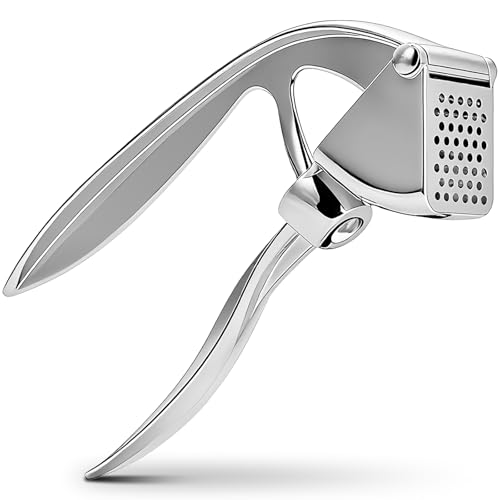
KITCHENDAO Heavy-duty Garlic Press ranks first overall in this specification-based comparison under the published weighted criteria.
KITCHENDAO Heavy-duty Garlic Press is the first overall specification-based choice in this comparison.
The final choice among the best easy-clean garlic presses depends on the documented features that match your intended use. KITCHENDAO combines a dual cleaning system, extended handles, fine-hole output, a large chamber, and peel-free operation. OXO Good Grips Garlic Press is the most specification-aligned all-around alternative because it combines a large-capacity chamber, built-in cleaner, soft non-slip handles, die-cast zinc construction, and dishwasher-safe care.
Among the top easy-clean garlic presses, Alpha Grillers and ORBLUE are useful choices when a separate silicone peeler is welcome. Amazon Basics keeps the feature set simple and focuses on stainless steel, soft-touch handles, mincing holes, and dishwasher-safe care. The best selection depends on whether your priority is access, accessories, capacity, or a streamlined cleanup routine.
Frequently Asked Questions
What makes the best easy-clean garlic presses different from ordinary models?
The most useful distinction is how the press handles residue. A dishwasher-safe label is helpful, but built-in cleaners, wipers, scrapers, swing-out baskets, flip handles, and detachable parts provide more specific evidence about access and residue removal. OXO, Joseph Joseph CleanForce, Kuhn Rikon, Full Circle, and COKORA each document one or more of these approaches.
Do I need to peel garlic before using these presses?
Not always. Kuhn Rikon, KITCHENDAO, Alpha Grillers, ORBLUE, TheDOM, and COKORA explicitly describe no-need-to-peel or unpeeled-clove use. Other listings, including Amazon Basics and Full Circle, do not make that claim in the supplied evidence. If peel-free preparation matters, choose a model whose listing states it directly.
Are stainless steel garlic presses easier to clean?
Material alone does not determine cleanup. Stainless steel models such as Full Circle, Alpha Grillers, ORBLUE, TheDOM, and Amazon Basics may be dishwasher safe, but cleaning access depends on the chamber and any removal mechanism. A swing-out, detachable, or flip-open design can be more relevant to residue access than the material name by itself.
Is a large chamber useful for everyday cooking?
A large chamber can accommodate multiple cloves and reduce repeated loading. OXO, KITCHENDAO, and ORBLUE explicitly document larger-capacity designs. However, shoppers who usually press one clove may prefer a compact model such as COKORA. Capacity is most useful when matched with a cleaner, scraper, or openable chamber.
Should I choose an included peeler set?
An included peeler can make unpeeled-clove preparation more convenient, and Alpha Grillers and ORBLUE include silicone peelers. It is still a separate accessory, so it adds another piece to wash and store. If you prefer fewer components, an integrated scraper or cleaning tool, as found on Full Circle or Joseph Joseph CleanForce, may better fit your routine.
Methodology
This is a specification-based comparison, not a hands-on product test. Editorial scores use a published weighted formula: cleaning access and residue removal (30%), handle comfort and pressing leverage (20%), chamber capacity and preparation efficiency (15%), construction and material durability (20%), and unpeeled-clove capability (15%). Scores are based on supplied listing features and specifications, not customer opinions, ratings, current listing information, popularity, or marketplace badges. Potential limitations are editorial inferences from documented category-relevant attributes rather than observations from hands-on testing.