Buying Guide
The best fluorescent close-to-ceiling light fixtures are usually integrated LED fixtures marketed as replacements for older fluorescent units. That distinction matters because the installation process, light source, controls, and dimensions can differ from a traditional fluorescent fixture. In this comparison, the selected products include 4-foot wraparound and puff-style designs, 2-foot linear fixtures, 1-by-4-foot flat panels, and round flush mounts. Choose by the existing ceiling layout and the light behavior you need rather than by the word “fluorescent” alone.
Match the fixture shape to the ceiling
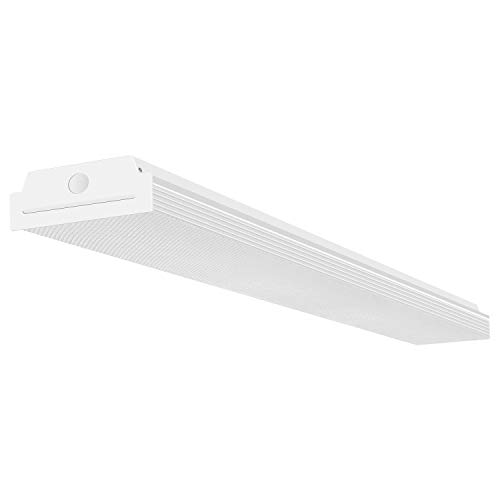
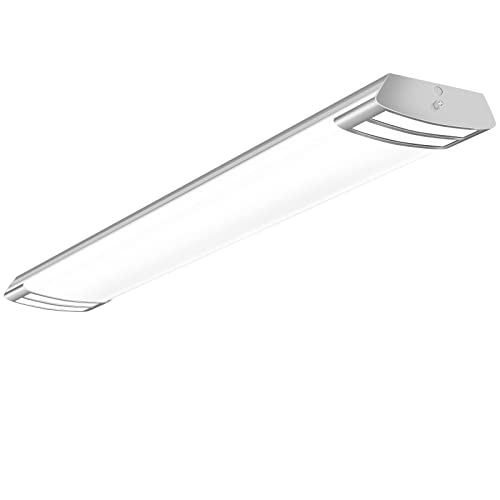
A 4-foot linear fixture is the closest visual and practical match for many older fluorescent installations. The Lithonia TruWrap, FAITHSAIL, hykolity wraparound, and ANTLUX puff light all provide long housings for garages, workshops, offices, kitchens, laundry rooms, and utility areas. Measure the available length and width before ordering. The Lithonia TruWrap is notably wide at 14-3/4 inches, while the two other wraparound listings are approximately 5 to 6 inches wide. ANTLUX lists a 4-inch width.
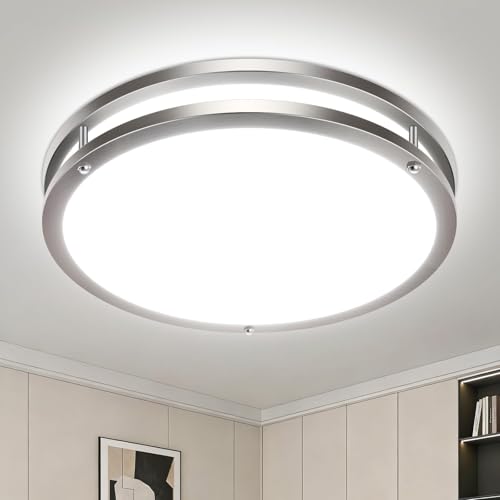
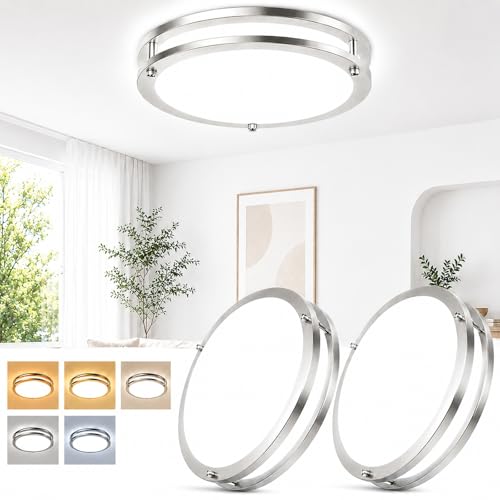
A round flush mount is a better fit when there is no existing long opening to cover. The Sylvania, libtit, DLLT, and hykolity 13-inch products install as individual ceiling lights and can suit bedrooms, hallways, kitchens, closets, and bathrooms when their documented specifications match the room. Their round footprints do not directly replace a 4-foot linear housing, so check whether the old mounting area will remain visible.
The Lithonia 2-foot wraparound occupies the middle ground. At about 24.5 inches long, it can fit smaller spaces where a 4-foot fixture would be excessive. The CPANL flat panel is another distinct design: its 1-by-4-foot format is suitable for T-grid ceilings or direct surface mounting and has a slim listed height of 1.26 inches.
Compare brightness with room use
Lumen output is the clearest documented basis for comparing brightness, although room size, ceiling height, wall color, and fixture placement also affect the result. The selected 4-foot products provide substantial output: the Lithonia TruWrap lists 5,500 to 7,500 lumens, ANTLUX lists 4,500 lumens, and both FAITHSAIL and hykolity list 4,400 lumens. These are the most specification-aligned candidates for broad utility or work-area illumination.
The CPANL panel lists 4,000 lumens and may suit an office, kitchen, garage, or other space where a broad rectangular distribution is useful. Round fixtures are generally more localized. The libtit listing gives 2,400 lumens, Sylvania gives 1,600 LMS in its title, and the 13-inch hykolity gives 1,300 lumens. The Lithonia 2-foot model lists 1,200 lumens. Those figures can be appropriate for smaller rooms, hallways, closets, or supplemental lighting, but they should not automatically be treated as direct equivalents to a high-output 4-foot unit.
Decide how much color control you need
Color temperature affects the appearance of a room. Fixed 4000K fixtures such as the FAITHSAIL and hykolity wraparound offer a neutral-white setting without requiring a pre-installation choice among several modes. ANTLUX is listed at 5000K, which is a daylight-white direction.
If the same fixture may move between rooms or uses, selectable CCT can be more convenient. The Lithonia TruWrap offers 3000K, 4000K, and 5000K. The CPANL offers 3500K, 4000K, and 5000K. Round products provide even broader choices: the Sylvania has five settings from 2700K to 5000K, while libtit spans 3000K to 6500K and DLLT spans 3000K to 6000K. The hykolity 13-inch model offers five settings from 2700K to 5000K.
Also check whether dimming is documented. Sylvania is compatible with most dimmers, libtit specifies 10% to 100% dimming with a compatible dimmer, DLLT supports dimming with most standard compatible dimmers, and the CPANL lists Triac dimming. The Lithonia TruWrap lists 0-10V dimming. These systems are not interchangeable, so the fixture and wall control must use the same dimming method.
Review wiring and mounting before purchase
Installation requirements are a key difference between these products. The hykolity wraparound explicitly requires hardwiring and does not use a plug-in setup. Sylvania also specifies a hardwired design. The hykolity 12-inch model requires hardwiring to a standard ceiling J-box, while the round models generally describe direct or surface mounting.
The Lithonia TruWrap offers the broadest documented mounting range, including J-box, stem, and suspension setups, plus conduit end feed and through-wire compatibility. The CPANL includes T-bar clips and a direct-surface bracket. FAITHSAIL describes replacement or new installation and says units can be connected in line. ANTLUX lists mounting hardware and a manual for its ceiling installation.
Turn off power and follow the product instructions. If the existing wiring, junction box, ceiling structure, or dimmer does not match the listing, consult a qualified electrician. “Flush mount” describes how the fixture sits against the ceiling; it does not mean every model is plug-and-play.
Check moisture, certification, and maintenance details
For bathrooms, laundry rooms, basements, or other humid areas, use only a product whose listing supports the intended location. Lithonia’s 2-foot wraparound, Lithonia’s TruWrap, the CPANL, and Sylvania include damp-location language in their supplied evidence.
Certifications also vary. The CPANL lists CSA, IC, DLC, and damp-location certification; the TruWrap lists CSA; the two 4-foot wraparound listings mention ETL; and the hykolity 13-inch fixture is ETL listed. These statements are product-specific, so do not transfer one model’s certification to another.
Integrated LED products avoid routine fluorescent tube and ballast replacement, but their light engine is built into the fixture. Review the warranty and installation access before buying. The selected listings document warranties ranging from one year to five years, depending on the model.
Final Recommendation
Lithonia Lighting CPANL 1x4 LED Flat Panel ranks first overall in this specification-based comparison under the published weighted criteria.
Lithonia Lighting TruWrap 4-Foot LED is the first overall specification-based choice among these best fluorescent close-to-ceiling light fixtures. Its combination of selectable brightness, three CCT settings, broad mounting support, damp-location rating, and 120-277 VAC operation gives it the widest documented application range.
For a grid ceiling or a tight plenum, the Lithonia Lighting CPANL 1x4 LED Flat Panel is the more appropriate design. For garages and workshops, the hykolity 4-Foot LED Wraparound and FAITHSAIL 4-Foot LED Wraparound provide high-output linear formats, with FAITHSAIL adding documented in-line connection capability. ANTLUX is a sensible option when a frosted puff cover and 5000K output are preferred.
For smaller spaces, the Lithonia Lighting 2-Foot LED Wraparound avoids the footprint of a full-length unit. Round fixtures are better when a single compact ceiling point is needed: Sylvania emphasizes 90 CRI, libtit provides a broad CCT and dimming range, DLLT adds CRI85+ and coverage guidance, and the hykolity 13-Inch model combines a metal frame with five CCT choices. These are the top fluorescent close-to-ceiling light fixtures here only in the context of their documented specifications, not hands-on testing or customer sentiment.
Frequently Asked Questions
Are these traditional fluorescent fixtures?
No. The selected products are integrated LED fixtures or LED fluorescent replacements. The FAITHSAIL and hykolity wraparound listings explicitly describe replacement of traditional fluorescent lighting, while the other products are LED flush mounts, flat panels, or wraparound fixtures. They do not use conventional replaceable fluorescent tubes based on the supplied evidence.
Which of the best fluorescent close-to-ceiling light fixtures is suitable for a low ceiling?
Several selected models list slim profiles. The CPANL is listed at 1.26 inches high, Sylvania at 1.25 inches, and the round hykolity model at 0.94 inches. The 4-foot models can also sit close to the ceiling, but their width and length may matter more than height in a crowded room. Always compare the published dimensions with doors, beams, and adjacent fixtures.
Do these fixtures require a ballast?
The FAITHSAIL listing says its design has no ballast to replace. The selected products otherwise describe integrated LED light sources rather than ballast-based fluorescent systems. Because wiring varies, do not assume an existing fluorescent circuit can be reused without checking the instructions and the electrical installation.
Can I change the color temperature after installation?
The supplied listings generally describe a selector on the fixture or a setting chosen before mounting. Lithonia TruWrap, CPANL, Sylvania, libtit, DLLT, and the hykolity 13-inch model offer documented selectable settings. Confirm where the selector is located before installation, since changing it later may require removing the diffuser or fixture.
What should I check before buying a replacement?
Measure the existing fixture area, confirm the desired shape, compare lumen output, identify whether fixed or selectable CCT is preferred, and verify hardwired or J-box requirements. If dimming is important, match the fixture’s documented Triac, 0-10V, or other compatibility to the intended control. For humid locations, use a model whose evidence specifically supports damp-location installation.