Buying Guide
The best folding room dividers are temporary space-management tools rather than permanent walls. They can define a work zone, create a dressing area, conceal clutter, or separate sleeping and living spaces without drilling into floors or ceilings. The right choice depends on how much visual blocking you need, how far the screen must extend, and whether it will stay in one place or move often.
Start with privacy needs
Privacy materials vary substantially. Opaque coated polyester is the most specification-aligned documented choice in this group. The SUNALLY 4-Panel Divider with Lockable Wheels uses 240gsm polyester with a PA coating and is described as non-see-through. RANTILA likewise specifies non-see-through coated polyester, while MAYOLIAH describes high-density, non-see-through fabric. These screens are better suited to bedrooms, temporary changing areas, and workspaces where visual blocking matters.
Some designs are intended to divide space without making it feel closed off. HOMCOM’s bamboo-and-cotton open weave is specifically described as allowing light and fresh air through. GIANTEX’s carved upper section is designed to diffuse light, and its lower louvers maintain an open decorative profile. Shoji-style panels, such as the Roundhill Furniture screen, create a softer visual boundary than solid fabric. Mesh and woven screens can be attractive, but the supplied evidence does not support treating them as fully opaque.
Match width and panel count to the room
Panel count is only part of the coverage story. The selected screens range from the 48-inch-wide GIANTEX to the 130-inch Sorbus and 136.4-inch VEVOR. A narrow three-panel screen can fit beside a bed or desk, while an eight-panel screen can span a broad open-plan area. Measure the intended opening, then leave room for the zigzag or angled footprint needed to keep a freestanding divider stable.
MAYOLIAH is notable for six panels and a maximum listed width of 120 inches. Its listing also describes two- through six-panel combinations, which may help when the layout changes. VEVOR’s four-panel screen reaches 136.4 inches, but its large footprint and 21.38-pound listed weight make it more appropriate when extensive separation matters more than quick movement. Sorbus also emphasizes an extra-wide eight-panel arrangement.
Check the base and hinge design
Freestanding screens need a stable shape. Wider feet can help, but the listing’s setup guidance matters too. SUNALLY combines widened feet with lockable wheels, allowing movement followed by a braked position. RANTILA uses extra-long, wide foot pads and triple-buckle hinges. The VEVOR wide screen recommends slightly folding its W-shaped sections for stability, while its assembly instructions recommend two people.
Hinge direction affects how much control you have over the layout. RHF uses two-way hinges, and GIANTEX uses hinges that allow custom angles. HOMCOM specifies 180-degree, single-direction hinges, so it may wrap around a desk effectively but offers a different range of movement. Flexible hinges are useful when the opening is irregular, but every screen should be arranged according to its supplied stability guidance rather than stretched flat by default.
Consider material and maintenance
Steel or iron frames are common in the fabric-focused models. SUNALLY, RANTILA, MAYOLIAH, and the VEVOR wide screen describe steel or iron frames with powder-coated finishes or other durability claims. Coated polyester and Oxford fabric are practical where wipeable or water-resistant surfaces are useful. SUNALLY and RANTILA specifically describe water resistance and easy-care characteristics.
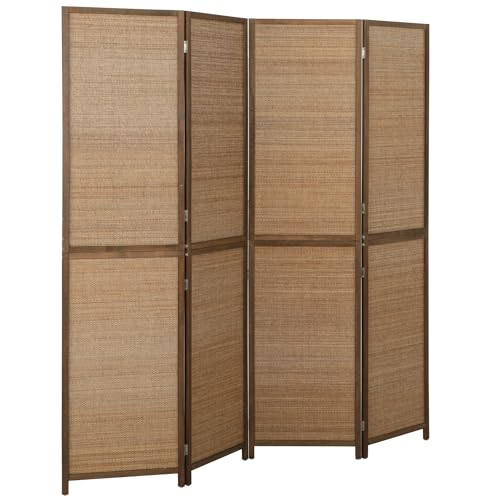
Wood screens provide a different balance. JOSTYLE uses an FSC-certified wood frame and woven rattan styling. HOMCOM pairs a pine frame with varnished bamboo panels. GIANTEX and the VEVOR wood screen use paulownia wood, while Roundhill Furniture uses a natural-finish wood frame with rice-paper-like panels. These materials may blend more naturally with living-room furniture, but paper-like, woven, or open designs may not provide the same visual blocking as coated fabric.
Plan setup and storage
For the simplest start, JOSTYLE and RHF are documented as requiring no assembly. Roundhill Furniture is also described as ready to use immediately. Other selections include hardware and instructions, with setup estimates or guidance supplied in their listings.
Storage dimensions matter in apartments and shared rooms. HOMCOM lists a folded thickness of 2.7 inches. RHF and Roundhill Furniture fold flat, while SUNALLY, RANTILA, MAYOLIAH, and Sorbus are described as foldable or portable. Compare the folded form with the available closet, wall, or under-bed space. A wide screen may separate a room effectively but still need a generous storage location.
Choose wheels only when you need them
Wheels are helpful for offices, multipurpose rooms, and households that regularly change layouts. SUNALLY is the only selected option with lockable wheels, so it is the clearest mobility-first choice. Fixed-foot models can still be moved, particularly lighter screens such as RHF and JOSTYLE, but they may require lifting or repositioning the entire folded unit. For a screen that will remain in one location, a stable foot design may be simpler.
Final recommendation
SUNALLY 4-Panel Divider with Lockable Wheels ranks first overall in this specification-based comparison under the published weighted criteria.
SUNALLY 4-Panel Divider with Lockable Wheels is the highest-scoring returned product and the first overall specification-based choice among the best folding room dividers. Its combination of opaque coated fabric, steel construction, widened feet, flexible hinges, and locking wheels gives it the broadest documented mix of privacy, stability, and mobility.
For the widest opening, compare the VEVOR 4-Panel 136-Inch Folding Privacy Screen with Sorbus’s eight-panel design. MAYOLIAH is another strong broad-coverage option with configurable panel use. For decor-led rooms, JOSTYLE, HOMCOM, GIANTEX, RHF, and Roundhill Furniture offer woven, bamboo, carved, or Shoji-inspired surfaces rather than plain opaque fabric. RANTILA is a sensible fixed-foot fabric alternative when wide feet and coated privacy material matter more than wheels. Together, these are the top folding room dividers for distinct room sizes and design priorities, based on listed specifications rather than hands-on testing.
Frequently Asked Questions
What should I look for in the best folding room dividers for a bedroom?
Prioritize documented opacity, sufficient height, stable feet, and a width that covers the intended opening. SUNALLY, RANTILA, and MAYOLIAH specify non-see-through or privacy-focused coated fabrics. Also check the folded size so the screen can be stored when the bedroom needs to return to an open layout.
Are folding room dividers stable without attaching them to a wall?
The selected products are freestanding, but stability depends on panel arrangement and base design. SUNALLY and RANTILA describe widened or extended feet, while the wide VEVOR model recommends a slightly folded W-shaped setup. Do not assume a fully flat arrangement is the most stable; follow the supplied assembly and placement guidance.
Which room divider is best for letting light through?
HOMCOM is the clearest choice because its open-weave bamboo and cotton design is specifically described as allowing natural light and fresh air through. GIANTEX also documents light diffusion through its upper cutout. These designs provide separation without the same visual blocking as opaque fabric screens.
Do folding room dividers require assembly?
It depends on the model. JOSTYLE and RHF are listed as requiring no assembly, and Roundhill Furniture is described as ready to use immediately. Other models include hardware and instructions. The VEVOR wide screen lists an approximately 15-minute setup and recommends two people, so review the installation details before choosing.
How wide should a folding screen be?
Measure the opening and account for the angled footprint needed for freestanding stability. Smaller areas may suit GIANTEX’s 48-inch width or RHF’s 63-inch width. Broad spaces may benefit from Sorbus at 130 inches, VEVOR at 136.4 inches, or MAYOLIAH at up to 120 inches. A wider screen is not automatically better if storage or movement space is limited.