Buying Guide
Choosing among the best frameless wall-mounted mirrors starts with deciding whether the mirror is primarily for full-body viewing, grooming, exercise, decoration, or a modular project. The selected products range from one-piece vertical mirrors to multi-panel gym sets, decorative irregular shapes, adhesive tiles, and a storage cabinet with an integrated mirror. Because this is a specification-based comparison, the guidance below reflects the supplied listing details rather than hands-on testing.
Match the mirror to the room
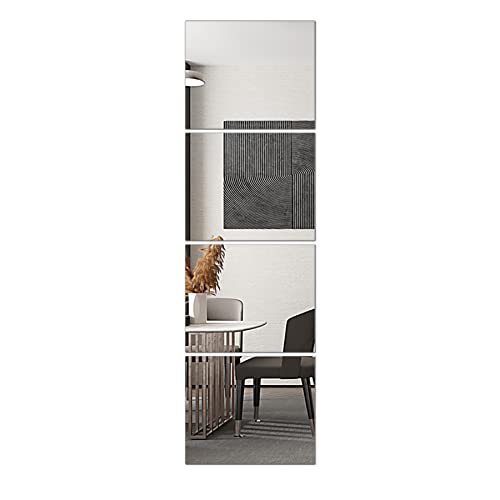
For dressing or checking an outfit, prioritize height and a clear vertical viewing path. The Erpele measures 51 by 16 inches, while the Ruomeng one-piece model measures 48 by 12 inches. These elongated designs suit bedrooms, entryways, closets, and narrow wall sections better than square tiles. The Erpele is documented for vertical mounting, so confirm that orientation works with the available wall.
For exercise, dance, or yoga, wall coverage is often more important than decorative styling. The Delma two-piece set provides two 60-by-25-inch panels, and the Honyee set includes three 48-by-24-inch panels. Multiple large panels can create a broad reflective surface, but they also require planning around spacing, alignment, wall structure, and handling. Review the included hardware and measure the intended installation area before ordering.
Choose between glass, tempered glass, and acrylic
Several selected mirrors specify HD float glass, including the Delma tile products, PERFNIQUE, and the Ruomeng tile set. The Erpele and Ruomeng one-piece option specifically document tempered glass. Honyee also lists tempered glass, an explosion-proof membrane, silver backing, and polished edges. These details are useful specification signals, but they do not replace careful handling and correct installation.
DARENYI uses acrylic rather than glass. Acrylic may make sense when shatter resistance and lower weight are important, such as in a children’s room or a lightweight DIY arrangement. Its listed thickness is 2.5mm, and the product has polished corners. It should be treated as a different material category rather than assumed to look or feel exactly like glass.
Consider shape and visual style
A frameless construction minimizes the visible border and can create a clean appearance. Rectangular formats are generally easier to align in a grid or use for full-body viewing. PERFNIQUE takes a different approach with an irregular cloud silhouette measuring approximately 43 by 24 inches. Its hooks support vertical or horizontal hanging, making it a strong fit for decorative walls, vanities, and spaces where the mirror is part of the design.
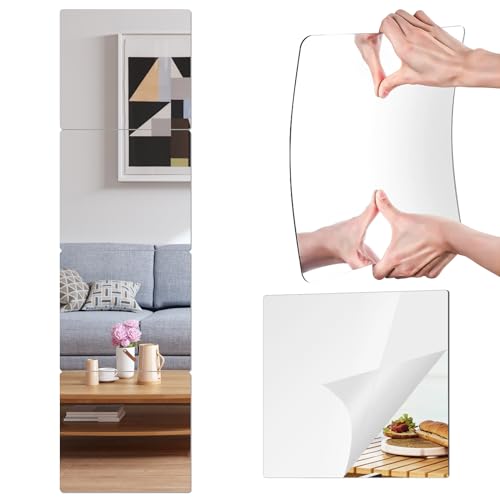
Tile sets provide control over arrangement. Delma supplies four 14-by-12-inch tiles, while Ruomeng supplies twelve 12-by-12-inch tiles. QEEYON offers one approximately 15.8-by-11.8-inch tile for a small project or an expansion piece. Modular products can create squares, rectangles, or custom patterns, but seams and alignment become part of the finished look.
Review the mounting method
Mounting flexibility differs substantially across these products. The Erpele is vertical only. The Ruomeng 48-by-12-inch mirror lists hardware for horizontal or vertical hanging. PERFNIQUE includes hooks for both directions. The tile products rely on double-sided stickers or foam tape and emphasize the need for a flat, dry, smooth, suitable surface. Ruomeng specifically warns that uneven surfaces may distort reflections.
Do not assume that included adhesive works on every wall. The supplied evidence cautions against surfaces such as wallpaper, moist walls, uneven walls, blistering paint, and surfaces shedding material for some tile products. Clean and inspect the wall first, and use the listed screws, anchors, or brackets where the product calls for them. For large glass panels, confirm that the wall and mounting points can support the installation.
Account for safety and handling
Frosted or polished edges appear on several tile and panel products. Tempered glass, explosion-proof membranes, and shatter-resistant descriptions also appear in the listings. These are relevant features, but a glass mirror remains a breakable item. Handle panels carefully, follow the supplied instructions, and avoid treating marketing language as a guarantee of damage prevention.
Packaging is also mentioned for several products, including protective foam or polystyrene. That can help during transit, but it does not remove the need to inspect the mirror and hardware before installation. Acrylic avoids ordinary glass breakage concerns but still needs careful mounting and surface preparation.
Think about whether storage is useful
The SONGMICS cabinet is a specialized option for shoppers who want a full-length frameless mirror together with organization. It is wall- or door-mounted and includes jewelry hooks, earring slots, shelves, drawers, interior lighting, and a lock. Its 42.5-inch height and 14.8-inch width provide a more compact mirror than the large glass panels. Choose it when storage is central to the purchase, not when the goal is maximum reflective area.
Final Recommendation
Erpele 51 x 16-Inch Frameless Full-Length Mirror ranks first overall in this specification-based comparison under the published weighted criteria.
Erpele 51 x 16-Inch Frameless Full-Length Mirror is the first overall specification-based choice among the best frameless wall-mounted mirrors because it combines full-length dimensions, explicit frameless construction, beveled styling, tempered glass, and included vertical-mount hardware. Its main limitation is the vertical-only installation requirement.
For a home gym or activity room, the Delma 60-by-25-inch two-piece set and Honyee three-piece set offer broad documented coverage. PERFNIQUE is the more decorative selection, while the Ruomeng one-piece mirror suits narrow spaces and flexible orientation. Delma, Ruomeng, and QEEYON tiles are better for custom layouts, provided the wall is appropriate for adhesive mounting. DARENYI is a suitable choice when acrylic and shatter resistance are more important than a conventional glass panel. The SONGMICS cabinet makes sense when mirror use and organized storage are equally important.
The top frameless wall-mounted mirrors are not interchangeable: dimensions, material, shape, and installation method change the best fit for each room. Measure first, identify the surface, and select the format that matches the intended viewing area.
Frequently Asked Questions
Among the best frameless wall-mounted mirrors, what size is suitable for a full-body view?
A taller format is generally more suitable for full-body viewing. The Erpele is 51 inches tall, and the Delma panels are 60 inches tall. The 48-inch Ruomeng option is narrower and can suit dressing areas with less wall space, but available viewing coverage depends on how the mirror is mounted and where the viewer stands.
Are frameless mirror tiles suitable for a home gym?
They can be suitable when the wall is flat, dry, smooth, and compatible with the listed adhesive. The Ruomeng 12-piece set is explicitly described for home gyms, and Delma also lists gym use. Uneven surfaces may distort reflections, so a large panel set may be more appropriate when a smooth adhesive surface is unavailable.
Can these mirrors be mounted horizontally or vertically?
Not all of them. Erpele is documented for vertical mounting only. The Ruomeng 48-by-12-inch mirror lists horizontal and vertical installation, and PERFNIQUE includes hooks for both orientations. Check the individual hardware instructions rather than assuming that every frameless mirror supports both directions.
Is acrylic a suitable alternative to glass?
DARENYI documents acrylic construction, shatter resistance, polished corners, and foam-tape mounting. It may be useful for lightweight decor, children’s rooms, or custom DIY arrangements. Acrylic is not the same material as glass, so shoppers should consider the intended location, surface, appearance, and installation method before choosing it.
What should be checked before installing a wall-mounted mirror?
Measure the wall, confirm the desired orientation, inspect the surface, and review the supplied screws, anchors, brackets, or adhesive. Tile listings specifically caution about uneven, moist, or unstable surfaces. For large panels, plan handling and support carefully, and inspect the mirror and hardware before beginning installation.