Buying Guide
The best g-scale hobby train tracks are not necessarily interchangeable in layout role. The supplied products include straight sections, several curve radii, directional turns, a station track set, and an operating crossing. Start by identifying the geometry your plan needs, then check the rail material, environment, and quantity before choosing a product.
Confirm the gauge and compatibility
Every selected product is identified as G-scale, Large G Scale, Gauge G, or Large Scale track in its listing. That terminology is relevant because compatibility is not established by appearance alone. Bachmann’s straight, curved, turn, crossing, and brass products specifically state compatibility with Large Scale locomotives and rolling stock. PIKO’s broad curve states compatibility with most other brands of G-scale track. LGB’s products are presented as G-scale track or G-scale layout components.
Even with compatible gauge language, compare the construction and connection system with track already on hand. A new section may be suitable in gauge but still need careful planning at joins. The PIKO curve is the clearest choice in this group for expansion across brands because its listing explicitly mentions compatibility with most other G-scale track brands. The Bachmann brass turn products also identify Code 332 track, which provides useful technical information when matching a brass system.
Choose brass or steel alloy
Brass appears on the LGB straight track, both Bachmann universal turns, the Bachmann 50-foot curve, the LGB large-radius curve, and the PIKO 10-foot curve. The PIKO listing goes further by identifying its rails as 100% pure virgin brass. Brass construction is therefore the most specification-aligned documented pattern among the products intended for outdoor layouts, though this comparison does not claim a hands-on performance advantage.
Steel alloy appears on the Bachmann straight, 40-foot curve, and crossing gate. These products are specifically listed for indoor use only. That limitation is important when planning a garden railway or any layout exposed to weather. The steel options can still be practical for an indoor layout, especially when their clear geometry or operating feature is more important than outdoor flexibility.
Match curve diameter to available space
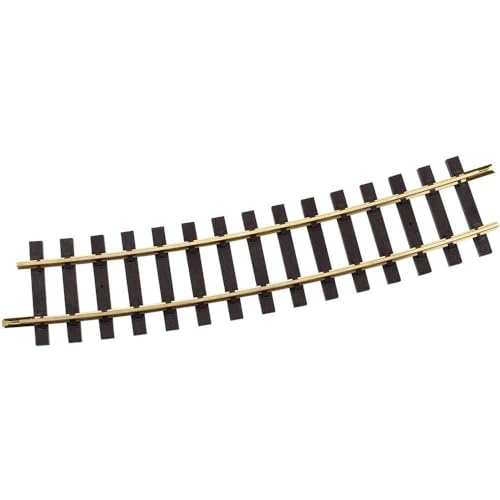
Curve geometry is one of the most important selection differences. The PIKO box is for a 10-foot-diameter curve and contains 12 pieces, with 24 pieces required for a full circle. That is a broad-radius design for spacious layouts. Bachmann’s 50-foot-diameter curve is broader still and comes in a 12-piece pack, but the listing does not say that those pieces complete a circle.
The LGB large-radius curve provides a different planning advantage: its listing states that 16 sections make a 360-degree circle. Bachmann’s curved steel option is identified as a 40-foot-diameter curve, while the LGB R1 section states that 12 sections make a four-foot circle. The Bachmann right- and left-hand turns are each 30-degree pieces for a four-foot-diameter curve.
Do not assume that a larger diameter is automatically better. A broad curve needs more room, and a compact layout may require the smaller documented circle or a different route plan. Measure the available footprint first. Then account for the train length, nearby scenery, and any clearance needed around the track.
Plan the quantity, not just the shape
Pack scope changes how quickly a layout can take shape. The Bachmann straight steel product is a four-piece pack, as is the Bachmann 40-foot curve. The PIKO curve includes 12 pieces, and the Bachmann 50-foot curve also lists a 12-piece quantity. By contrast, the LGB R1, the LGB large-radius item, and the two Bachmann directional turns are listed as individual track sections or pieces.
A single turn or curve section may be exactly what a repair or custom plan needs, but it is not a complete loop. The LGB R1 listing is unusually helpful because it states the number of sections needed for a full circle. The PIKO curve similarly states how many pieces are required for a full circle. Use those figures for planning rather than treating the package count as a finished layout.
Consider operational and scenic sections
The station track set is useful when the layout needs trains to pass each other or a locomotive to be switched from one end of the train to the other. That is a different purpose from a standard straight section. It may be a better fit for an operating plan, while a simple loop builder may prefer ordinary straight and curved pieces.
The Bachmann crossing gate is another specialized choice. Its gate activates when a train passes, adding a documented operating feature. Because the product is indoor-only steel alloy track, place it where the feature can be used without exposing it to the elements. These sections should supplement a route plan rather than replace the basic track needed to form that route.
Indoor and outdoor planning
The PIKO curve, LGB straight, LGB large-radius curve, LGB station set, and Bachmann brass products are listed for indoor and outdoor use. The three selected Bachmann steel products are listed for indoor use only. Treat those statements as product-scope guidance, not as a guarantee about a particular installation or climate.
Outdoor layouts also need a plan for the complete route, including joins, supports, drainage, and storage. Those details are not supplied in the listings, so they are outside this specification comparison. What the evidence does establish is which products are described for outdoor use and which are not.
Final Recommendation
PIKO G-Scale 10-Foot Diameter Curved Track ranks first overall in this specification-based comparison under the published weighted criteria.
The final choice among the best g-scale hobby train tracks depends on the documented features that match your intended use.
PIKO G-Scale 10-Foot Diameter Curved Track is the highest-scoring returned product and the first overall specification-based choice for broad-radius layouts. Its documented 10-foot diameter, 12-piece box, pure virgin brass rails, UV-stabilized HDPE ties, and indoor/outdoor suitability create a particularly complete specification profile. Remember that 24 pieces are required for a full circle.
Among the top g-scale hobby train tracks, the LGB G Scale Straight Track is the better fit for a long straight run where solid brass rails and indoor/outdoor use matter most. Choose the Bachmann 50-foot curve or LGB Large Radius Curve when the layout has room for wide geometry. For more deliberate routing, select the Bachmann right- or left-hand 30-degree turn according to the direction required.
The Bachmann steel straight and 40-foot curve are sensible indoor-focused options with clearly stated four-piece packs. The crossing gate adds an operating feature, while the LGB Station Track Set adds passing and locomotive-switching capability. Before ordering, verify the available footprint, intended environment, required circle diameter, and whether the package supplies enough sections for the planned route.
Frequently Asked Questions
What should I check first when comparing the best g-scale hobby train tracks?
Check the documented gauge terminology and compatibility statement first, then compare geometry and intended environment. A product listed for Large G Scale may still be a poor fit if its curve is too broad for the available space or if it is specified for indoor use only. The PIKO curve, for example, documents both G-scale compatibility and a 10-foot diameter, while the Bachmann steel products identify indoor-only use.
Are brass rails the only option in this comparison?
No. Brass rails are documented on the LGB straight, LGB large-radius curve, PIKO broad curve, Bachmann universal turns, and Bachmann 50-foot curve. Steel alloy is documented on the Bachmann straight, 40-foot curve, and crossing gate. The brass products offer more documented indoor/outdoor scope in this selection, while the steel products are explicitly indoor-only.
How many pieces are needed for a complete circle?
It depends on the product. The LGB R1 listing says 12 sections make a 360-degree circle, and the LGB large-radius listing says 16 sections make a 360-degree circle. PIKO states that 24 pieces are required for a full 10-foot-diameter circle, although the box contains 12 pieces. The Bachmann 50-foot curve listing gives a 12-piece pack but does not state that it completes a circle.
What is the difference between a standard curve and a directional turn?
A standard curve is described by its radius or diameter and is generally used to shape a loop or route. The Bachmann universal products are specifically 30-degree right- and left-hand turns for a four-foot-diameter curve, so they provide directional choices within a planned route. Select the side that matches the intended path, and confirm that additional sections are available for the rest of the curve.
Which selected track adds an operating feature?
The Bachmann Steel Alloy Track with Operating Crossing Gate includes a gate that activates when a train passes. The LGB Station Track Set serves a different operational purpose: its listing says it allows two trains to pass and lets a locomotive be switched from one end of the train to the other. Both are specialized layout components rather than ordinary straight track.