Buying Guide
The best galaxy s10 plus power banks are not defined by capacity alone. The Galaxy S10 Plus uses USB-C, so the first practical check is whether the bank includes a USB-C output, a built-in USB-C lead, or a suitable port arrangement. The selected models range from compact 10,000mAh banks to higher-capacity designs intended for longer trips and multiple devices.
This is a specification-based comparison using public listing data. It is not a hands-on test and does not summarize customer opinions. Charging behavior can vary with the phone, cable, charger protocol, battery level, and simultaneous loads.
Choose capacity for the length of your outing
A 10,000mAh bank is the most portable capacity tier represented here. The INIU P41, Aioneus, Aaoyun, WeeFancy, VRURC, RORRY, and NOBIS models all document 10,000mAh batteries. This size is generally easier to carry in a pocket or small bag, while still providing meaningful backup for a phone.
The INIU P51 and Miady set document 20,000mAh capacity, and the Pxwaxpy lists 30,800mAh. These larger choices are better suited to extended time away from an outlet, tablet support, or sharing power with other devices. The trade-off is that larger banks can take more room and may weigh more, and the Miady listing does not supply individual dimensions.
Compare output speed carefully
Output wattage is a useful comparison point, but the highest number does not automatically mean the Galaxy S10 Plus will charge at that exact rate. The INIU P41 lists 45W output, while the Pxwaxpy lists 25W PD and QC 4.0. Several selected models list 22.5W, including the INIU P51, Aioneus, Aaoyun, RORRY, and NOBIS through its USB-C output. WeeFancy lists 20W.
For ordinary phone backup, a documented USB-C fast-charge specification is more useful than a vague fast-charging label. A compatible cable and the phone’s own charging limits still affect the result. If you also carry a tablet or several USB devices, prioritize a bank that documents both sufficient output and simultaneous charging.
Match the port layout to your carry
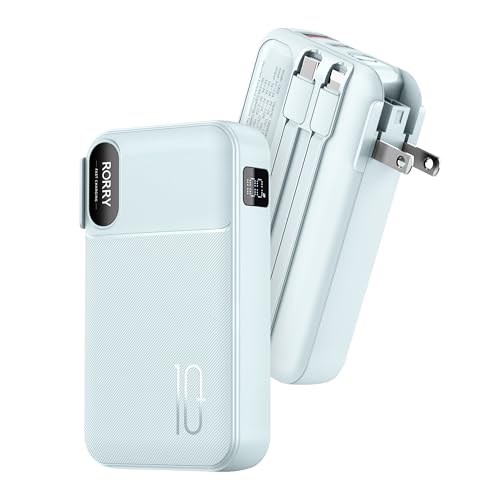
Port versatility is where the models differ most. Aioneus provides two built-in cables plus USB-A and USB-C ports. VRURC includes four cables and five outputs, while RORRY adds a foldable AC plug, USB-C and Lightning cables, and two dedicated ports. The Pxwaxpy lists built-in USB-C and iOS cables alongside five outputs and two inputs.
The INIU P41 takes a different approach with a detachable USB-C cable. That cable can be replaced separately if needed, unlike a permanently attached lead. The INIU P51 uses one USB-C input/output port and two USB ports, allowing up to three devices to charge at once. Before choosing, count the devices you actually carry and check whether their connectors match the supplied cables.
Decide whether you need wireless charging or a stand
NOBIS is the selected model with a documented magnetic wireless charging design and foldable stands. It lists wireless output up to 15W, USB-C output up to 22.5W, and USB-A output. That makes it useful for hands-free viewing or compatible magnetic devices, but a Galaxy S10 Plus user should plan around the wired USB-C connection unless a suitable magnetic attachment is present.
Wireless alignment can be convenient, but it may add thickness and should not replace checking connector compatibility. A conventional wired bank is usually the simpler fit when the main goal is charging a Galaxy S10 Plus.
Consider portability and physical design
The smallest listed bodies include the INIU P41 at 5.26 by 2.7 by 0.5 inches, Aaoyun at 0.6 inch thick, and WeeFancy at approximately 4.32 by 2.7 by 0.62 inches. These measurements favor pocket or small-bag carry. Aioneus also lists a compact 4.33-inch length and a 209-gram weight.
The RORRY is only 4.37 inches long but reaches one inch in listed thickness because it contains a wall plug and multiple charging components. The Pxwaxpy is 5.91 inches long, and its greater capacity naturally makes it a more substantial choice. Dimensions matter when the bank must fit beside a phone, wallet, or travel documents.
Compare safety documentation without overinterpreting it
The supplied listings mention different protection systems. WeeFancy specifies nine-layer protection and names temperature, voltage, current, overheating, and overcharging controls. Aaoyun lists a 15-layer protection system. RORRY describes a smart secure design, while NOBIS lists over-temperature and over-current protection.
These are listing claims, not independent verification. Use them as documentation to compare, and follow the manufacturer’s charging instructions. Also note that a bank with more ports can have its output divided when several devices are connected.
Check special features against your routine
Digital displays are useful when you want a precise remaining percentage. They appear on Aioneus, WeeFancy, VRURC, RORRY, and Pxwaxpy. Four-light indicators, such as those found on some other candidates, provide a less precise status check. Built-in cables reduce what you need to pack, while a detachable cable offers easier replacement.
A wall plug can simplify recharging the bank itself, as shown by RORRY. A lanyard can make carrying easier, as shown by VRURC. A stand can support desk or travel viewing, as shown by NOBIS. These features are most useful when they solve a specific inconvenience rather than simply adding components.
Final Recommendation
Pxwaxpy 30,800mAh 25W Power Bank ranks first overall in this specification-based comparison under the published weighted criteria.
INIU P41 is the highest-scoring returned product and the first overall specification-based choice among the best galaxy s10 plus power banks. Its 45W output, compact 10,000mAh design, detachable USB-C cable, and travel-oriented construction create the most specification-aligned balance for everyday phone backup.
Choose INIU P51 or Miady’s 20,000mAh set when capacity is the priority. Select Pxwaxpy when the largest listed reserve and broad output layout matter most. Aioneus and RORRY are compelling for integrated cables, while RORRY adds a wall plug. Aaoyun and WeeFancy emphasize slim carry, with WeeFancy adding a clear percentage display. VRURC suits users who want a lanyard and many built-in connectors. NOBIS is the specialized option for wireless charging and stand use, but wired USB-C charging is the more direct path for the Galaxy S10 Plus.
Among the top galaxy s10 plus power banks, the right choice depends on whether your priority is speed, reserve capacity, cable convenience, or a distinct travel design. Check the listed ports, dimensions, and output claims against the devices you intend to charge before deciding.
Frequently Asked Questions
Which capacity is practical for the best galaxy s10 plus power banks?
The selected 10,000mAh models are the most balanced for routine carry, while 20,000mAh and 30,800mAh options provide more reserve for longer outings or shared devices. Actual phone charges vary with conversion losses, battery condition, cable quality, and charging behavior, so listed capacity should be treated as a comparison specification rather than a stated number of charges.
Does the Galaxy S10 Plus need a special power bank?
No special battery chemistry is identified in the supplied evidence. Look for a power bank with USB-C output or a built-in USB-C cable and confirm that the included cable fits your phone. Models such as INIU P41, Aioneus, Aaoyun, and RORRY document USB-C connectivity. NOBIS also offers wireless charging, but its magnetic alignment should not be assumed to attach directly to the Galaxy S10 Plus.
Is a higher wattage always better?
Not necessarily. Higher documented output can be useful for compatible devices, but the phone and cable determine the charging behavior. The INIU P41 lists 45W, while several other selected banks list 20W or 22.5W. For the Galaxy S10 Plus, choose a clearly documented USB-C output and a suitable cable, then consider higher wattage mainly if you also charge other compatible equipment.
Are built-in cables worth choosing?
Built-in cables can reduce the number of separate accessories in your bag. Aioneus, VRURC, and RORRY document multiple integrated cables, while INIU P41 uses a detachable USB-C cable that can be replaced. Permanent cables are convenient but cannot be separated from the bank when you want a bare battery pack, so choose based on how you normally organize your charging gear.
What should I check before using a multi-device bank?
Check the number and type of outputs, whether USB-C is input, output, or both, and whether the listing explains simultaneous charging. Some banks can charge several devices but divide available output across ports. Also review the manufacturer’s safety instructions and use cables suited to the connected devices. The product specifications in this guide describe listed features and do not independently verify charging performance.