Buying Guide
The best glass media storage bottle is defined by the relationship between its glass, closure, capacity, markings, and intended handling. The products above are laboratory-style media or reagent bottles, generally using round glass bodies and polypropylene screw caps. They are not interchangeable containers by default: cap-neck formats, thermal guidance, and capacity affect whether a bottle fits a particular workflow.
Choose capacity before pack count
Capacity is the first practical filter. The United Scientific SIMAX bottle is the largest selected option at 2,000ml and is designed for heavy-duty storage, mixing, and sampling. Its wide mouth also supports powders, pastes, and larger items. The 1,000ml Yopay, QWORK, and PATIKIL options suit larger liquid batches while remaining more manageable than a 2L bottle.
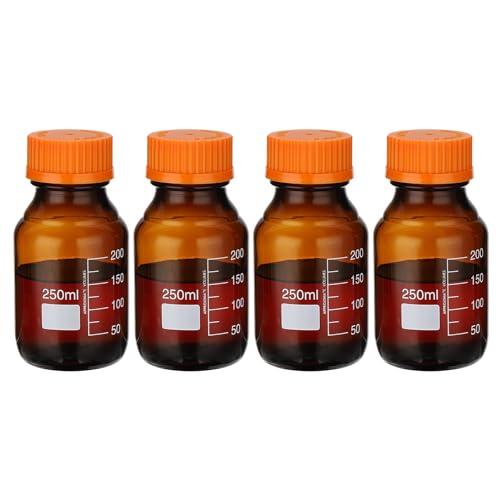
For routine preparation, 500ml bottles provide a middle ground. A six-bottle or four-bottle set can support parallel storage, while a two-pack is more appropriate when only a few containers are needed. At the smaller end, Irenare and PATIKIL offer 250ml formats, and Patelai supplies 100ml bottles for sample-scale quantities.
Pack count matters when containers must be labeled, separated, or rotated. A high-count set can reduce mismatched bottle sizes in a shared workspace, but it also consumes more shelf space. A single large bottle can work for one batch but offers less flexibility when several liquids need separate identification.
Compare glass construction and heat guidance
Borosilicate glass is explicitly identified for most selected products, including the Yopay, Irenare, PATIKIL, MorexLab, Karter Scientific, and Patelai bottles. Listings describe properties such as thermal stability and resistance to water, acids, or alkalis. These are specification claims, not a guarantee that every liquid or process is compatible.
Heat instructions vary. The United Scientific bottle is documented as autoclavable to 140°C and usable at high temperatures, but it is also marked as unsuitable for vacuum use. Several Yopay listings caution that tightening the cap immediately after autoclaving can create a cooling vacuum and break the glass. That limitation should be included in process planning.
Do not infer complete-bottle autoclave suitability from a cap specification alone. PATIKIL lists polypropylene cap temperature tolerance up to 140°C, while Patelai describes cap sterilization at 140°C. Those details concern the closure and should not be expanded into a claim about the entire assembly.
GL45 is common in this comparison. The Yopay, QWORK, MorexLab, Karter Scientific, Irenare, and Patelai products use GL45-style caps, while the PATIKIL 250ml bottle uses GL32. The United Scientific bottle uses GL80. These formats should be treated as different systems; a GL45 cap should not be assumed to fit a GL32 or GL80 bottle.
A gasket, O-ring, or sealing insert can help when evaporation, exposure, or leakage is a concern. Yopay describes an O-ring and linerless cap design, MorexLab describes leakproof caps, and several other listings describe leakproof or tight-seal construction. QWORK identifies its GL45 caps as leakproof and heat-resistant to 120°C. For transport or storage, verify the exact closure instructions and keep the bottle upright unless the manufacturer states otherwise.
Use graduations and labeling areas correctly
Graduations help with volume checks and repeatable filling, but they do not automatically establish laboratory calibration accuracy. The Yopay 1L bottles list markings every 100ml from 100ml to 900ml. The Yopay 500ml set marks 100ml through 400ml, while Karter Scientific lists 50ml graduation intervals from 100ml to 400ml. Patelai’s 100ml bottles use 20ml through 80ml markings.
A large marking area is useful when bottles are stored together. The Yopay and PATIKIL listings explicitly mention larger areas for labeling. Brown or amber glass can change how easily contents are visually inspected; choose those formats only when their appearance fits the identification process. Label contents, concentration where applicable, date, and handling information according to the relevant workplace procedure.
Consider access, cleaning, and shelf space
Round bottles are familiar and generally easy to place, but tall 1L and 2L models need adequate vertical clearance. The wide-mouth United Scientific bottle is documented for easier access to solids and pastes, unlike narrower GL45 liquid-storage designs. Smooth surfaces are mentioned for some PATIKIL bottles and may simplify cleaning, although the supplied evidence does not quantify cleaning performance.
A clear bottle makes remaining liquid easier to see, while an amber or brown bottle changes visibility. Transparent options include QWORK, MorexLab, and Karter Scientific. Choose based on whether direct visual inspection or a particular storage environment matters more, without assuming unsupported light-protection performance.
Final Recommendation
Yopay 6-Pack 500ml Glass Media Bottles ranks first overall in this specification-based comparison under the published weighted criteria.
Yopay 6-Pack 500ml Glass Media Bottles is the first overall specification-based choice.
The final choice among the best glass media storage depends on the documented features that match the intended use.
United Scientific SIMAX GL80 2L Wide-Mouth Media Bottle is the preferred selected option for large-volume storage because its listing documents Boro 3.3 glass, 2,000ml capacity, wide-mouth access, autoclave suitability to 140°C, leakproof storage, and a traceability code.
For routine 1L work, Yopay 4-Pack 1000ml Glass Media Bottles supplies four matching bottles with graduated scales and labeling areas. Yopay 6-Pack 500ml Glass Media Bottles is the more flexible middle-size choice, while Patelai’s 100ml set fits sample-scale work. Among the top glass media storage options, closure compatibility and process limits should guide the final selection.
Frequently Asked Questions
United Scientific SIMAX GL80 2L Wide-Mouth Media Bottle is the selected format with the largest stated capacity at 2,000ml. Its wide mouth is documented for mixing and access to powders, pastes, and larger items. Confirm that its dimensions and non-vacuum limitation fit the intended setup.
No. Autoclave or heat suitability differs by product. Some Yopay listings describe cap sterilization at 140°C but warn about cooling-vacuum breakage if caps are tightened too soon. The United Scientific bottle is specifically listed as autoclavable to 140°C. A cap temperature statement should not be treated as proof that the complete bottle is autoclavable.
GL45 identifies a neck and closure format used by many products in this comparison. It helps match a compatible cap, but it does not mean every GL45 bottle has identical dimensions, gasket construction, or process limits. The PATIKIL 250ml amber bottle uses GL32, and the United Scientific bottle uses GL80.
Do graduations make a bottle a precision measuring vessel?
Not necessarily. Graduations help with reading and repeatable filling, but the supplied listings do not establish calibration accuracy. Use marked scales as storage and workflow aids, and use suitable calibrated equipment when precise measurement is required.
Is a 500ml or 1,000ml bottle better for everyday use?
A 500ml bottle suits moderate liquid quantities and is available in several selected multi-packs. A 1,000ml bottle reduces the need to divide a larger batch and may be preferable for routine bulk storage. Choose the smallest capacity that comfortably holds the intended amount, leaving room for handling and any required mixing.