Buying Guide
This guide compares the best glass mug sets using documented glass thermal and material durability, capacity and set size flexibility, handle ergonomics and base stability, thermal insulation design, microwave and dishwasher compatibility, and beverage and use versatility.
Why glass mugs are worth a closer look
Glass coffee and tea mugs have moved well beyond novelty status because borosilicate formulations, thicker rims, and tempered builds now handle daily hot and cold cycles. When comparing the best glass mug sets, focus on what the materials and shapes actually do, not just on how clear the glass looks. Capacity, glass type, handle geometry, and base stability change how each mug feels in the hand and how it behaves on a saucer, mug warmer, or stacked shelf.
Glass type and thermal durability
Most modern glass mugs use either standard soda-lime glass or borosilicate glass. Borosilicate resists thermal shock across a wider range, which is useful for pouring boiling water into a room-temperature cup or moving from fridge to microwave. Standard glass can still be durable when the wall thickness is generous, but it tolerates less sudden temperature change. A thicker rim and base also help the cup survive small knocks and dishwasher cycles, which matters for everyday sets that go through the sink often.
Capacity and set size
Capacity decisions shape how a set gets used day to day. Twelve ounce mugs work well for drip coffee, tea, and standard lattes, while fifteen to sixteen ounce mugs give headroom for milk-heavy drinks or hot chocolate. Larger twenty ounce mugs suit long desk sessions where refills are inconvenient. Set size should match the household or hosting style: two mug sets fit couples or personal use, four to six mug sets cover small families or shared offices, and eight to twelve mug sets work for entertaining or larger workspaces.
Handle design and base stability
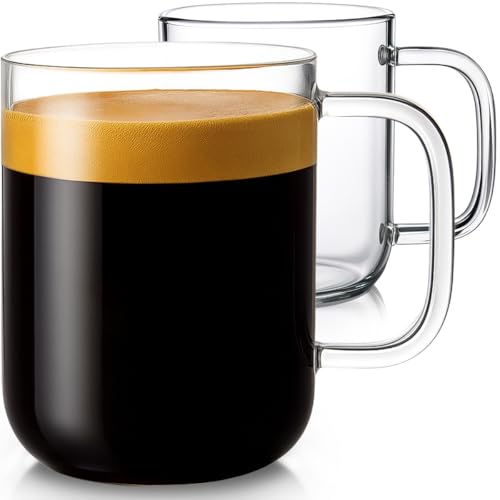
A wide, thick handle is easier to grip than a thin loop, especially when hands are wet or full. A C-shaped or oversized handle keeps fingers away from the glass wall, which reduces heat transfer from hot drinks. Wide flat bases resist tipping on crowded counters and pair well with electric mug warmers, which need a flat contact surface to transfer heat efficiently. For stacked storage, cylindrical mugs often nest more cleanly than tapered ones.
Single-wall versus double-wall construction
Single-wall mugs are usually lighter, simpler, and clearer, which suits decorative embossed or striped designs. Double-wall borosilicate mugs add an insulating air gap that keeps the outer wall cooler and holds temperature longer, but they tend to feel lighter and can be harder to grip for users who expect weight in the hand. Choosing between them is mostly about whether thermal comfort or a traditional solid mug feel matters more.
Microwave, dishwasher, and lid features
Microwave and dishwasher compatibility matters for daily use, especially for office mugs that get rinsed repeatedly. Borosilicate mugs handle microwave reheating more reliably than thinner glass. Lids, typically bamboo or plastic, add sealed storage options that turn a mug into a short-term container for oats, yogurt, or iced coffee, but lids usually rule out microwave use and may require hand washing, which is a practical trade-off to weigh.
Matching sets to drink styles
Larger capacity sets work for Americanos, lattes, and hot chocolate. Smaller crystal-style sets suit espresso, tea, and after-dinner coffee. Decorative embossed or striped mugs fit settings where presentation matters, such as brunch tables or coffee bars. Double-wall sets pair well with slow sipping because they hold temperature across longer sessions.
Final recommendation
LIBWYS Double Wall Glass Coffee Cups Set of 6 ranks first overall in this specification-based comparison under the published weighted criteria.
The final choice among the best glass mug sets depends on the documented features that match your intended use.
Among the top glass mug sets in this comparison, the Mfacoy Glass Coffee Mugs Set of 4 stands out as the first overall specification-based choice thanks to its 15 ounce capacity, wide handle, wide base, food grade glass, and microwave plus dishwasher compatibility. For shoppers prioritizing thermal insulation, the LIBWYS Double Wall Glass Coffee Cups Set of 6 offers borosilicate double-wall construction and included spoons, while the Aquach 20oz Borosilicate Glass Mugs Set of 2 covers extra-large capacity needs, and the Catsayer 12 Pack Striped Glass Coffee Mugs suits group or office use with twelve matching striped mugs.
Frequently Asked Questions
What size glass mug is best for everyday coffee?
Twelve to fifteen ounce mugs cover most drip coffee, latte, and tea needs, while sixteen to twenty ounce mugs suit milk-heavy drinks or longer desk sessions.
Are borosilicate glass mugs better than regular glass mugs?
Borosilicate glass tolerates a wider temperature range and resists thermal shock better than standard glass, which makes it a strong choice for mugs that move between cold storage, microwaves, and hot pour-over use.
Do double-wall glass mugs really keep drinks hotter longer?
Double-wall designs use an insulating air gap that slows heat transfer, which can keep drinks at a comfortable temperature longer and keep the outer wall cooler to hold than a single-wall mug.
Can glass mugs go in the microwave and dishwasher?
Many borosilicate and food grade glass mugs list microwave and dishwasher compatibility, but mugs with bamboo lids, embossed decorations, or crystal construction often require hand washing and may not be microwave safe.
Which of the best glass mug sets work for entertaining guests?
Large eight, six, or twelve piece sets like the Libbey Tapered Glass Mug Set of 8, the LIBWYS Double Wall Glass Coffee Cups Set of 6, and the Catsayer 12 Pack Striped Glass Coffee Mugs give hosts enough matching mugs for several guests at once.