Buying Guide
Choosing the best glass roasting pans is mainly a matter of matching capacity, shape, thermal guidance, and handling features to the meals you prepare. The products in this comparison are glass baking or casserole dishes whose supplied listings independently document roasting, oven cooking, or closely related uses. They are not presented as hands-on tested products; the ranking is based on the available specifications and feature descriptions.
Start with capacity and usable shape
Capacity is the first practical filter. The SIMAX dish is listed at 8 quarts including its lid, making it the clearest fit for bulky foods such as turkey, leg of lamb, or two chickens. The Ôcuisine XL dish holds 5.2 quarts, while the HUSANMP dish is listed at 5.4 liters. These larger formats give more room for substantial portions and deeper ingredients, but they also need more oven and cabinet space.
A 5-quart format, such as the Pyrex 233-D, can be a useful middle ground for large casseroles, lasagna, and moderate roasts. OXO’s 3-quart dish is more compact and includes dimension markings, which can help when a recipe specifies a particular pan size. NUTRIUPS lists a 2.6-quart capacity with a 9x13 outer format but also provides smaller usable interior dimensions, so shoppers should distinguish external measurements from cooking surface.
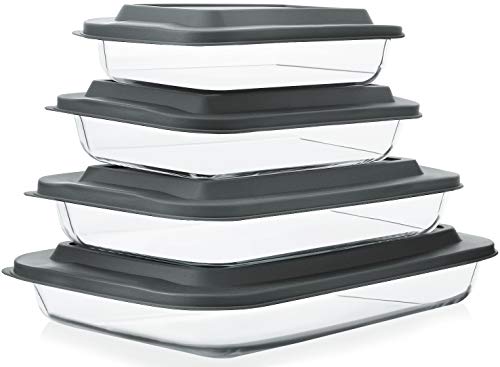
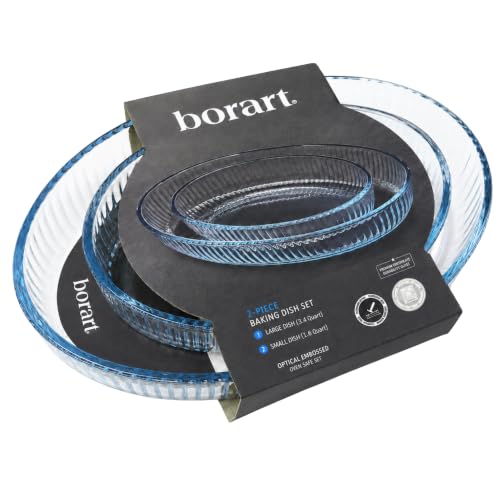
Multi-piece sets take a different approach. Anchor Hocking includes 2-quart and 3-quart dishes, while the M MCIRCO and KOMUEE sets provide four dishes from 1 to 3.2 quarts. These collections can cover side dishes, smaller bakes, and moderate mains without requiring one oversized pan for every task. The borart set uses two oval sizes, 3.4 and 1.6 quarts, for a combination of main-dish and side-dish cooking.
Check the glass and temperature guidance
Glass type and thermal information should be read together. OXO, SIMAX, Ôcuisine, M MCIRCO, KOMUEE, and borart identify borosilicate glass in their supplied evidence. Several other selections use tempered glass, including Anchor Hocking, Pyrex, HUSANMP, and NUTRIUPS. Borosilicate and tempered descriptions are not interchangeable claims, so use the manufacturer’s stated guidance for each specific dish.
This article selects products with strong overall category evidence, but a temperature number should never override the product’s use instructions. Ôcuisine specifically warns that its lid is not oven- or microwave-safe. Plastic lids supplied with OXO, Pyrex, Anchor Hocking, M MCIRCO, and KOMUEE are intended for storage or handling according to their individual descriptions, not automatically for high heat.
Decide whether a lid matters
A lid is useful when the same dish needs to move from cooking to storage, but the lid material determines how it can be used. OXO’s BPA-free lid is described as freezer-, microwave-, and top-rack-dishwasher-safe, and its slosh-proof design allows stacking. Pyrex includes a BPA-free red lid, while Anchor Hocking supplies BPA-free plastic lids with its two dishes.
The M MCIRCO and KOMUEE sets emphasize storage: both include four plastic lids, and both describe stacking or nesting features. These are useful for meal preparation and leftovers, but the listings distinguish the glass dishes from the lids for heat use. Ôcuisine is an especially important example because its feature text explicitly says the red lid is not oven- or microwave-safe. Always remove a plastic lid before oven cooking unless the listing expressly says otherwise.
The SIMAX high lid is different from a flat plastic storage cover. Its deep dome-shaped cover is described as helping contain heat and moisture and accommodating bulky foods. This covered format may be useful for large roasts or slow cooking, but its dimensions make it less compact than a standard rectangular dish.
Look for handles and transfer details
Glass bakeware can be heavy, especially when filled. OXO documents generous handles, and NUTRIUPS uses small handles on both sides that are intended to make moving the dish easier. M MCIRCO and KOMUEE describe widened or thickened handles. These details matter when carrying a hot dish to the table or moving a chilled dish for reheating.
The borart dishes are oval and intended for oven-to-table presentation, but the supplied evidence does not describe dedicated handles. The Pyrex 5-quart and HUSANMP listings likewise emphasize capacity and material rather than grip features. When a product page does not specify handles, do not assume that a broad rim provides the same grip as a dedicated handle. Use dimensions and the stated design details to judge whether the dish will be comfortable to move when full.
Consider cleaning and monitoring
Most selected products document dishwasher compatibility for the glass. OXO, SIMAX, HUSANMP, Anchor Hocking, borart, and NUTRIUPS list dishwasher use, while M MCIRCO and KOMUEE describe dishwasher use for the dishes. The KOMUEE listing specifically excludes its lids from top-rack dishwasher cleaning. Glass is also transparent, allowing cooks to monitor food without opening a lid, and several listings describe clear or crystal-clear construction.
Nonporous glass is repeatedly described as resistant to stains, odors, or food flavors. That feature is useful for dishes that alternate between savory roasts, baked pasta, and desserts. It does not eliminate the need to follow the manufacturer’s cleaning and thermal instructions. Ôcuisine advises washing with soap and warm water, avoiding abrasive cleansers, and not setting a hot glass container on a damp surface.
Match the pan to your routine
For one covered everyday dish, OXO gives the most balanced specification set. For large covered meals, SIMAX provides the greatest documented capacity, while Ôcuisine and HUSANMP offer large rectangular alternatives. Choose Pyrex when a 5-quart covered format fits your routine, or Anchor Hocking when two moderate sizes are more useful than one large dish.
If storage and meal preparation are central, M MCIRCO and KOMUEE provide four sizes with lids. Borart is better suited to oven-to-table presentation in two oval formats, and NUTRIUPS focuses on a smaller handled rectangular pan. The best glass roasting pans are not identical: capacity, lid heat limits, handles, and storage geometry can change how practical one design is for your kitchen.
Final Recommendation
OXO Good Grips 3 Qt Glass Baking Dish with Lid ranks first overall in this specification-based comparison under the published weighted criteria.
OXO Good Grips 3 Qt Glass Baking Dish with Lid is the first overall specification-based choice among these best glass roasting pans. Its borosilicate construction, documented freezer-to-oven use, generous handles, dimension markings, and slosh-proof stacking lid create the most balanced combination for regular cooking and storage.
The top glass roasting pans for specific needs are more specialized. SIMAX is the clearest large-capacity option because its 8-quart format and deep covered design are documented for bulky foods. Ôcuisine and HUSANMP are strong large rectangular alternatives, while Pyrex offers a 5-quart covered format. Anchor Hocking provides two useful moderate sizes, and borart adds oval oven-to-table presentation.
For a multi-pan collection, compare M MCIRCO and KOMUEE by their storage details and four-size range. Their dishes run from 1 to 3.2 quarts and include plastic lids, so they suit meal preparation more than a single oversized roast. NUTRIUPS is the compact handled choice when a 2.6-quart dish is enough. Before use, verify the exact dimensions, temperature instructions, and whether any supplied lid must be removed for heating.
Frequently Asked Questions
What capacity should I choose for the best glass roasting pans?
Choose by the food’s size and the room needed around it. SIMAX provides the largest listed capacity at 8 quarts, while Ôcuisine and HUSANMP are around 5.2 quarts and 5.4 liters. A 3-quart dish such as OXO suits moderate meals, and 1- to 3.2-quart sets offer more flexibility for different portions.
Can the plastic lids go in the oven with the glass pan?
Not automatically. OXO, Pyrex, Anchor Hocking, M MCIRCO, and KOMUEE include plastic lids intended for storage-related uses, while Ôcuisine expressly states that its red lid is not oven- or microwave-safe. Remove a plastic lid during oven cooking unless the product’s instructions specifically approve heat use.
Is borosilicate glass better than tempered glass for a roasting pan?
The supplied listings identify both materials across the selected products, but they do not establish a universal performance ranking between them. Instead, check the specific pan’s temperature guidance and transition instructions. SIMAX, Ôcuisine, and NUTRIUPS provide numerical ranges, while other products describe appliance compatibility without a full range.
Are these glass dishes suitable for serving at the table?
Several are explicitly described for serving. SIMAX is an oven-to-table-to-fridge design, and borart highlights oven-to-table presentation with clear oval dishes. Pyrex, HUSANMP, and NUTRIUPS also describe serving or table use. Use the handles, rim, and manufacturer instructions to decide how to transfer a filled dish.
Which selected pan is easiest to store with leftovers?
OXO has a slosh-proof lid that allows stacking, while M MCIRCO and KOMUEE include four lids with stackable or nesting features. Anchor Hocking, Pyrex, and Ôcuisine also include lids, but their heat limitations should be observed. If storage is the priority, compare lid fit and the available refrigerator space with the dish dimensions.