Buying Guide
Searching for the best gluten free calcium supplements means looking past the front label and into the actual calcium form, elemental dose, and what nutrients ride alongside it. The ten picks above span capsules, tablets, softgels, and liquids so you can match a format to your daily routine while keeping gluten out of the bottle. Use the sections below to narrow the field and decide which design best fits your bone-support goals.
Calcium supplements are not interchangeable once you look at the form on the label. Calcium citrate, like in Pure Encapsulations Calcium Citrate and PrimeMD 4-in-1, absorbs well even when stomach acid is lower, which matters for older adults and those on acid-reducing diets. Calcium carbonate, found in Carlyle Calcium 1200 mg with Vitamin D3 and Nature’s Bounty Calcium 1200 mg with D3, is a denser source of elemental calcium but typically needs food in the stomach to break down. Chelated forms such as dicalcium malate and bisglycinate in Life Extension Bone Restore Calcium are engineered for gentler digestion. Plant-sourced options like Garden of Life Calcium with Magnesium, D3 & K2 and New Chapter Bone Strength Take Care pull calcium from algae, appealing to shoppers avoiding rock-derived sources.
Elemental calcium per serving
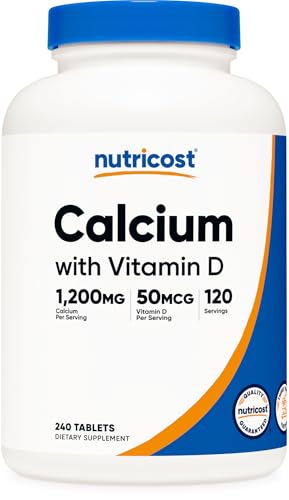
The milligrams listed on the front of a bottle are not always the milligrams your body can use, because the elemental calcium content varies by salt. A 1200 mg softgel of calcium carbonate, such as Nature’s Bounty Calcium 1200 mg with D3, delivers more elemental calcium per softgel than a 600 mg capsule of calcium citrate. If you need a single-serve high dose, softgels and tablets from Carlyle and Nutricost Calcium with Vitamin D3 may match that target. If you prefer spreading smaller doses across the day, multi-capsule formulas like Life Extension Bone Restore with Vitamin K2 are designed for split dosing.
Supporting nutrients that move the needle
Calcium does not work alone. Vitamin D3 helps the gut absorb calcium, while vitamin K2 helps route calcium into bone rather than soft tissue. Several picks stack these together: PrimeMD 4-in-1 pairs calcium citrate with D3, K2, and B12, while Garden of Life and New Chapter combine plant calcium with D3 and K2 plus magnesium. When a formula omits D3, look at how your diet or a separate D3 product might fill that gap.
Dietary compatibility and allergen statements
Gluten-free certification or a “no wheat, no gluten” claim is a baseline expectation in this category, and the picks above all state gluten-free on the label. Beyond gluten, shoppers with multiple sensitivities can narrow the list to formulas that also avoid dairy, soy, and common additives. Plant-based buyers can look at Garden of Life, New Chapter, and PrimeMD, each of which is also vegan-friendly.
Format shapes how consistently you will actually take the supplement. Capsules are the most common middle ground, with Life Extension Bone Restore with Vitamin K2 and Pure Encapsulations Calcium Citrate offering 120 to 180 capsules per bottle. Larger-count bottles, like Nature Made Calcium Magnesium Zinc with D3 at 300 tablets or Nutricost at 240 tablets, reduce reorder frequency if you take calcium long term.
Manufacturing and quality signals
Look for third-party testing, cGMP manufacturing, and certifications that match your priorities.
Final recommendation
Life Extension Bone Restore with Vitamin K2 ranks first overall in this specification-based comparison under the published weighted criteria.
The final choice among the best gluten free calcium supplements depends on the documented features that match your intended use.
Pure Encapsulations Calcium Citrate stands out as the first overall specification-based choice for shoppers prioritizing a clean, hypoallergenic calcium citrate that fits cleanly within a gluten-free routine. Garden of Life Calcium with Magnesium, D3 & K2 is the runner-up for adults who want a plant-based algae calcium with a full D3, K2, and magnesium stack. Those who prefer a softgel or multi-mineral tablet can confidently turn to Nature’s Bounty Calcium 1200 mg with D3, Carlyle Calcium 1200 mg with Vitamin D3, or Nature Made Calcium Magnesium Zinc with D3. Together, these options represent the top gluten free calcium supplements across formats, doses, and nutrient pairings.
Frequently Asked Questions
What makes the best gluten free calcium supplements different from regular calcium pills?
The best gluten free calcium supplements carry explicit gluten-free labeling or third-party verification, and they are produced in facilities that prevent cross-contamination with wheat, barley, or rye, while still providing meaningful elemental calcium and complementary nutrients.
Is calcium citrate or calcium carbonate better for a gluten free calcium supplement?
Calcium citrate absorbs well without stomach acid and tends to be gentler, while calcium carbonate offers more elemental calcium per tablet but usually needs to be taken with food. Both forms can be excellent when paired with vitamin D3 in a gluten-free formula.
How much elemental calcium should a daily gluten free supplement provide?
Most adults look for products that contribute roughly 500 to 1200 mg of elemental calcium per serving, then split the total daily target across meals and doses. The top gluten free calcium supplements in this guide range from 500 mg gummies to 1200 mg softgels and tablets.
Do I need vitamin D3 and K2 with my calcium supplement?
Vitamin D3 supports calcium absorption in the gut, and vitamin K2 helps direct calcium toward bone, so a formula that includes both, like PrimeMD 4-in-1 or Garden of Life, can be a convenient single-product option for many shoppers.
Plant-sourced calcium from algae, as in New Chapter Bone Strength Take Care and Garden of Life, can be comparable to other well-absorbed forms when paired with vitamin D3 and K2, and it offers a non-rock alternative for those who prefer it.