Buying Guide
The best gold double window rods should be selected by the window opening, curtain weight, and desired appearance rather than color alone. Every rod in this comparison is designed to hold two curtain layers, but the documented construction varies considerably. Some prioritize wraparound coverage, some focus on long spans, and others use crystal or decorative finials.
Start with the window width
Measure the window and the space available for the supports before choosing a size. A listed rod range is not always the same as the recommended window width. The Lwiiom model covers 36-72 inches, while the Mayrhyme wide-span model extends from 72 to 144 inches. TANGWIN covers 66-120 inches, and Wolistsa’s mid-wide model reaches 91 inches.
For ordinary bedroom or living-room windows, a 36-72-inch rod may be sufficient. Hosmile, USFOOK, and the 36-72-inch Lwiiom are all in that group. A 34-92-inch or 36-91-inch format can be more flexible when the opening sits between common sizes. For very wide openings, check whether the listing recommends center support or includes three brackets. TANGWIN documents three brackets, and the extra-wide Mayrhyme listing describes multiple mounting bases.
Match the two rods to your curtains
A double rod is intended to separate two treatments. Typically, the front rod carries the more substantial panel and the rear rod carries a sheer or lighter layer. The documented diameters show how each product approaches that arrangement. Hosmile uses a 1-inch front rod and a 5/8-inch back rod. Mayrhyme lists a 3/4-inch front pole and a 5/8-inch rear pole on its long warm-gold design.
The listing for TVWOO goes further by giving separate capacities: the current price for the front rod and the current price for the back rod. That level of detail can help when the two layers differ substantially. Lwiiom instead provides a 60-pound maximum for the overall heavy-duty system. Always compare the documented capacity with the combined curtain hardware and fabric weight; do not assume every double rod supports the same load.
Choose wraparound ends for side coverage
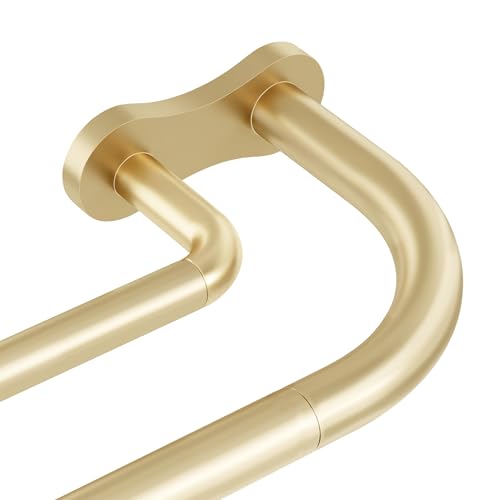
Wraparound rods curve toward the wall at the ends. This design is documented on Lwiiom, Wolistsa’s 34-92-inch model, and the USFOOK and other selected blackout-focused options. The purpose is to reduce side gaps when curtains are closed. It can be useful in bedrooms, home theaters, or any room where privacy and reduced light leakage are priorities.
A wraparound design also affects placement. Check the available wall depth and the location of trim, blinds, handles, and nearby furniture. The rod must project far enough for both curtain layers to move without rubbing against the wall or window treatment. The product listing may describe light-blocking intent, but the result will still depend on curtain dimensions, fabric, and installation.
Consider bay-window geometry separately
A standard straight rod is not automatically suitable for a bay window. The Mayrhyme warm-gold bay-window model is the selected option that specifically documents two-sided bay-window installation. It can be arranged in curved or straight form and uses connectors intended for the corner layout.
Before buying a bay-window rod, map the sides of the window and decide whether the curtains should meet at the corners or continue across the full arrangement. Confirm that the supports can be attached to the available surfaces. A two-sided design may provide more useful coverage than trying to force a straight rod into a corner.
Compare installation systems
Installation details differ. Hosmile, USFOOK, Wolistsa’s standard models, and TVWOO list brackets, screws, anchors, and instructions. TVWOO uses locking bracket screws and specifies maintaining a two-to-three-inch overlap between telescoping and fixed sections. That guidance should be followed rather than treating the rod as a loose decorative bar.
Several selected wraparound models use hidden or concealed bases. A hidden base can create a cleaner appearance after installation, but it does not eliminate the need to locate the supports accurately.
Spliced rods can cover wider openings, but they introduce more joints and assembly steps. TANGWIN uses sections that adjust in approximately 16-inch increments. The Wolistsa 34-92-inch model combines splicing with telescoping adjustment. These systems offer range, but buyers should carefully align threaded connections and use the included center support where specified.
Decide how much decoration fits the room
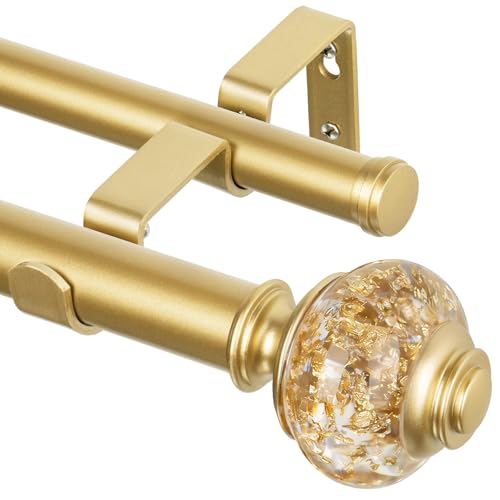
Gold finishes range from simple round finials to crystal details. The Wolistsa crystal model and TVWOO use crystal accents, while USFOOK lists translucent crystal finials. Crystal can complement formal, glam, or traditional rooms, but a plain cap may be easier to coordinate with minimalist furnishings.
Also look at the documented material and surface treatment. Lwiiom lists solid aluminum brackets and finials. Hosmile lists aluminum-alloy brackets and a baked-paint process. Wolistsa documents carbon steel, baked paint, and a 0.8-millimeter wall thickness on selected models. These details are more useful for comparison than a finish name by itself.
Final recommendation
TVWOO Gold Crystal Double Rod 36-88 Inch ranks first overall in this specification-based comparison under the published weighted criteria.
The final choice among the best gold double window rods depends on the documented features that match your intended use.
Lwiiom Gold Double Curtain Rod 36-72 Inch is the highest-scoring returned product and the first overall specification-based choice. Its documented 60-pound capacity, solid aluminum hardware, curved ends, and adjustable dual-rod format make it the most specification-aligned fit for buyers who want support and side-gap coverage in a common window range.
For large spans, choose Mayrhyme Warm Gold Double Rod 72-144 Inch. For a bay window, the Mayrhyme Warm Gold Double Bay Window Rod is the most directly targeted design. Hosmile is a straightforward standard option, while TANGWIN and the two Wolistsa adjustable designs cover wider or less conventional sizes. The top gold double window rods are not interchangeable: measure first, identify your curtain layers, and then use the documented capacity and installation details to narrow the choice.
Frequently Asked Questions
What should I look for in the best gold double window rods?
Prioritize a suitable adjustment range, a documented front-and-back rod configuration, adequate stated capacity, and mounting hardware that fits your wall. Wraparound ends may be useful when side gaps are a concern. For decorative rooms, compare finial styles after confirming size and support.
Can these rods hold blackout and sheer curtains together?
Yes. The selected products are double curtain rods, and their listings describe using the front rod for heavier or blackout panels and the rear rod for sheers. The exact suitable combination depends on the fabric and hardware weight. TVWOO documents separate front and back capacities, while Lwiiom gives a 60-pound maximum capacity for its system.
Which selected rod is suited to a bay window?
The Mayrhyme Warm Gold Double Bay Window Rod is the clearest match because its listing specifically describes two-sided bay-window installation and curved-or-straight use. Measure each side and confirm the connector and support positions before ordering.
Are wraparound double rods better for blackout curtains?
They may reduce side gaps because the ends curve toward the wall. Lwiiom and Wolistsa’s 34-92-inch model document wraparound designs for room-darkening use. However, the curtain’s width, fabric, overlap, and installation accuracy also affect coverage, so a wraparound rod does not by itself guarantee a dark room.
How do I choose between crystal and plain gold finials?
Choose crystal finials when you want a more decorative or formal accent; selected Wolistsa, TVWOO, and USFOOK models document crystal details. Plain round or cap finials generally create a simpler visual line. In either case, check the rod range and capacity before making the style decision.