Buying Guide
The best gold-plated cuff bracelets are easiest to compare when the listing gives more than a finish name. Start with the bracelet’s opening format, then check the stated measurements, base metal, plating description, and surface details. A cuff can look similar to a bangle in a title but differ substantially in how it fits and how much adjustment the wearer can make.
Check whether the bracelet is truly an open cuff
An open cuff has a gap or flexible opening that lets the wearer slide it over the hand and, in some designs, gently adjust the fit. MAIKERDER, PEARLADA, POTESSA, RATVIU, MystiGlimmer, and BE & CHEERY all document open or adjustable formats. That information is more useful than a generic “one size” label because it explains how the bracelet is put on.
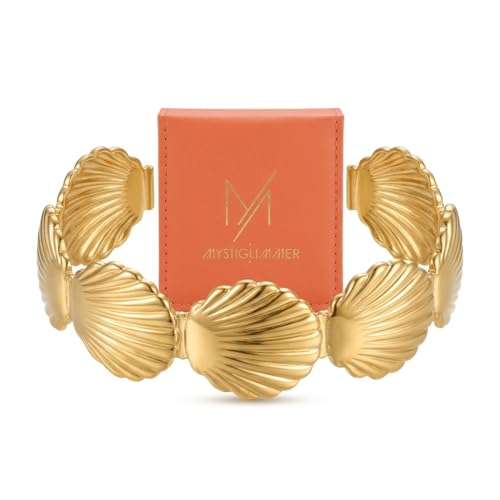
Not every open cuff should be repeatedly bent. BE & CHEERY specifically notes that firm pressure may be required for adjustment, while other listings describe gentle bending or flexible adjustment. Treat those descriptions as product-specific instructions rather than assuming every plated cuff has the same tolerance. If a bracelet has an unusual shape, such as the POTESSA twist or MystiGlimmer’s seashell theme, the opening may be part of the visual design as well as the fit system.
Match the measurements to your wrist
Measurements are particularly important for a cuff because an open bracelet may still have a fixed inner diameter or a limited adjustment range. PAVOI gives a 6.5- to 7.5-inch wrist range. The mulanci listing identifies a 60 mm inner diameter and a suggested 6- to 6.8-inch wrist range. BE & CHEERY provides a 2.56-inch inner diameter and approximately 7-inch inner circumference, while MAIKERDER specifies a 2.5-inch inner diameter.
Compare those figures with your own wrist measurement before choosing a design. A smaller inner diameter can be more suitable for a narrower wrist, but the listing may also warn that a style is intended for slender or ordinary wrist sizes. Conversely, a wide cuff can have a visually generous profile without offering unlimited adjustment. When a listing only says “adjustable,” as with RATVIU or Kendra Scott Elton, the absence of a numeric range means fit is less precisely documented.
Look past the karat number
A 14K or 18K label describes the gold-plating specification supplied by the listing; it does not, by itself, explain the underlying bracelet material. The selected products show several approaches. BE & CHEERY and RATVIU identify stainless steel bases, HZMAN identifies brass, and PEARLADA identifies copper. MAIKERDER and mulanci do not identify a base metal in the supplied specifications, so their material profiles are less complete.
Base-metal information matters when you are comparing weight, structure, and skin-contact details. BE & CHEERY names 316 stainless steel, while RATVIU names stainless steel and describes it as hypoallergenic. PAVOI documents hypoallergenic, nickel-safe, lead-safe, and cadmium-compliant characteristics, although its supplied specifications do not name the base metal. These details should be read as listing claims, not as a substitute for independent material verification.
Choose the surface treatment that fits your wardrobe
Plain polished cuffs are the easiest to coordinate with other jewelry. MAIKERDER has a high-polish surface and rounded edges, while BE & CHEERY describes a smooth gold-plated surface. These profiles work when you want the bracelet to remain a clean supporting detail.
Texture creates more visual emphasis without requiring stones. PEARLADA uses a plaid or lattice-like pattern, POTESSA uses an irregular twist and grooves, and HZMAN adds brushed texture and milgrain edging. These are useful choices when the bracelet itself is intended to be the focal point. A wide design such as POTESSA may need less additional wrist jewelry because its silhouette already occupies more visual space.
Stone accents create another level of decoration. Kendra Scott Elton uses a rose quartz colorway, mulanci documents select cubic-zirconia-accent styles, and HZMAN combines multicolor cubic zirconia with a vintage Byzantine design. Check whether the stones are central to the selected variant, since the mulanci listing describes several finish and clasp styles rather than one single configuration.
Gold-plated jewelry generally benefits from following the care instructions supplied for the specific product. The Kendra Scott listing advises removing the bracelet before hand washing, swimming, exercising, cleaning, and applying personal-care products.
Some listings use terms such as waterproof, rust-resistant, or tarnish-resistant. Those descriptions are part of the supplied product evidence, but they do not remove the need to check the maker’s care guidance. Plating is a surface layer, and the listings do not provide a universal thickness or wear timeline. For a specification-based comparison, the most supportable conclusion is that care requirements vary by product and should be followed as written.
Decide between a single cuff and a stack
A single cuff makes the design easier to evaluate and lets a textured or stone-accented piece stand alone. PEARLADA, mulanci, and MAIKERDER explicitly support solo or stackable styling in their supplied descriptions. A narrow, smooth bracelet can also serve as a base layer under more decorative pieces, but the listings do not establish that all combinations will fit comfortably together.
For a coordinated stack, compare widths and surface treatments rather than choosing several pieces with the same visual weight. A smooth MAIKERDER-style profile can balance a textured PEARLADA design, while a wide POTESSA cuff may be better worn alone. These are styling inferences from the documented shapes, not hands-on performance findings.
Final Recommendation
PAVOI Adjustable 14K Gold-Plated Bangle ranks first overall in this specification-based comparison under the published weighted criteria.
PAVOI Adjustable 14K Gold-Plated Bangle is the first overall specification-based choice among these best gold-plated cuff bracelets. Its documented 6.5- to 7.5-inch range, 14K yellow-gold plating, and detailed skin-contact standards make the listing unusually useful for comparing fit and material information.
BE & CHEERY is a close alternative when a named 316 stainless steel base and dimensional information matter most. RATVIU suits a simpler open cuff with a distinctive lip-link motif, while MystiGlimmer is the more thematic selection for a seashell and starfish design. HZMAN and POTESSA provide more pronounced decorative silhouettes, and PEARLADA adds a plaid texture for stacking.
The top gold-plated cuff bracelets in this comparison cover different priorities rather than one universal shape. Before choosing, match your wrist measurement to the supplied dimensions, decide whether you want a plain, textured, stone-accented, or themed finish, and review each listing’s care language. Those checks provide a more dependable basis for selection than the gold-karat number alone.
Frequently Asked Questions
How should I choose among the best gold-plated cuff bracelets for fit?
Start with products that provide a numeric range or inner diameter. PAVOI lists a 6.5- to 7.5-inch wrist range, mulanci lists a 60 mm inner diameter and 6- to 6.8-inch wrist guidance, and BE & CHEERY provides both an inner diameter and approximate circumference. If a listing only says adjustable, compare the design and adjustment description carefully because the fit is less precisely documented.
What is the difference between 14K and 18K gold-plated cuffs?
The supplied listings use 14K and 18K as plating descriptions. They do not provide a universal plating-thickness standard or a direct durability comparison between the two numbers. For a more complete material picture, check the base metal and any skin-contact details. HZMAN identifies brass with five layers of 14K plating, while PEARLADA identifies copper with 18K plating.
Are open cuffs better for stacking?
An open cuff can be convenient for putting on and taking off, and several selected products describe stackable styling. However, stacking depends on width, shape, and how much visual space each piece occupies. Narrow polished designs are generally easier to combine visually, while wide or heavily textured cuffs such as POTESSA or HZMAN may be better treated as the main bracelet in a stack.
Which selected cuff has the most decorative detail?
HZMAN documents brushed texture, milgrain edging, and multicolor cubic zirconia. Kendra Scott Elton uses a rose quartz colorway, while MystiGlimmer uses starfish and seashell elements. These designs are more visually specific than plain polished cuffs, so consider whether you want a centerpiece or a neutral bracelet for combining with other jewelry.
Read the product-specific care instructions before wearing the bracelet around water, during exercise, or with personal-care products. The Kendra Scott listing specifically advises removing the cuff for hand washing, swimming, exercising, cleaning, and contact with products such as lotion or perfume. Other listings use water- or tarnish-resistance language, but the supplied evidence does not establish identical care requirements for every design.