Buying Guide
The best gold-plated hoop earrings are easier to compare when the listing separates the gold finish from the underlying material and gives practical dimensions. In this comparison, the selected products range from 6 mm huggies to 70 mm flattened hoops, so the right choice depends first on scale, then on construction and fastening details.
Start with the plating and base material
Look for a listing that identifies both the gold finish and the material beneath it. PAVOI’s chunky 30 mm pair documents 14K yellow-gold plating over stainless steel. Amazon Essentials identifies yellow 18K gold plating over stainless steel for its 70 mm flattened half-moon design. Several other selections, including Gacimy’s 20 mm flatted hoops and OOOPEL’s 50 mm hoops, state 14K plating while identifying sterling silver posts.
The plating description tells you the intended color and finish, but it does not by itself describe the entire earring. A product may use a plated copper hoop with a different post material, as stated for OOOPEL and Geveay. That distinction matters if you are comparing earrings for sensitive ears or want to understand the construction more fully. Claims such as nickel-free, lead-free, hypoallergenic, or compliance with named standards are listing statements; they are useful evidence, but they are not substitutes for knowing your own sensitivities.
Match diameter to the look you want
Diameter changes the visual impact more than brand wording does. The selected PAVOI chunky hoops are 30 mm, while Gacimy’s flatted pair is 20 mm. Those moderate sizes can work when you want a visible hoop without the scale of a dramatic statement earring. The sovesi pair is also 30 mm, but its 5 mm hollow tube creates a thicker appearance.
For a larger look, Gacimy lists a 60 mm thin hoop, OOOPEL provides a 50 mm selection within a 30/40/50/60 mm range, and Amazon Essentials lists a 70 mm flattened hoop with additional 40, 50, and 60 mm choices. Large sizes can frame the face more prominently, but the listing’s weight and thickness information should be checked alongside diameter. A large hoop is not automatically heavy, and a thin or hollow profile may change how substantial it feels; however, public listing claims should not be treated as hands-on comfort testing.
Choose a huggie or a larger hoop
Huggies sit closer to the ear and are the most compact option in this selection. PAVOI’s 13 mm huggies are specifically described for a second hole. BESTEEL lists 7, 10, and 12 mm inner diameters, while FriBasics includes five sizes from 6 to 14 mm. These formats suit users comparing multiple piercings, stacking options, or a restrained single-hoop look.
A conventional large hoop creates more open space below the lobe. The Gacimy 60 mm pair and Amazon Essentials 70 mm pair document that larger scale, while the OOOPEL 50 mm model uses a 3 mm width. If you are unsure, compare the stated diameter with an earring you already own. Inner diameter is especially useful for huggies because it gives more information about how much room the hoop may have inside the opening.
Consider thickness and profile
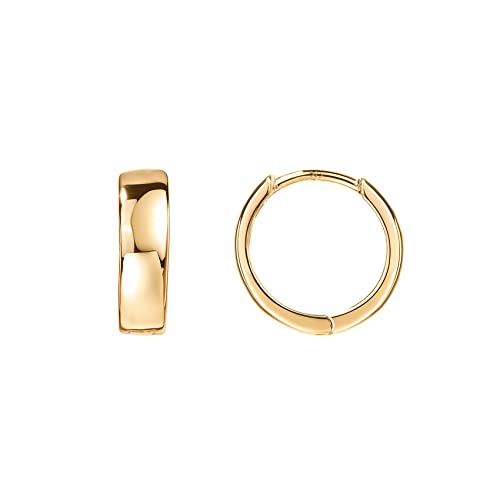
Thickness affects whether a hoop reads as fine, chunky, flatted, or sculptural. The sovesi listing gives a 5 mm thickness, PAVOI gives 4.5 mm, and OOOPEL gives 3 mm. By contrast, Gacimy’s 20 mm flatted hoops are listed at 0.1 inch thick, while its 60 mm hoops are 0.07 inch thick. These details help distinguish a broad, bold design from a thin outline even when two products share a similar diameter.
Shape also matters. Geveay uses layered lines in a twist design, sovesi uses a hollow tube, and Amazon Essentials uses a flattened half-moon profile. The PAVOI 30 mm pair is a bold classic design, while the Gacimy 20 mm pair is flatted and polished. Choose a plain round hoop for simplicity, a twist for texture, or a flattened profile when you prefer a broader reflective surface.
Check the post and clasp information
A post material can be more informative than a general statement about the hoop. Gacimy, OOOPEL, Geveay, and sovesi each identify 925 sterling silver posts in their supplied descriptions. BESTEEL and FriBasics provide more information about small huggie sizing but less detail about the base metal or fastening hardware.
Closure details vary across the selected products. OOOPEL and sovesi specify secure click-top clasps, and BESTEEL describes flexible clasps. Other listings identify a secure clasp without naming its exact mechanism, while some do not provide closure information. If you regularly remove earrings or prefer a particular fastening style, prioritize listings with explicit clasp descriptions rather than assuming all hoops use the same hardware.
Use care instructions as part of the comparison
Care guidance is not equally detailed across listings. Amazon Essentials specifically says to wipe the earrings with a dry cloth only. BESTEEL recommends cool, dry storage in a lined jewelry box or closed plastic bag and advises preventing wear and scratches. Those directions are practical because plated surfaces can require different handling from solid precious-metal jewelry. Do not extend a listing’s care statement into an unsupported promise about how long a finish will last.
Final recommendation
OOOPEL 14K Gold-Plated Large Hoops, 50 mm ranks first overall in this specification-based comparison under the published weighted criteria.
The final choice among the best gold-plated hoop earrings depends on the documented features that match your intended use.
PAVOI Chunky 14K Gold-Plated Hoops, 30 mm is the first overall specification-based choice among these selections. Its 14K yellow-gold plating, stainless-steel construction, 30 mm diameter, 4.5 mm thickness, and detailed material-compliance statements make it a well-documented all-purpose comparison candidate. The top gold-plated hoop earrings for a large, thin silhouette are Gacimy’s 60 mm hoops or OOOPEL’s 50 mm model, depending on whether you prefer a very thin profile or a 3 mm width with a named click-top clasp. For compact stacking, compare the PAVOI 13 mm huggies, BESTEEL’s three sizes, and FriBasics’ five-size set. For a decorative finish, Geveay’s twist design provides texture without relying on stones or extra embellishment.
Frequently Asked Questions
What should I check first when choosing the best gold-plated hoop earrings?
Check the stated plating, base material, post material, diameter, thickness, and closure. A complete listing makes it easier to compare a 14K-plated copper hoop with a stainless-steel hoop carrying an 18K-plated finish. If you have sensitive ears, pay particular attention to the material and nickel-free or lead-free claims supplied by the manufacturer.
Are large hoops always heavier than small hoops?
Not necessarily. The supplied listings show that construction matters alongside diameter. Gacimy describes its 60 mm hoops as thin and lightweight, while sovesi describes its 30 mm hoops as hollow. These are listing claims, not independent measurements, so use the stated thickness and weight information as comparison points rather than guarantees of how an earring will feel.
Which selected earrings are designed for stacking?
BESTEEL lists 7, 10, and 12 mm inner diameters for mixing across multiple piercings. FriBasics provides five small sizes from 6 to 14 mm, and PAVOI identifies its 13 mm huggies as suitable for a second hole. These designs are more directly oriented toward compact layering than the 50, 60, or 70 mm large hoops.
Do gold-plated hoops need special care?
Follow the instructions supplied with the specific product. Amazon Essentials says to use a dry cloth only, while BESTEEL recommends cool, dry storage and protection from scratches. The evidence does not support one universal care routine for every plated hoop, so avoid adding cleaning or exposure claims that the listing does not provide.
OOOPEL and sovesi specify secure click-top clasps, and BESTEEL describes flexible clasps. Gacimy identifies a sturdy secure clasp on its 60 mm pair and a similar secure clasp on its 20 mm flatted pair. Several other listings do not name the clasp type, so verify the current product details if fastening hardware is a deciding factor.