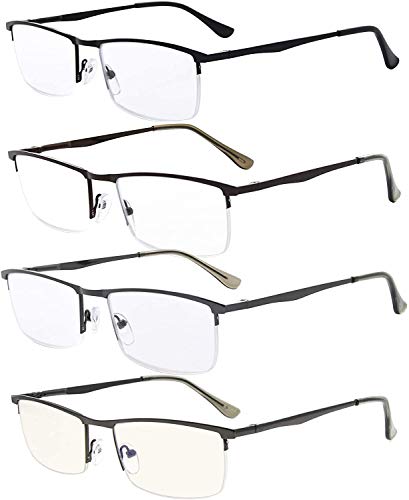
Buying Guide
Choosing the best half-rim reading glasses starts with understanding what the lower lens area is meant to do. Most products in this comparison use a half-moon or flat-top layout so the wearer can look down through the magnified area and look above it toward the surroundings. Other selected products use a fully magnified lens inside a half-rim frame, while DEHOTRE documents a bifocal layout with a clear upper field and a reading-powered lower field. These are different designs, so the right choice depends on how often you move between close work and distance viewing.
Choose the lens layout first
A standard half-moon reader is useful when you want close-up magnification available at the bottom of the frame without covering the upper field. TOVEEN, touk, Viseng, Henotin, COVESATO, and The Shay all describe this general look-down-to-read approach. This design can suit reading labels, books, documents, and screens while allowing the wearer to glance over the lenses.
The Shay is different in one important respect: its listing calls the lens fully magnified even though the frame is semi-rimless and half-moon shaped. The Parker also describes a fully magnified lens in a rectangular half-rim frame. That may appeal to someone who wants the visual style of a half-rim but prefers magnification across the lens area. The listing evidence does not establish that either design will suit every distance-viewing routine, so shoppers should distinguish frame style from lens layout.
DEHOTRE is the clearest bifocal option in the selection. Its listing describes a clear upper portion for distant viewing and full-power magnification below. That arrangement is not the same as a simple half-moon reader. If you specifically want two documented viewing fields, it deserves consideration; if you want an unobstructed upper area with no stated distance prescription, a conventional half-moon model may be a closer match.
Compare frame materials and fit details
Metal and plastic both appear in the selected products. Metal frames can provide a slim semi-rimless appearance, but the supplied listings do not establish that one material is universally more comfortable or durable.
Fit information varies considerably. Eyekepper gives the most complete dimensional set, including a 53mm lens width, 17mm bridge, 138mm frame width, 31mm lens height, and 140mm temple length, along with a narrow head-size designation. The Shay lists a 128mm frame width, 31mm frame height, 23mm bridge, and 136mm temples for a narrow fit. Parker provides average-fit measurements, including a 132mm frame width and 17mm bridge. These details are more useful for comparison than a generic small or medium label.
Nose pads and hinges are also worth checking. Spring or spring-loaded hinges appear on many selections, including Viseng, Boost Eyewear, Henotin, The Shay, Eyekepper, and COVESATO. A spring hinge may allow temple movement, but the supplied evidence does not provide a standardized fit measurement or hands-on comfort result.
Review lens features for your routine
TOVEEN and touk list anti-blue-light and UV400 features, while DEHOTRE lists blue-light and UV lens treatments. These are listing claims about lens features, not independent test findings, so they should be treated as specifications rather than outcomes established through testing.
Other lens details may matter more if you do not need screen-related features. The Shay and Eyekepper identify aspheric lenses, while Parker lists scratch-resistant lenses. Viseng describes plastic lenses, and TOVEEN and touk identify anti-reflective resin lenses. Compare the feature you actually need rather than assuming every half-rim reader uses the same lens construction.
The best half-rim reading glasses are still dependent on selecting a suitable strength. The supplied candidates list different fixed strengths, ranges, or selectable options. Henotin documents the widest range, from 0.00 through 4.00. Other selected listings identify a particular strength, such as TOVEEN at +2.25, touk at +2.5, Viseng at +2.5, DEHOTRE at 2.50, Eyekepper at +1.50, and COVESATO at +2.00.
A broad range gives more selection on the listing, but it does not determine which strength is appropriate for an individual. If you already know the strength you use, check that the exact model and selected variation match it. If you are uncertain, an eye-care professional can help determine whether ordinary readers are appropriate and what correction is needed. The supplied product evidence cannot establish a personal prescription.
Consider multipacks and storage
Multipacks can be useful when you want readers in several places. Boost Eyewear lists six pairs at one strength, Henotin four pairs, Eyekepper four pairs, and TOVEEN, touk, Viseng, DEHOTRE, and COVESATO list two-pair formats. The Shay and Parker include a microfiber cleaning carrying case, while Viseng includes soft pouches and a cloth. TOVEEN lists two hard cases, and touk lists hard cases and anti-lost cords.
A larger set is not automatically better. Six identical-strength pairs make the most sense when you want consistent readers in multiple locations. A four-pair color mix may be more useful when frame variety matters. A two-pair set can be enough when you want a spare without storing several identical frames. Check whether the package includes cases, pouches, cloths, or cords, because those contents differ by product.
Final recommendation
TOVEEN Half Lens Readers ranks first overall in this specification-based comparison under the published weighted criteria.
The final choice among the best half-rim reading glasses depends on the documented features that match your intended use.
TOVEEN Half Lens Readers are the highest-scoring returned product and the first overall specification-based choice. They document the essential half-moon function, adjustable silicone nose pads, spring hinges, anti-blue-light and UV400 features, a stated 16.7g weight, two pairs, and two hard cases. For shoppers comparing the top half-rim reading glasses, touk is a close alternative with a similar lightweight half-moon concept, anti-reflective resin lenses, and portable accessories.
Henotin is the better fit for shoppers prioritizing a broad magnification range and four color-mix pairs. Boost Eyewear is the practical multipack choice when six identical-strength pairs are more useful than several strengths. Viseng and COVESATO focus on slim metal half-rim construction, with COVESATO adding adjustable nose pads. The Shay and Parker provide more specific shape and dimension information, with The Shay aimed at narrow fits and Parker offering a rectangular style. DEHOTRE is the specialized bifocal option, and Eyekepper is the most specification-aligned measurement-led selection for comparing a narrow metal frame.
No single design covers every reading routine. Start with whether you want a half-moon, fully magnified, or bifocal lens layout; then compare strength, frame measurements, fit components, lens features, and package contents. That sequence keeps the selection grounded in the documented specifications rather than assumptions about comfort or performance.
Frequently Asked Questions
What are half-rim reading glasses?
Half-rim reading glasses are readers with a partial frame or semi-rimless construction around the lens. Several selected models use a half-moon or flat-top lens arrangement that places the reading area lower in the frame. The Shay and Parker show that a half-rim frame can also contain a fully magnified lens, so shoppers should check the lens description rather than relying on the frame name alone.
Are the best half-rim reading glasses suitable for computer use?
Some selected products are specifically described for screen-related use. Those features are listing specifications, not independent performance results. For computer work, also compare the lens layout, because a lower reading segment and a fully magnified lens provide different viewing arrangements.
How do I choose between half-moon and bifocal readers?
A half-moon design generally places the reading area below the upper line of sight, as described for TOVEEN, Viseng, and Henotin. DEHOTRE documents a bifocal arrangement with a clear upper field and magnified lower field. Choose based on whether you want a simple lower reading area or two stated fields of view. If you need prescription distance correction, the supplied product descriptions cannot determine whether an over-the-counter reader is appropriate.
Which selected product provides the most magnification choices?
Henotin documents choices from 0.00 through 4.00. Confirm the exact strength variation before ordering because the selected listings also identify specific displayed strengths.
Look for frame width, lens width, bridge width, temple length, and any stated head-size designation. Eyekepper provides a narrow head-size label and several measurements; The Shay identifies a narrow fit with a 128mm frame width; Parker lists average-fit dimensions. TOVEEN, touk, and COVESATO add adjustable silicone nose pads, while spring hinges appear across several selected models. These specifications help comparison, but they do not replace an individual fit assessment.