Buying Guide
The best halogen vanity lighting fixtures are usually standard wall-mounted vanity units that accept E26 bulbs. In this comparison, the listings document three main design variables: the number of sockets, the shade material, and whether the body can be installed facing up or down. Those details matter because a halogen bulb choice alone does not determine how broadly or softly the fixture will illuminate a mirror.
Match fixture width to the mirror
Start with the wall space and mirror width. The DIKAIDA fixture is 29.9 inches long and has five lights, while the Ascher and MOKATNG four-light models measure 26.8 and 27.2 inches respectively. These are the clearest choices in the group when a wider vanity needs more evenly distributed bulb positions. A larger body can also look disproportionate above a small mirror, so measure the available wall area before choosing.
The compact options serve a different purpose. FonmYim measures 17.3 inches and is specifically listed for 24- and 30-inch mirrors. IZORRO measures 17.7 inches and documents pairing two fixtures for a large mirror. Lanhall is also listed at approximately 17.5 inches, making it a practical size for a smaller wall section. The 24.4-inch Spiglamm fixture occupies the middle ground and may coordinate with a moderately wide mirror without the length of a four- or five-light bar.
Choose clear or frosted glass
Clear glass shades expose more of the bulb and are used by DIKAIDA, the brushed-nickel Unicozin, Spiglamm, IZORRO, Lanhall, and the black Unicozin. Based on the supplied descriptions, clear glass is the better fit when a visible bulb and more direct-looking illumination are part of the intended style. It also makes the selected halogen bulb more visually prominent, so the bulb shape and finish can become part of the design.
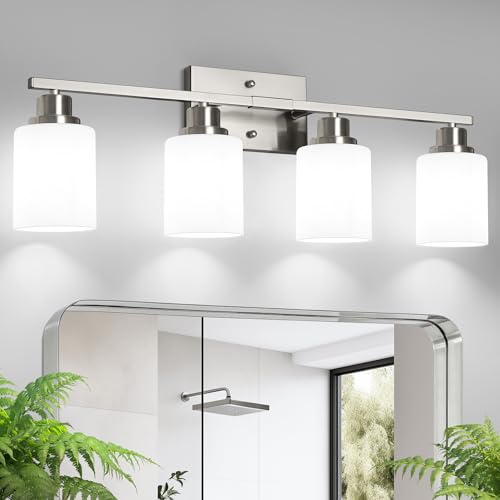
Frosted or milky shades are documented on Ascher, MOKATNG’s four-light fixture, and FonmYim. Their listings describe diffused or softened illumination and reduced harshness. That makes them worth considering when the vanity is used close to eye level or when a less exposed bulb appearance is preferred. The green MOKATNG model uses leaf-textured glass instead. Its listing describes a patterned glow, so it is best understood as a decorative accent rather than a plain, uniform shade.
Every selected product uses an E26-style socket or base, but the evidence is not identical across the group. DIKAIDA, FonmYim, the brushed-nickel Unicozin, IZORRO, and several other listings specifically describe heat-resistant or ceramic sockets. FonmYim additionally identifies its socket as ETL-certified. These are useful specification details for shoppers planning to use halogen bulbs, which produce more heat than many LED alternatives.
The documented maximum is generally 60W per bulb or socket. DIKAIDA states that limit for each of its five sockets, while Ascher, FonmYim, MOKATNG, the brushed-nickel Unicozin, Spiglamm, IZORRO, Lanhall, and the green MOKATNG provide similar limits in their listings. Stay within the fixture’s stated rating and confirm the bulb’s base before installation. The black Unicozin listing gives an E26 socket and a 60W maximum but does not separately name halogen, so it ranks lower for explicit category evidence.
Consider light count and coverage
Light count is a useful comparison point, but it is not a substitute for measuring the space. DIKAIDA has five lights, four-light Ascher and MOKATNG models have broader documented bodies, and most other selected fixtures use two or three sockets. More sockets can distribute bulbs across a longer area, but the final result also depends on the bulbs selected and the shade design. The supplied data does not establish measured brightness, beam spread, or real-world performance, so those factors should not be inferred from light count alone.
The two-light green MOKATNG is better suited to accent placement or a smaller vanity where its textured glass is the main visual feature. For a larger mirror, a three-light IZORRO may be used as a pair according to its listing. This is a documented installation approach, not a guarantee that two fixtures will suit every wall or electrical setup.
Review mounting and installation details
Up-and-down reversibility appears repeatedly in the supplied evidence. DIKAIDA, Ascher, FonmYim, MOKATNG, both Unicozin fixtures, Spiglamm, IZORRO, and Lanhall can be installed in either direction according to their listings. This helps when the shade profile or desired visual orientation needs to change, but it does not remove the need to follow the installation instructions.
These products are wall-mounted and hardwired rather than plug-in accessories. DIKAIDA, Lanhall, and the black Unicozin explicitly reference wall or hardwired installation, while several listings say mounting hardware and instructions are included. Lanhall specifically mentions a US standard junction box. Even with included hardware, electrical work may require appropriate knowledge or a qualified installer. Check junction-box compatibility, wall clearance, fixture dimensions, and local requirements before purchase.
Compare finish and room placement
Finish should coordinate with the surrounding hardware. Matte black appears on DIKAIDA, MOKATNG, Lanhall, IZORRO, and the black Unicozin. Brushed nickel is used by Ascher, FonmYim, and the brushed-nickel Unicozin, while Spiglamm combines black and nickel. The green MOKATNG adds brushed-gold accents and leaf-textured glass. These fixtures are described for bathrooms, but several are also listed for bedrooms, hallways, porches, cabinets, or dressing tables.
The top halogen vanity lighting fixtures in this list differ mainly in how directly they document bulb compatibility, socket construction, and intended coverage. Use the scores as an evidence-based comparison, then verify the current installation requirements and bulb rating for the specific fixture you select.
Final Recommendation
Among the top halogen vanity lighting fixtures, the ranked products differ under documented halogen bulb compatibility, socket and heat handling, shade and light distribution, fixture coverage and light count, and mounting and installation flexibility.
DIKAIDA 5-Light Black Vanity Fixture ranks first overall in this specification-based comparison under the published weighted criteria.
DIKAIDA 5-Light Black Vanity Fixture is the highest-scoring returned product and the first overall specification-based choice. Its 29.9-inch width, five E26 heat-resistant sockets, clear glass shades, and reversible mounting give it the most specification-aligned documented combination of coverage and halogen readiness in this group.
Choose Ascher if frosted shades and a wide four-light layout are more important than clear-glass styling. MOKATNG’s 4-Light Matte Black fixture is another strong broad-coverage option, with milky shades and a 27.2-inch body. For a compact installation, FonmYim offers a 17.3-inch format, frosted glass, and documented dimming compatibility. The brushed-nickel Unicozin is a balanced three-light alternative with heat-resistant ceramic sockets, while IZORRO is useful when a paired installation may be needed for a larger mirror.
For a decorative statement, the green MOKATNG fixture has leaf-textured glass and two lights. Spiglamm suits mixed black-and-nickel hardware, Lanhall fits farmhouse-oriented rooms, and the black Unicozin provides a straightforward clear-glass three-light layout. Across all choices, confirm the E26 bulb rating, maximum wattage, wall dimensions, and wiring arrangement before installation. These specifications help narrow the best halogen vanity lighting fixtures, but they do not replace checking the product’s installation instructions.
Frequently Asked Questions
Among the best halogen vanity lighting fixtures, are these fixtures compatible with halogen bulbs?
Most selected products explicitly list halogen compatibility with E26 sockets, generally up to 60W per bulb or socket. DIKAIDA, Ascher, FonmYim, both MOKATNG fixtures, the brushed-nickel Unicozin, Spiglamm, IZORRO, and Lanhall provide that evidence. The black Unicozin lists E26 and incandescent compatibility but does not separately name halogen, so verify the manufacturer’s current instructions before using one.
Do the fixtures include bulbs?
The supplied listings commonly state that bulbs are not included. That is explicit for Ascher, FonmYim, the brushed-nickel Unicozin, MOKATNG, Spiglamm, IZORRO, and Lanhall, and the other listings also describe bulb compatibility without supplying bulb specifications. Plan to purchase compatible E26 bulbs separately and remain within the stated wattage limit.
Can these vanity lights be mounted facing up or down?
Yes, the listings document reversible up-or-down mounting for all of the selected products except where the evidence is less specific about the exact hardware arrangement. DIKAIDA, Ascher, FonmYim, MOKATNG, both Unicozin fixtures, Spiglamm, IZORRO, and Lanhall explicitly describe this flexibility. Follow the included instructions to determine the correct orientation for the shades and wiring.
Which design is better for softer light?
Frosted or milky glass is the clearest documented choice for softer, diffused illumination. Ascher, FonmYim, and the four-light MOKATNG use those shade types. Clear glass fixtures such as DIKAIDA, Spiglamm, IZORRO, and Lanhall are described with transparent or clear shades and may provide a more exposed-bulb appearance. The green MOKATNG’s textured glass is a decorative alternative that creates a patterned effect.
How should I size a vanity fixture for my mirror?
Measure the mirror and the available wall area, then compare those dimensions with the fixture length. FonmYim is listed for 24- and 30-inch mirrors, while the wider DIKAIDA, Ascher, and MOKATNG four-light fixtures are better suited on paper to broader spaces. IZORRO’s listing documents pairing two units for a large mirror. These are listing-based guidelines, not a guarantee of fit, so also check the junction box and mounting surface.