Buying Guide
The best hanging tie racks are defined by more than the number of hooks in a title. A useful comparison should consider how the rack attaches to the closet, how ties are retained, how easily the collection can be viewed, and whether the organizer also handles belts or scarves. The products above are ranked from supplied listing specifications and feature descriptions. They were not hands-on tested, and the comparison does not summarize customer opinions.
Choose the mounting style first
Most selected products are designed to hang from a closet rod or hanger rail. This is generally the simplest option when you want to add storage without drilling. The Amazon Basics 20-Bar Wooden Tie Hanger is described as fitting most standard hanger rails and closet rods. Fitnice also supplies top-hook dimensions, which can help shoppers compare the organizer with the available rod before ordering.
A wall-mounted model can make use of a door, wall, or another vertical surface. TieMaster is the selected example of this design and is described as installing with screws or 3M tape. Its wall-based format may help when a closet rod is crowded, but installation becomes part of the purchase decision. Check whether the intended surface can accept the installation method.
The best hanging tie racks for small closets are not necessarily the narrowest products. A rack that projects outward, has folding hooks, or needs room for ties to hang freely can affect the clearance around it. Check both the rack dimensions and the space below the rod or mounting point.
Match capacity to the collection
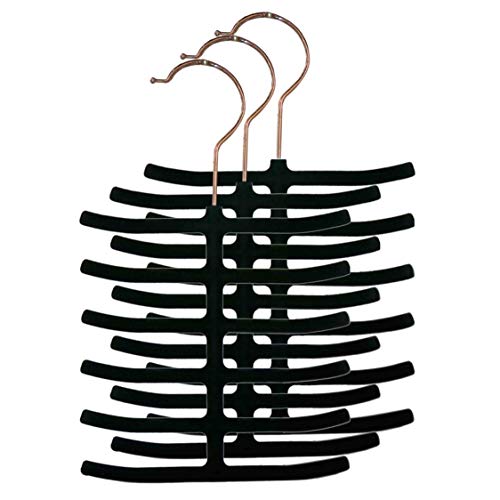
A rack with 20 hooks can suit a medium collection, while 24-hook designs provide additional room for larger wardrobes. Ohuhu and TOPIA HANGER’s cedar model both document 24 tie positions. Mkono, Umo Lorenzo, and Fitnice document 20-hook layouts. Home Basics lists up to 12 ties per hanger, but its three-unit format can help divide accessories among closets.
Capacity wording should be read carefully. Some listings describe several items per hook or use different capacity figures in the title and description. RESOVO’s double-sided design is described with 20 metal hooks on each hanger and also presents a broad belt-and-accessory use case. OMHOMETY describes up to 24 ties, while its title references 30 ties. These differences make layout and documented features more useful than accepting the largest number automatically.
TieMaster has the highest stated capacity in this selection, with 60 ties or scarves and five belt hooks. That figure is relevant for a substantial collection, but the product is wall-mounted and made of plastic, so it serves a different use case from a compact wooden over-rod hanger.
Look for access features
Rotation can make a rack easier to browse when ties are arranged close together. Ohuhu, Mkono, Umo Lorenzo, TOPIA HANGER’s cedar rack, and Home Basics document 360-degree movement in the top hook or hanger. Some products also let individual hooks move: TOPIA HANGER’s cedar design specifies 180-degree clip rotation, while Fitnice describes 180-degree rotating hooks.
Foldability is another access and clearance feature. Ohuhu says its hooks collapse inward when not in use. RESOVO describes foldable hooks, and the TOPIA HANGER cedar model says its clips can fold to save space. These features may reduce the organizer’s profile, but the listing data does not establish a specific clearance amount for every closet.
Bar-style storage is simpler. Amazon Basics uses 20 bars rather than individual rotating hooks. That may suit shoppers who prefer a straightforward wooden layout, while clip or hook designs can provide more separation between individual ties.
Prioritize tie retention
A tie rack should keep neckwear from sliding into the closet floor or becoming tangled with nearby accessories. Ohuhu uses individual clips, TOPIA HANGER’s cedar rack uses stainless steel clips, and Home Basics uses a non-slip velvet finish. Mkono describes inward-bending hook ends, and OMHOMETY describes a hook design intended to secure ties.
Retention claims vary in specificity. A clip directly attaches to the tie, while a bar or open hook may depend on the tie’s position and the holder’s shape. If ties are delicate or frequently moved, a clip-based rack may be appealing. If you want faster loading and unloading, an open hook or bar can be more convenient. The supplied listings do not provide independent fabric-protection testing, so no design should be treated as universally wrinkle-proof.
Consider materials and accessory use
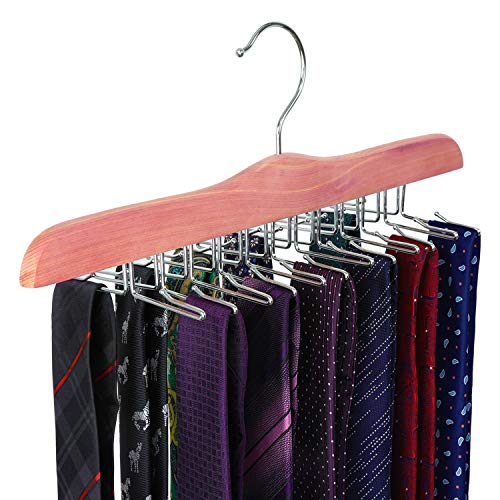
Wooden bodies appear across much of this selection, including Ohuhu, Mkono, Fitnice, Umo Lorenzo, Amazon Basics, and both TOPIA HANGER designs. The listings differ in species, finish, and hardware. TOPIA HANGER documents natural cedar, while Mkono and Umo Lorenzo specify walnut-oriented finishes. Ohuhu combines hardwood with stainless steel hooks.
Plastic can be a practical choice when a glossy finish or a different construction is preferred, but material alone does not determine how well a rack suits a particular closet.
Many of these products are not limited to ties. Belts and scarves are common additional uses, while selected listings also mention tank tops, camisoles, hats, jewelry, or other accessories. Multipurpose claims are useful when documented, but loading several accessory types may reduce the room available for neckwear.
Final recommendation
Ohuhu 24-Hook Wooden Tie Rack ranks first overall in this specification-based comparison under the published weighted criteria.
Ohuhu 24-Hook Wooden Tie Rack is the first overall specification-based choice among the best hanging tie racks under the published criteria. It combines 24 hooks, individual clips, 360-degree access, folding storage, and rust-resistant stainless steel hardware. For cedar construction, TOPIA HANGER’s 24-clip rack is a strong alternative. Mkono is a compact option with 20 inward-bending rotating hooks, while RESOVO suits shoppers who want a foldable, double-sided accessory organizer.
The top hanging tie racks are not identical, so the right choice depends on the closet. Choose Amazon Basics for a simple two-pack bar layout, Home Basics for multiple velvet hangers, or TieMaster when a wall-mounted high-capacity design makes more sense than an over-rod hanger. Check capacity, attachment method, dimensions, and retention style before buying.
Frequently Asked Questions
What should I look for in the best hanging tie racks?
Start with the mounting method and available clearance. Then compare documented tie capacity, hook or bar movement, retention features, materials, and multipurpose storage. A 20-hook organizer can be sufficient for a medium collection, while 24-hook or higher-capacity designs suit larger wardrobes. Also check whether the product hangs from a rod or requires wall installation.
Are rotating hooks useful on a tie rack?
Rotating hooks can make individual ties easier to view and select without moving the entire hanger. Several selected products document 360-degree top-hook rotation, while others specify 180-degree movement for clips or individual hooks. Rotation is an access feature, but the listing data does not establish a universal performance result for every closet arrangement.
Should I choose clips, bars, or open hooks?
Clips directly hold a tie and may provide more secure retention. Bars offer a simple layout, as shown by Amazon Basics. Open or shaped hooks can make loading and removal easier, and Mkono describes inward-bending ends to help prevent sliding. Consider how often you change ties, how delicate the fabrics are, and whether you prefer quick access or a more secured hold.
Can a tie rack also store belts and scarves?
Yes, several selected listings explicitly describe belt and scarf use. RESOVO, Umo Lorenzo, Mkono, Home Basics, and TieMaster all document additional accessory storage in some form. Capacity may change when different accessories share the rack, so treat the stated tie capacity as a separate reference rather than a promise that every accessory combination will fit.
Is a wall-mounted rack better than an over-rod hanger?
Neither style is universally better. An over-rod hanger avoids drilling and can move with the closet arrangement. A wall-mounted rack can free rod space and use a door or wall, but it requires a suitable surface and installation. TieMaster is the selected wall-mounted example; the other products in this comparison are primarily hanging organizers for rods or rails.