Buying Guide
Choosing the best kitchen glass tiles starts with the installation method, not just the color. The selected products fall into two broad groups: peel-and-stick pieces intended for smooth, clean surfaces, and mesh-mounted sheets or individual tiles intended for mortar, adhesive, and grout. The right group depends on the wall condition, the desired permanence, and how much layout work the project can accommodate.
Choose the installation method first
Peel-and-stick products such as Diflart, DICOFUN, and V-MOZZA are designed around adhesive backing. That can simplify a small update because the listings describe no-mortar or no-grout installation. However, adhesive tiles still need a clean, flat surface. Soulscrafts specifically says its mirror hexagon product is not recommended on wet, oily, uneven, or dusty walls, and the same preparation principle is sensible for adhesive backsplash products generally.
Traditional mesh-mounted products take more preparation but offer a more conventional tile installation. SODI MOSAIC, Adedeo, LSDECO, Hominter, Blujellyfish, and Parrotile document mesh-backed formats. Soulscrafts Ice Age is sold as individual pieces rather than peel-and-stick. These formats permit mortar or adhesive placement and grout, and several listings mention cutting sheets for borders or fitting. They are better suited to a planned renovation where the substrate can be prepared properly.
Match coverage to the project
Coverage varies considerably. DICOFUN lists 12.1 square feet per box, while several mesh-mounted options cover 5 square feet. SODI MOSAIC provides five sheets for 5 square feet, Adedeo Grey and Silver provides the same stated coverage, and Hominter, Blujellyfish French Pattern, and Parrotile also document five-square-foot packages. Diflart covers about 4.84 square feet, and Soulscrafts Ice Age covers 4 square feet.
Measure the backsplash in square feet before ordering. Include separate measurements for walls, returns, and areas around outlets. Cutting creates waste, and DICOFUN recommends purchasing at least 10% extra; V-MOZZA recommends additional material for corner cuts. Even when a listing gives exact box coverage, the usable installed area may be lower after trimming and pattern matching.
Consider heat and moisture documentation
Glass is commonly selected for a backsplash because smooth surfaces are associated with straightforward wipe-down cleaning, but individual listings provide different guidance. SODI MOSAIC, LSDECO, Diflart, and the selected mirror and mosaic products document water or moisture suitability. Diflart is the most specific about stove placement, listing heat resistance up to 250°F and a 12-inch safety gap. DICOFUN includes a warning not to touch flame, so it should not be treated as a substitute for a direct-flame surface.
For areas behind a range, follow the product’s stated clearance and installation instructions rather than assuming every glass tile has identical heat performance. For wet areas, check whether the listing calls for sealing seams or using a particular grout. DICOFUN says glass glue or caulk can improve waterproof performance at seams, while mesh-mounted products commonly specify non-sanded grout.
Pick a shape and finish that fits the room
Subway tiles create a directional look. SODI MOSAIC uses a glossy white subway style, Soulscrafts uses a longer 4 x 12-inch format, Diflart uses a green water-wave subway design, and V-MOZZA uses a reflective 3 x 6-inch mirror subway format. These are useful when cabinet lines or counter edges benefit from horizontal emphasis.
Square mosaics produce a more compact rhythm. Parrotile uses 2 x 2-inch squares, while LSDECO uses smaller mosaic chips on a 12 x 12-inch sheet. DICOFUN uses larger adhesive mosaic sheets with smaller internal chips. Mesh-mounted patterns can reduce the work of spacing many individual pieces, although cuts at corners and outlets still require planning.
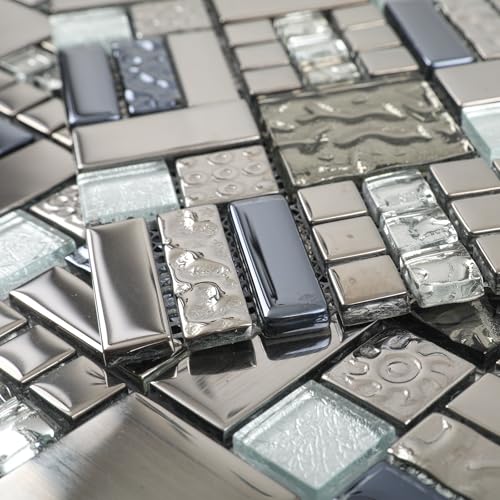
Finish also changes the visual effect. Glossy white glass reflects light in SODI MOSAIC, while V-MOZZA and LSDECO add stronger reflective qualities through mirror or iridescent details. Hominter combines seafoam glass with marble-look pieces and shell accents, and Blujellyfish French Pattern combines blue crystal glass with ice-crackle ceramic elements. These mixed or reflective designs can become the focal point, so sample colors against cabinets and counters before buying enough material for a full wall.
Plan grout, cuts, and cleaning
Read the installation notes before selecting tools. Mesh-backed options may need thin-set or adhesive, and several listings call for non-sanded grout. For the selected V-MOZZA product, the supplied evidence emphasizes measuring and allowing extra material for cuts but does not specify a particular cutter.
Smooth glass surfaces are generally presented in the listings as easy to clean, but decorative combinations deserve attention. Metal, shell, ceramic, and stone-look components may have different care needs than a uniform glass tile. Use the product’s own cleaning and grout instructions, and avoid treating a general claim about one material as a guarantee for every part of a mixed mosaic.
Final recommendation
SODI MOSAIC Glossy White Glass Subway Tile ranks first overall in this specification-based comparison under the published weighted criteria.
SODI MOSAIC Glossy White Glass Subway Tile is the first overall specification-based choice among these best kitchen glass tiles because it combines clear 6 mm glass construction, mesh-mounted sheets, five-square-foot coverage, and stated kitchen heat and moisture resistance. It is a practical starting point for a conventional white backsplash.
For a simpler adhesive project, Diflart offers genuine water-wave glass and unusually specific stove-clearance guidance. DICOFUN is the coverage-oriented pick for a larger peel-and-stick area. Soulscrafts Ice Age and Parrotile suit shoppers who prefer thicker or square-format conventional tile. For decorative impact, consider LSDECO, Hominter, or Blujellyfish French Pattern. V-MOZZA is the reflective mirror choice, while Adedeo provides a restrained grey-and-silver middle ground.
The top kitchen glass tiles are not interchangeable: installation, substrate condition, heat exposure, coverage, and finish all affect suitability. Confirm the wall measurements, buy enough material from the same production batch when possible, and follow the chosen product’s instructions for adhesive, grout, clearance, and cleaning.
Frequently Asked Questions
Are the best kitchen glass tiles peel-and-stick or mesh-mounted?
Both types appear in this comparison. Diflart, DICOFUN, and V-MOZZA use adhesive backing, while SODI MOSAIC, Adedeo, LSDECO, Hominter, Blujellyfish, and Parrotile use mesh-mounted sheets. Peel-and-stick products need a smooth, clean surface; mesh-mounted products generally require conventional adhesive or mortar and grout.
Which selected tile gives the most coverage per package?
DICOFUN documents 12.1 square feet per box, the largest stated coverage in this selection. Several mesh-mounted products document 5 square feet per package. Actual installed coverage will depend on cuts, layout, outlets, corners, and any recommended allowance for waste.
Can glass backsplash tile be used behind a stove?
Some selected products document heat suitability, but their instructions differ. Diflart lists resistance up to 250°F and calls for a 12-inch safety gap behind stoves. DICOFUN warns not to touch flame. Always follow the specific product’s heat guidance and required clearances rather than relying only on the word glass.
What grout should be used with these tiles?
Several mesh-mounted listings specify non-sanded or sandless grout, including SODI MOSAIC, LSDECO, and Blujellyfish French Pattern. Follow the selected product’s instructions and confirm compatibility with the tile finish before installation. Adhesive products such as DICOFUN may not require conventional grouting, although its listing discusses sealing seams in wet areas.
Extra material helps cover cuts and layout adjustments. DICOFUN recommends at least 10% extra, and V-MOZZA recommends additional material for corner cuts. Measure the complete backsplash, calculate coverage, and account for outlets, corners, pattern matching, and damaged pieces before placing the order.