Buying Guide
Choosing the best kosher food coloring starts with the recipe and the decorating method. The products in this comparison are not interchangeable: a gel is designed for controlled tinting, a powder is useful when dry ingredients or natural color sources matter, petal dust is intended for surface decoration, and oil-based coloring is generally a separate design for chocolate and candy. Only designs documented by the selected listings are discussed here.
Gel is the most broadly represented format in this comparison. Ann Clark, Wilton, U.S. Cake Supply, and ENCO describe gel products for icing, frosting, buttercream, fondant, batter, cakes, cupcakes, or cookies. Gel is a practical middle ground because the listings emphasize concentrated color and drop-by-drop control. If you decorate several types of baked goods, a multi-color gel kit may be easier to match to different projects than a single-shade product.
Liquid food coloring is represented by Watkins and McCormick. McCormick documents baking, frosting, egg dye, and selected craft uses, while Watkins describes four plant-derived colors. Liquid bottles can be useful when you want primary shades for mixing or a set that can serve seasonal projects as well as food decoration. The supplied Watkins listing does not document kosher certification, so check the package if that requirement is essential.
Powder has a different workflow. Color Kitchen describes adding its powder to dry ingredients or blending it into prepared frosting. Supernatural also documents powder use across baking and decorating projects, with a stated heat-resistance claim. Powders may be a good fit for shoppers seeking plant-based or dye-free positioning, but the evidence does not establish that every powder behaves identically in every recipe. Follow the maker’s application directions.
Petal dust is a specialist option. Oh! Sweet Art describes an edible, food-grade kosher dust for matte color on gum paste shapes and molds. It is not water soluble, which is an important design distinction rather than a defect. The listing says it can be mixed with lemon extract for painting, so it is better suited to details and molded decorations than to tinting a large bowl of icing.
Markers serve a different purpose again. FooDoodler is listed as a 10-color kosher food-coloring marker set. Its compact format is relevant for writing, outlining, and small surface accents, but the supplied evidence does not document use in batter, frosting, or fondant. Treat it as a detail tool rather than a substitute for a mixing color.
Match palette size to the project
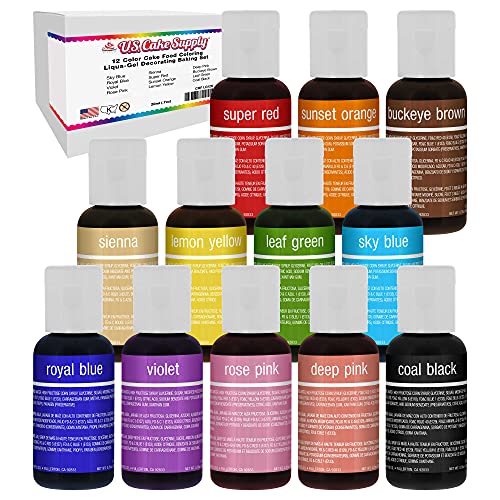
A 12-color kit gives the widest documented base palette among the selected gel options. Ann Clark and U.S. Cake Supply both list 12 colors, while Wilton lists eight and Color Kitchen lists six. More colors can reduce the need to blend shades, but a smaller set may be sufficient when you mainly use primary colors. Supernatural and Oh! Sweet Art are more specialized four-color choices, and ENCO is a single red shade for focused use.
Look at the actual named colors instead of relying only on the count. Ann Clark lists super black, super red, royal blue, regal purple, bubblegum pink, pumpkin orange, lemon yellow, leaf green, ocean teal, sky blue, mocha brown, and vivid fuchsia. Wilton includes brown and violet alongside common baking shades. These details matter when a project needs a dark neutral, a warm accent, or a specific bright family.
Review dietary and certification wording carefully
Kosher documentation varies in specificity. Ann Clark, U.S. Cake Supply, Wilton’s eight-count set, McCormick, Color Kitchen, Supernatural, Oh! Sweet Art, and FooDoodler each provide an explicit kosher statement in the supplied listing. ENCO qualifies its wording by saying select colors are kosher and vegan. Watkins provides natural and dye-free claims but does not state kosher certification in the supplied evidence.
Natural positioning is also not the same as kosher certification. Color Kitchen and Supernatural describe plant-based or naturally derived powders, while ENCO describes natural ingredients and no artificial dyes or preservatives. Watkins names beet juice, turmeric, and spirulina extract. These claims can help with ingredient preferences, but they should be considered separately from certification language.
Allergen notes deserve attention too. Ann Clark lists the product as free of several allergens, while Wilton states that its manufacturing equipment also processes multiple allergens. That information does not determine how a color performs, but it is relevant when selecting supplies for a sensitive kitchen. Use the label and current package information for the final check.
Consider recipe-specific constraints
For icing, buttercream, fondant, batter, and cookies, the selected gel products provide the clearest documented coverage. U.S. Cake Supply additionally describes freeze tolerance, while Wilton says its gel formula is intended not to change icing or batter consistency. These are listing claims, not independent test results, so they should be read as stated specifications.
Chocolate and candy require extra care because the supplied candidates include oil-based designs that are not selected for this kosher-focused top 10. The evidence describes those products as intended for chocolate, candy, mousse, and candy melts, but it does not document kosher status. Do not assume that a coloring’s suitability for chocolate also establishes certification.
Final recommendation
Ann Clark Professional-Grade Gel Food Coloring ranks first overall in this specification-based comparison under the published weighted criteria.
Ann Clark Professional-Grade Gel Food Coloring is the first overall specification-based choice for the best kosher food coloring. Its documented 12-color palette, broad baking applications, controlled gel format, and explicit kosher, vegan, non-GMO, and allergen claims give it the most complete evidence profile in this comparison.
For a classic alternative, Wilton’s eight-color gel set offers familiar decorating shades and explicit kosher certification. U.S. Cake Supply is a well-documented fit when freeze tolerance and a 12-color palette matter. Color Kitchen and Supernatural are the better format matches for plant-based powder coloring, while Oh! Sweet Art is the specialist choice for matte gum-paste details. McCormick is useful when baking and egg dyeing share one set. ENCO narrows the field to a natural red gel, and FooDoodler handles surface writing rather than recipe-wide tinting.
The top kosher food coloring depends on what you are coloring. Choose a documented gel for general cake work, a powder for natural-color projects, petal dust for molded decorations, or markers for fine edible detail. When certification is non-negotiable, prioritize products whose supplied listing states kosher status directly and verify the current package label before use.
Frequently Asked Questions
What is the best kosher food coloring for general cake decorating?
Ann Clark Professional-Grade Gel Food Coloring is the most complete specification-based choice here. Its listing documents 12 colors, gel control, and uses across icing, frosting, buttercream, batter, cakes, cupcakes, and cookies, along with kosher and vegan positioning.
Are powder and gel food coloring used the same way?
No. The selected powder products describe mixing into dry ingredients or prepared frosting, while the gel listings emphasize drop-by-drop control for icing, frosting, batter, fondant, and related applications. The correct format depends on the recipe and the maker’s directions.
Which selected product is designed for matte decoration?
Oh! Sweet Art Edible Petal Dust is the selected matte-decoration option. Its listing identifies an edible, food-grade kosher dust for gum paste shapes and molds and notes that it is not water soluble.
Is a natural food coloring automatically kosher?
No conclusion like that is supported by the supplied evidence. Natural claims and kosher certification are separate specifications. Color Kitchen, Supernatural, and several other products state kosher status, while the supplied Watkins listing describes natural ingredients without stating kosher certification.
What should I use for edible lettering?
FooDoodler Food Coloring Markers are the selected detail-oriented option. The listing identifies a 10-color kosher marker set, but it does not document use in batter or frosting, so it should be treated as a surface-detail format rather than a general mixing color.