Buying Guide
Choosing among the best large camping blankets starts with the way you will carry and use the blanket. A blanket for backpacking should balance coverage with packed size and weight, while a car, cabin, stadium, or base-camp blanket can reasonably prioritize thick fleece or wool. The products above are compared from supplied listing specifications and features, not from hands-on testing or customer sentiment.
Start with coverage
Large does not mean the same thing across this category. The selected options range from roughly 75 inches to 88 inches in length, with widths from about 55 to 64 inches for one-person formats. The Gaialoop is a distinct two-person design at 80 by 87 inches, while the PuTian and Arcturus blankets provide particularly long coverage for taller users. For seating, Tikroom, sowwon, and KawaGebo Kamp document layouts intended to wrap two people or seat several adults.
Check whether the dimensions describe the unfolded blanket. A broad rectangle can work as a ground cover, picnic surface, or shared wrap, but the same surface area may be less convenient inside a hammock or sleeping system. If you want a blanket for one person with room to pull it around your shoulders, a puffy model around 78 by 56 inches can be more manageable than a heavyweight wool rectangle.
Choose insulation by use
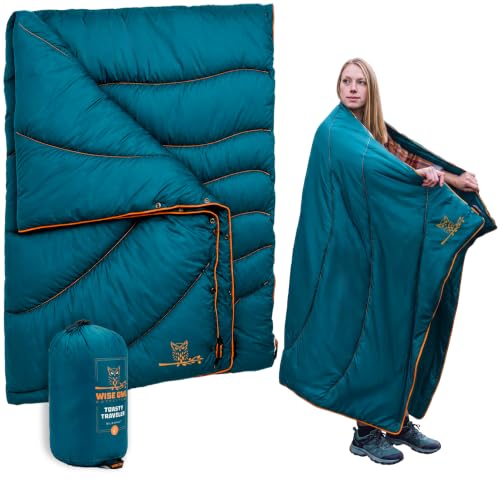
Puffy blankets use down or synthetic insulation and are generally the most transport-oriented designs in this selection. Gaialoop specifies 80% duck down and 20% feather, while Wise Owl Outfitters and COVACURE use down-alternative or synthetic insulation. These products also include features such as snaps, loops, or storage bags that make them suitable for changing positions at camp.
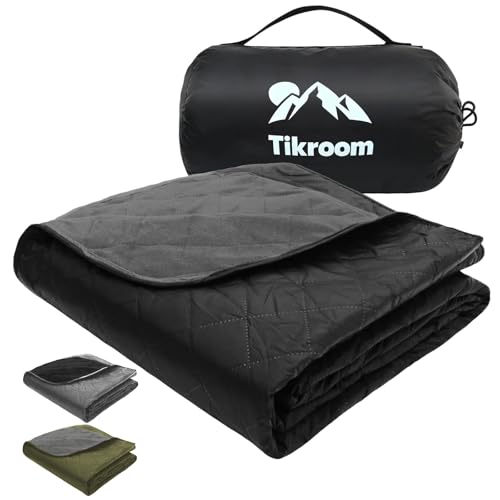
Fleece blankets emphasize a soft surface and layered construction. Tikroom specifies 300gsm polar fleece, sowwon specifies 300gsm anti-pill polar fleece, and KawaGebo Kamp lists 350gsm fleece with an additional cotton layer. These details are useful for comparing the construction, but they do not establish a universal temperature rating. Use the blanket’s documented materials and size as planning information rather than assuming a precise cold-weather limit.
Wool is a natural-insulation alternative. ACUSHLA and PuTian specify merino wool, and Arcturus describes a heavyweight wool build. The listings state that wool can continue insulating when wet, but moisture resistance is not the same as a waterproof shell. Wool options also weigh more and do not include the compact packed dimensions supplied by several puffy blankets.
Weather protection varies by construction. A coated shell or backing is the clearest choice when the blanket may touch damp grass or be exposed to drizzle. Tikroom, sowwon, KawaGebo Kamp, and KingCamp document coated or water-repellent outer materials. Wise Owl Outfitters and COVACURE also specify water-resistant shells. These features can help repel moisture, dirt, or spills, but they should not be treated as proof that every surface or seam is fully waterproof.
Some designs separate the dry side from the soft side. KawaGebo Kamp explicitly notes that its plush fleece side is not waterproof. That distinction matters when using a blanket as a ground cover. If ground contact is likely, place the coated side down and confirm which surface the listing identifies as weather resistant.
Compare portability and storage
Packed dimensions are more useful than the word “packable” alone. Wise Owl Outfitters lists a 17-by-6.5-inch roll, KingCamp lists a 13.39-by-7.48-by-7.48-inch packed size, and COVACURE documents a 1.14-pound folded bag weight. These details make them easier to compare for backpacks, vehicles, or limited storage.
Other products include a stuff sack, storage backpack, or carrying handle without giving compressed measurements. That still improves transport, but it leaves more uncertainty about the space required. Wool blankets such as PuTian, ACUSHLA, and Arcturus are better viewed as car, cabin, emergency, or base-camp equipment than as ultralight backpacking layers.
Look for useful closures and care details
Snaps can turn a blanket into a shawl, poncho, or wearable layer. KingCamp, COVACURE, Wise Owl Outfitters, and Gaialoop document buttons, clasps, or comparable wearable features. Corner loops can anchor a quilt against movement or help attach it in a hammock, while KawaGebo Kamp adds a poncho buckle and storage features.
Care instructions also affect suitability. Several synthetic and fleece blankets are machine washable, and ACUSHLA, PuTian, and Arcturus provide wool-care information. Follow the individual listing’s instructions, particularly for wool and down. A washable design is convenient, but washing alone does not establish long-term durability or drying speed.
Match the blanket to the trip
For shared coverage, begin with Gaialoop or one of the large fleece designs. For a backpack or hammock, Wise Owl Outfitters and COVACURE offer the clearest portability evidence. For a soft, layered surface at a stadium or picnic, Tikroom, sowwon, or KawaGebo Kamp are logical specifications-based matches. For car storage, emergency preparation, or colder base camping, the larger wool blankets provide more substantial coverage but require more carrying space.
Final Recommendation
Tikroom Large Waterproof Outdoor Camping Blanket ranks first overall in this specification-based comparison under the published weighted criteria.
Gaialoop 2-Person Down Puffy Blanket is the first overall specification-based choice among these best large camping blankets because its 80-by-87-inch coverage, down filling, and two-person format are unusually well documented. KingCamp is the more balanced alternative when a supplied packed size, sherpa lining, wearable snaps, and water-repellent shell matter. Wise Owl Outfitters is the most specification-aligned portable multi-use option, while Tikroom and KawaGebo Kamp suit shoppers who favor thick fleece and weather-oriented backing. PuTian and Arcturus are better fits for wool-focused car, cabin, or emergency use. Together, these top large camping blankets cover the main trade-off: compact puffy designs travel easily, while wool and layered fleece designs provide a more substantial stationary blanket format.
Frequently Asked Questions
What should I look for in the best large camping blankets?
Start with unfolded dimensions, insulation type, outer-shell or backing protection, packed size, and care instructions. Add closures or corner loops if you want a wearable layer, hammock setup, or anchored ground cover. Do not rely on the word “large” alone; compare the stated length and width.
Are wool camping blankets better than puffy blankets?
Neither type is universally better. Wool options such as ACUSHLA, PuTian, and Arcturus provide broad coverage and natural insulation, but they are heavier and lack the compact dimensions documented for several puffy blankets. Puffy designs are generally more transport-focused, while wool can suit vehicles, cabins, and base camps.
Which selected blanket is best for two people?
Gaialoop is the clearest two-person choice because it measures 80 by 87 inches and is labeled for two-person use. KingCamp, Tikroom, sowwon, and KawaGebo Kamp also document features or coverage intended to wrap two people, although their exact comfort depends on how the blanket is positioned.
Can a camping blanket replace a sleeping bag?
The supplied listings describe some blankets as usable as quilts, sleeping-bag blankets, or convertible layers, but they do not establish standardized sleeping-bag temperature ratings. Treat a blanket as supplemental or flexible camp insulation unless its documented design and your intended conditions are appropriate.
How should I use a waterproof-sided outdoor blanket?
Put the coated or waterproof-backed side toward the ground or weather and keep the soft fleece side facing inward. KawaGebo Kamp specifically notes that its plush fleece side is not waterproof. Always check the product’s own care and surface instructions before exposing it to sustained rain.