Buying Guide
Large kites vary more than their shared category label suggests. A giant frameless sea creature, a framed delta, and a dual-line stunt kite can all be large, but they serve different flying styles. The best large kites for a beach display are not automatically the best choice for learning control or carrying in a small bag. Start by deciding whether you want visual impact, active steering, easy family use, or a compact travel format.
Choose the right kite structure
Frameless soft kites use fabric rather than a rigid skeleton. The SQLWYLAT octopus and stingray, Catch&Hunt goldfish, and HENGDA frog are examples in this comparison. Their listings describe fabric-balloon, soft umbrella, or parafoil construction. That design can reduce rigid-part assembly and make folding easier, but the largest shapes still need open space and suitable wind. A soft design is a practical direction when you prioritize unusual three-dimensional silhouettes and compact storage.
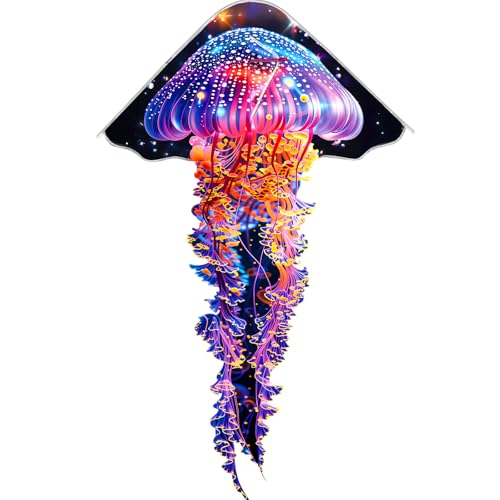
Framed kites use rods to hold their shape. The HONBO eagle lists a fiberglass frame, the Yiranzide delta lists lightweight fiber rods, and the jellyfish lists fiberglass-reinforced plastic. Framed designs may appeal if you prefer a defined profile and a more traditional setup. They can also have more parts to insert or protect during transport, so check the stated folded size and assembly instructions before choosing.
A dual-line stunt kite is a different category of use within large kites. The Babyeden model includes two lines with handles and is specifically described as an entry-level sport kite. It is better suited to someone who wants to practice steering than to someone who only wants a single-line festival display. Control-oriented kites require more active handling, even when the listing positions them for beginners.
Match size to your flying area
The largest documented options here include the 41-foot stingray, the 26-foot octopus, and the goldfish with an 11.5-foot body description plus a 32-foot tail. These designs can be highly visible, but size is not a substitute for room. Beaches, wide fields, and organized kite-festival areas are more appropriate than crowded parks, tree-lined yards, or areas near overhead wires. A long tail also needs clearance from people, branches, and other lines.
Medium-large framed choices, such as the 73-inch eagle, 83-inch delta, 84-inch stunt kite, and 98-inch radar kite, are easier to relate to ordinary beach or field outings. They still need a clear launch area, but their stated dimensions are less extreme than the giant soft designs. The 63-inch dragon and 43-by-84-inch jellyfish provide additional display-oriented options when you want a recognizable shape without selecting the biggest model in the pool.
Check what comes in the package
Included equipment can change how quickly you can use a kite. The octopus includes a reel, the goldfish includes a handle wheel, and the Babyeden includes line with handles. The HONBO eagle lists a 200-foot line with swivel and two bags. These packages reduce the need to identify compatible control equipment separately.
Other listings call out limitations or recommendations. The radar kite includes a line spool but advises a larger reel winder for its large size. When a reel is not clearly included, treat it as a likely additional planning item rather than assuming the package is ready to fly.
Consider materials and maintenance
Fabric terminology helps compare construction, but it does not prove performance in every condition. Ripstop nylon appears on the radar kite and HONBO eagle, while reinforced nylon is documented for the octopus and stingray. Polyester appears on the delta, dragon, frog, and other selected models. Fiberglass or fiber rods appear in several framed designs. These details indicate how each product is built; they should not be read as a guarantee against damage.
Keep any kite dry before storage, follow the supplied assembly instructions, and inspect fabric, rods, tails, and line before flying. A frame should be inserted as directed rather than forced into a sleeve. For soft kites, check that the fabric is fully arranged and that tails or bridles are not tangled. Adult supervision is particularly important where a listing gives an age recommendation, and all large kites should be flown away from roads, power lines, trees, and storms.
Decide between display and practice
For a dramatic sky display, the 41-foot stingray and 26-foot octopus lead on documented scale. The goldfish adds a long tail and no-skeleton construction. For classic framed display, the HONBO eagle, Yiranzide delta, jellyfish, and dragon provide distinct shapes. The radar kite offers a box-style profile with long twin tails.
For active skill-building, choose the Babyeden dual-line stunt kite. Its supplied handles and line make the control format explicit. If your priority is a simple single-line outing, favor a model whose listing clearly includes a reel or line and whose setup is straightforward. This approach helps narrow the top large kites to products that fit your actual flying plan rather than just the biggest number.
Final recommendation
Among the top large kites, the ranked products differ under documented documented scale and visibility, frame and fabric construction, stated ease of flying, included line and handling gear, setup and portability, and outdoor and audience fit.
Catch&Hunt 43-Foot 3D Goldfish Kite ranks first overall in this specification-based comparison under the published weighted criteria.
SQLWYLAT 26-Foot Giant Octopus Kite is the first overall specification-based choice among these best large kites. It combines a highly visible 26-foot design with frameless construction, reinforced nylon, compact folding, and an included reel. If maximum documented scale matters most, choose the SQLWYLAT 41-Foot Giant Stingray Kite. For a soft three-dimensional design with clearly listed handling equipment, the Catch&Hunt goldfish is a strong alternative.
The Babyeden dual-line stunt kite is the clearest pick for beginners who want active steering, while the HONBO eagle is better for portable framed display. The Yiranzide delta, HENGDA jellyfish, HENGDA frog, radar kite, and classical dragon each serve different combinations of shape, construction, setup, and audience. Because this is a listing-based comparison rather than a hands-on test, confirm current package contents and safety instructions before flying.
Frequently Asked Questions
What should I look for when choosing the best large kites?
Prioritize the documented dimensions, construction type, fabric, frame material, included line or reel, setup instructions, and intended audience. Also consider where you will fly. A 41-foot soft kite needs more clearance than a 63-inch framed dragon, while a dual-line stunt kite requires a different handling style from a single-line display kite.
Are frameless kites easier to carry than framed kites?
The selected frameless models document folding or flexible soft construction, and the octopus specifically says it folds to laptop size. Framed models can also fold, as shown by the HONBO eagle and other rod-based designs. Portability therefore depends on the individual design, not only on whether a kite has a frame.
Which selected kite is designed for stunt flying?
The Babyeden 84-Inch Dual-Line Stunt Kite is the only selected model explicitly presented as a dual-line sport kite. It includes line with handles and is described as an entry-level option. The other selected products are presented primarily as single-line or display-style kites, so they should not be assumed to provide the same control format.
Do large kites always include a reel or line?
No. The supplied evidence varies by model. The octopus, goldfish, eagle, and Babyeden clearly list included handling equipment, while the radar and delta listings include or recommend specific reel arrangements that require attention. Check the package details for the exact model before planning a flying session.
Where should I fly a large kite?
Use a clear beach, open field, or suitable festival area away from overhead wires, roads, trees, crowds, and storms. Large bodies, long tails, and long lines need extra clearance. Follow the included instructions and any age or supervision guidance, especially for children and the giant soft-kite designs.