Buying Guide
The best large serving trays are defined by more than a long outside measurement. A useful comparison should consider the usable surface, edge height, carrying method, material, cleaning instructions, and storage footprint. A tray that looks spacious may still be awkward if it has no handles, shallow edges, or a finish that requires delicate care.
Start with the serving job
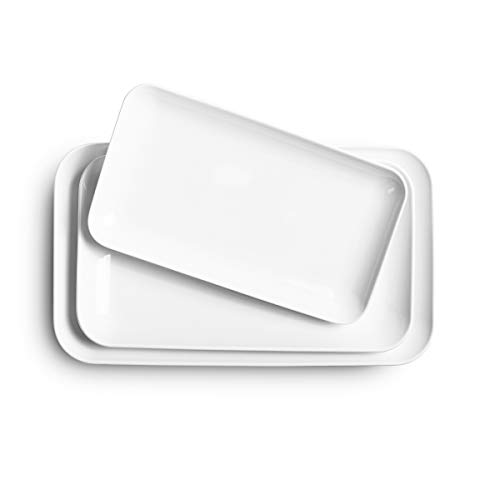
For a buffet or dessert table, matching sets can be more useful than one oversized tray. VITEVER, greenandlife, and US Acrylic each document four-piece sets, giving a host several surfaces for separating appetizers, fruit, cookies, or desserts. DELLING takes a different approach with 16-, 14-, and 12-inch porcelain platters, which lets the serving surface match the amount of food being presented.
A single large tray can be better for breakfast, drinks, or a complete meal. DOFIRA measures about 17 by 13 inches and is explicitly positioned for ottoman service, while Kazozobi measures 17.7 by 12.5 inches and is described as holding a plate, beverage, snacks, and cutlery. Consider whether the tray will stay on a table or travel between the kitchen and another room.
Compare usable dimensions and edges
Published dimensions are a helpful starting point, but edge height also affects practical capacity. The VITEVER trays are 16 by 11 by 1.5 inches, while greenandlife lists a similar 15.9-by-11-inch footprint with 1.5-inch edges. Those raised sides can help contain food during carrying. Kazozobi lists a taller 1.8-inch profile, and DOFIRA lists approximately 2 inches, offering more side structure for meals and drinks.
TasticTotes is unusually broad at 17.2 by 10.5 inches but only 0.8 inches high. That shallow profile suits barbecue prep and plating, especially because the listing describes contoured edges for juices, but it may not contain tall or loose foods as effectively as a deeper tray. Always compare both length and width with your plates, serving bowls, and storage shelf.
Choose the material deliberately
Plastic is a practical choice for repeated parties and outdoor use. The selected plastic models document BPA-free or food-grade materials, and several describe shatter-resistant or unbreakable construction. US Acrylic emphasizes high-density plastic and outdoor suitability; VITEVER and greenandlife emphasize reusable party service. Plastic can also be lighter than ceramic or metal, which matters when a tray is fully loaded.
Porcelain and ceramic provide a more formal table appearance. DELLING documents high-fired porcelain, a smooth glaze, and compatibility with several appliances. Tlence uses ceramic with a gold rim, built-in handles, and a decorative shape. These materials can look polished, but their greater weight and breakage risk may make them less suitable for crowded outdoor movement.
Stainless steel offers another presentation style. Teecyhooo describes stain- and odor-resistant steel with a mirror-polished surface. It can suit desserts, fruit, snacks, and cold dishes, but the supplied listing also notes sharp edges and a 5.73-pound set weight. Read handling cautions before choosing metal for frequent service.
Look for carrying and stability features
Handles are particularly valuable when a tray will be carried across a room. DOFIRA has wide metal handles, Tlence has built-in hollow handles, and Teecyhooo includes handles that require installation. Kazozobi and Czlizdyt also emphasize handles for carrying. Check whether the handles are built in, installed, or simply formed in the tray, and allow room for your grip.
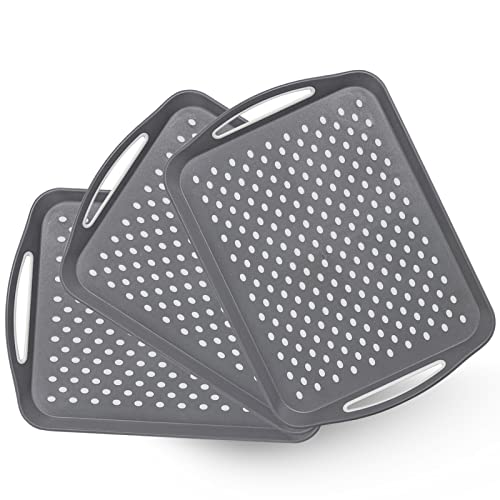
Non-slip features address a different problem: movement while the tray is being carried or used on a lap. Kazozobi uses non-slip dots, while Czlizdyt combines silicone grippy dots with a grippy underside. These features are relevant to drinks, plates, and casual meal service. They do not replace careful carrying, especially when a tray is heavily loaded.
TasticTotes documents a raised textured surface to keep food lifted from grease or juices. Tlence lists four non-slip feet for table stability. These are useful design details, but each addresses a specific situation rather than every serving need.
Check cleaning and storage requirements
Cleaning instructions vary significantly. DELLING and Tlence are listed as dishwasher safe, while US Acrylic specifies top-rack dishwasher use. Czlizdyt is also described as dishwasher safe.
Stacking matters when cabinet space is limited. VITEVER, greenandlife, and TasticTotes document stackable or nesting designs. Czlizdyt also describes stackable storage. Handled trays may need more vertical clearance, while ceramic and porcelain pieces may require protective spacing. Measure the cabinet opening rather than relying only on the tray’s footprint.
Match the tray to the occasion
For large gatherings, start with the number of surfaces required. Four-piece plastic sets are convenient for a buffet, while DELLING’s graduated sizes support a more coordinated table. For barbecue preparation, the separate colors and food-use roles of TasticTotes are more relevant than decorative styling. For a living room, ottoman, or breakfast-in-bed setting, handles and raised edges become more important than having multiple pieces.
Final Recommendation
DELLING Porcelain Serving Platter Set ranks first overall in this specification-based comparison under the published weighted criteria.
DELLING Porcelain Serving Platter Set is the first overall specification-based choice among these best large serving trays because it combines three useful sizes with high-fired porcelain and unusually broad appliance compatibility. It is followed by TasticTotes for barbecue preparation, US Acrylic for dishwasher-friendly reusable service, and DOFIRA for a large handled ottoman tray.
The top large serving trays are not identical because their documented strengths differ. Choose Kazozobi or Czlizdyt when non-slip meal transport matters, greenandlife or VITEVER when several matching plastic platters are useful, Teecyhooo for polished stainless steel presentation, and Tlence for decorative ceramic service. Before ordering, verify the available cabinet space, expected load, edge height, and cleaning method.
Frequently Asked Questions
What size should I look for in the best large serving trays?
The selected options range from about 15 by 10 inches to 17.7 by 13 inches. A 15- or 16-inch tray can suit appetizers, desserts, and fruit, while a 17-inch-plus handled tray may be better for a plate, beverage, and snacks together. Compare the tray’s width with your plates and the cabinet where it will be stored.
Are plastic serving trays suitable for outdoor parties?
Several selected plastic trays are explicitly described for patios, pools, camping, picnics, or outdoor gatherings. Plastic can also reduce breakage concerns compared with ceramic or porcelain. However, follow the supplied care instructions and avoid assuming heat or dishwasher compatibility unless the listing documents it.
Which of the top large serving trays is best for barbecue preparation?
TasticTotes is the most purpose-specific choice because the set uses separate green and black trays for raw and cooked food. The listing also documents a textured surface, contoured edges, dishwasher safety, and heat resistance up to 248°F. Those details make it different from general-purpose party platters.
Do handles make a serving tray easier to use?
Handles can give the user a defined grip when carrying food or drinks, especially on larger trays. DOFIRA, Kazozobi, Czlizdyt, Teecyhooo, and Tlence document handles. Handle placement can also increase storage height, so measure both the tray footprint and the space above it.
What should I check before buying a tray for everyday use?
Check the stated dimensions, edge height, material, weight, cleaning method, and storage design. Also decide whether you need a non-slip surface, built-in handles, multiple matching pieces, or appliance compatibility. The best large serving trays are the ones whose documented features match the way you will carry, clean, and store them.