Buying Guide
The best leather business card holders should match the number of cards you carry, the way you access them, and the amount of structure you want in a pocket-sized case. Public listings show meaningful differences in material terminology, pocket layout, closure style, and stated capacity. Because this is a specification-based comparison, the recommendations below rely on documented features rather than hands-on testing or customer sentiment.
Choose the right leather description
“Leather” is not a single material category in these listings. HISCOW’s two selected cases specify full-grain leather or full-grain cowhide, while the Outrip and Samsill cases specify genuine leather. These descriptions provide more material detail than the PU and microfiber leather options. VULKIT identifies top-grain leather, giving it a different material position from the full-grain and genuine-leather cases.
Several selected cases use PU leather, including Ocadux, Uloryce, and MaxGear. PU can suit shoppers who prioritize a neat appearance, a lower-cost format, or easy everyday organization, but the listings do not support treating it as equivalent to full-grain or genuine leather. Padike’s selected model uses microfiber leather with stainless steel, emphasizing slim organization, RFID blocking, and a metal element rather than natural-hide material.
Match capacity to your card routine
Capacity claims should be read as estimates because thickness affects how many cards fit. The HISCOW full-grain case states up to 25 business cards or 15 credit cards, while the HISCOW slim bifold states up to 14 name cards or eight credit cards. These products illustrate the main trade-off between a roomier compartment and a thinner minimalist arrangement.
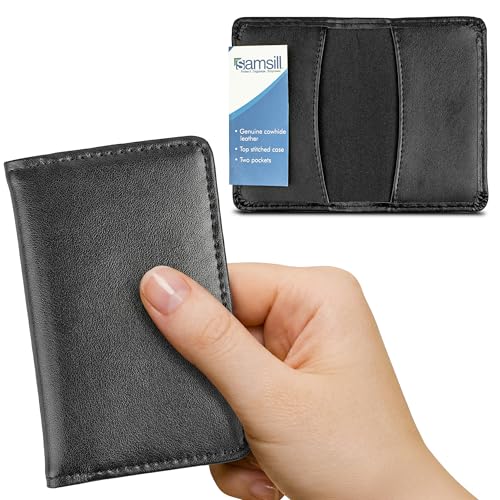
The YURU case lists approximately 35–40 business cards, the largest stated capacity among the selected products. It may suit conferences, sales meetings, or anyone who regularly exchanges cards, although its metal-and-leather construction is listed as heavier than many alternatives. Samsill also documents capacity for 25 business cards in a simpler two-pocket design.
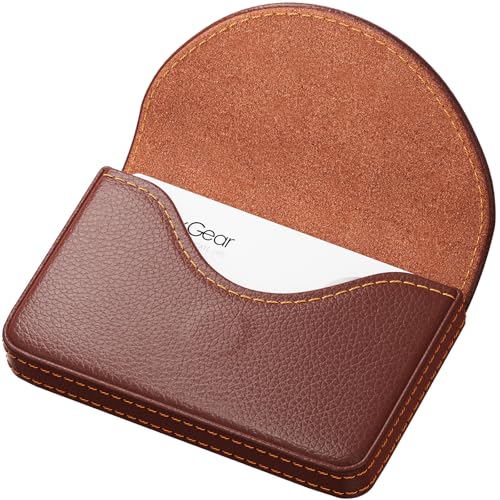
VULKIT’s single-slot case states capacity for 20 business cards or 15 credit cards. Ocadux states approximately 25 cards, while Padike gives a 15–25 business-card range. MaxGear lists approximately 15–25 cards. For Uloryce and Outrip, the listing supports multi-card use, but Outrip provides the more specific range with 10–20 cards in its main pocket. Do not assume that a stated maximum will be comfortable when cards are unusually thick, embossed, or mixed with cash.
Decide whether you need separate pockets
A single compartment is useful when every card has the same purpose and quick retrieval matters. VULKIT’s single-slot design is built around that use, with a magnetic closure and quick-flip access. It may be less convenient if you want to separate personal cards from cards received at an event.
Two-sided or multi-pocket formats provide more structure. HISCOW’s slim bifold has two symmetrical pockets, while Samsill documents two pockets without adding extra features. Outrip goes further with a main pocket, two interior card slots, and a clear ID window. Padike also documents two internal compartments. These layouts can help separate business cards, credit cards, and IDs, but they may add seams or handling steps compared with a basic sleeve.
The YURU case uses a flip-top format with a magnetic closure and an interior pocket. Ocadux, Uloryce, and MaxGear also use magnetic closures, but their listings provide less detail about internal separation. Check the card types you plan to carry before choosing a compartment layout.
Consider closure and protection features
A magnetic closure can help keep the case closed and cards contained, as documented for VULKIT, YURU, Ocadux, Uloryce, MaxGear, and Padike. Padike additionally lists RFID blocking, as does its metal-and-microfiber construction. RFID blocking is a technical feature for cards that support relevant contactless communication; it does not replace careful handling or confirm protection for every card type.
Rigid construction is another consideration. VULKIT lists a reinforced casing and microfiber lining, while YURU combines leather with stainless steel. Padike also uses stainless steel. These designs may provide more structure against bending than an unreinforced soft case, but the supplied listings do not provide independent test results. The HISCOW full-grain case offers an ID window and a sturdy multi-pocket format, though its listing does not document a rigid shell or magnetic closure.
Prioritize pocket dimensions and weight
Most selected cases are designed for pocket, briefcase, handbag, or travel use, but their profiles differ. The HISCOW slim bifold is listed at about 4.33 by 2.83 by 0.6 inches, while VULKIT is about 4.25 by 2.68 by 0.55 inches. Outrip is listed at approximately 4.1 by 2.95 by 0.6 inches, and MaxGear at 3.9 by 2.5 by 0.7 inches.
Thickness matters when a case is carried in a shirt or trouser pocket. A larger capacity often requires more space, especially when the design includes a metal shell or several pockets. If you carry only a small number of cards, the slim HISCOW bifold or VULKIT single-slot case may be more comfortable than a high-capacity organizer. If you regularly exchange cards, YURU, Samsill, Ocadux, or the larger HISCOW case may better fit the documented use case.
Think about presentation and gifting
A business card holder is often used during introductions, so appearance and access can matter as much as storage. Full-grain and genuine-leather options provide the clearest traditional leather positioning in the supplied evidence. HISCOW’s cases also list gift packaging, while several other listings describe professional or gift-oriented use without providing a separate presentation feature.
For a gift, first choose the recipient’s carry style. A minimalist user may prefer VULKIT or the slim HISCOW bifold. Someone who carries identification with business cards may prefer Outrip. A frequent networker may benefit from YURU’s larger stated capacity. For a simple office case, Samsill, Ocadux, Uloryce, or MaxGear offer straightforward formats with documented pocket-friendly dimensions.
Final Recommendation
HISCOW Full Grain Leather Business Card Holder ranks first overall in this specification-based comparison under the published weighted criteria.
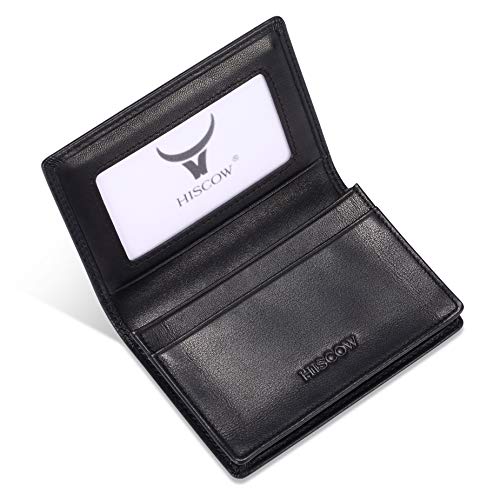
HISCOW Full Grain Leather Business Card Holder Case is the first overall specification-based choice among the best leather business card holders because it combines full-grain nappa leather, up to 25 business cards, an interior card slot, and a clear ID window in a compact format. It is a well-rounded option when material detail, capacity, and organization all matter.
Choose the HISCOW Slim Full-Grain Leather Card Holder if thin front-pocket carry is your priority. VULKIT is the focused single-slot alternative, while YURU is the more spacious metal-and-leather choice. Outrip suits mixed cards and ID storage. Samsill is the uncomplicated two-pocket format. Padike adds RFID blocking and two-sided access, and Ocadux, Uloryce, and MaxGear provide simpler PU leather alternatives for shoppers who want a practical magnetic case.
Among the top leather business card holders, the right choice depends less on appearance alone than on how many cards you exchange and whether you need separate storage. Confirm the listed dimensions against your preferred pocket, and treat capacity as dependent on card thickness.
Frequently Asked Questions
Which of the best leather business card holders has the largest stated capacity?
YURU lists approximately 35–40 business cards, the largest stated capacity among the selected products. Its leather-and-stainless-steel construction and 0.78-inch listed thickness may make it less pocket-minimal than smaller cases. The HISCOW full-grain case and Samsill case each document capacity for up to 25 business cards, while several others list ranges around 15–25 cards.
Is full-grain leather better for a business card holder?
Full-grain leather is the most detailed natural-leather specification in this comparison, and both selected HISCOW products identify full-grain construction. That makes them suitable choices for shoppers who prioritize documented material quality. However, the preferable material depends on your needs: PU leather cases such as Ocadux, Uloryce, and MaxGear may still provide the magnetic closure, dimensions, and capacity that suit everyday use.
Do magnetic closures protect business cards?
A magnetic closure helps keep the case closed and cards contained, as documented for VULKIT, YURU, Ocadux, Uloryce, MaxGear, and Padike. It does not establish complete protection against bending, moisture, or every type of damage. VULKIT additionally lists reinforced casing and microfiber lining, while YURU and Padike document stainless-steel components.
Which case is best for carrying an ID with business cards?
Outrip is the clearest choice because its listing documents a clear ID window, two interior card slots, and a main pocket for business cards. The HISCOW full-grain case also includes a clear plastic ID window and an interior credit-card slot. These options are more explicitly organized for mixed card use than the single-slot VULKIT case.
How should I choose between a two-pocket case and a single-slot case?
Choose a single-slot design when you want simple, fast access and carry one main group of cards; VULKIT is the selected example. Choose a two-pocket or multi-pocket case when you want to separate business cards, IDs, and payment cards; HISCOW’s slim bifold, Samsill, Outrip, and Padike document that kind of organization. Capacity and thickness should still guide the final choice.