Buying Guide
Choosing the best living room floating shelves starts with the wall, the objects you plan to display, and the visual arrangement you want to create. These products range from compact three-packs to long picture ledges and dedicated corner units. Because this is a specification-based comparison, treat capacities and installation details as listing information and confirm that the included hardware suits your wall construction.
Match shelf length to the wall
Measure the usable wall section before choosing a shelf. Compact shelves around 15 to 16 inches wide are easier to distribute around a fireplace, doorway, sofa, or narrow section of wall. The AMADA white set, AMADA paulownia set, QEEIG, and HOOBRO options all support smaller compositions, although their depths and shapes differ.
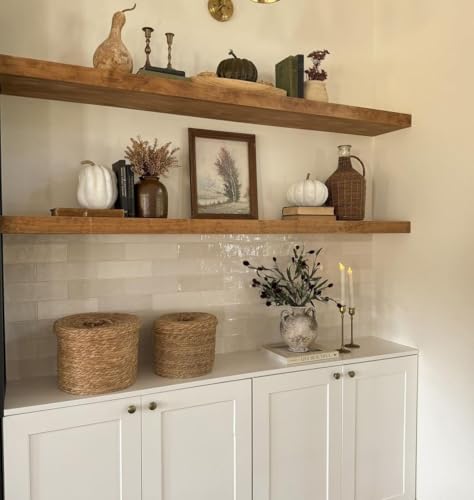
Long shelves create a continuous visual line. The FLYJOE 48-inch picture ledge is intended for broad displays and includes a front lip that helps hold frames and small objects. Forbena and Harwaya offer three long shelves at roughly 36 inches, with deeper surfaces that are more accommodating for books and plants. BAYKA sits between these groups at 22.5 inches, making it a useful compromise when a full-width ledge would overwhelm the wall.
Check depth for the items you own
Shelf width describes the horizontal span, but depth determines what can sit on the board. Narrow ledges are appropriate for frames, small collectibles, and lightweight decorative objects. Deeper shelves such as QEEIG, Forbena, and Harwaya provide more room for books, baskets, or larger ornaments. A deeper board also projects farther into the room, so leave clearance around walkways and seating areas.
The FLYJOE picture ledge uses a raised lip rather than a deep open platform. That design is useful when the main purpose is to display frames in layers or keep smaller pieces from sliding forward.
A stated weight limit is useful for comparing products, but it does not replace proper installation. ROMGUAR CRAFT lists a 40-pound maximum per shelf, while HOOBRO also states up to the current price. AMADA, BAYKA, and QEEIG provide lower but clearly documented capacities. FLYJOE specifies up to the current price when mounted into wall studs.
Do not assume that a shelf can carry its stated maximum on every wall. Stud mounting, anchors, screw selection, and wall condition all matter. The FLYJOE listing specifically describes stud-spaced holes. BAYKA documents accessories for wood, brick, drywall, and cement walls. HOOBRO identifies hardware and instructions, while the AMADA paulownia model includes a drilling template. These details make installation planning easier, but they are not a substitute for checking the wall and hardware yourself.
Choose between concealed and visible structures
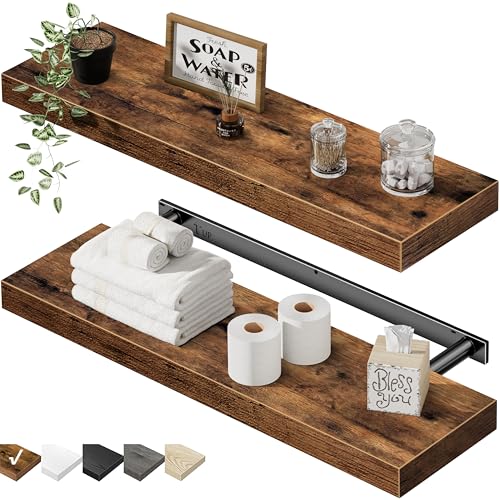
Concealed brackets create a clean floating appearance. AMADA’s white and paulownia shelves, QEEIG, Forbena, and several other selected models describe invisible or hidden mounting systems. These designs keep attention on the boards and displayed objects.
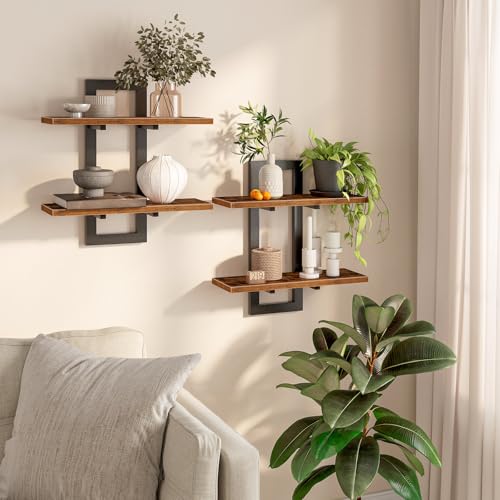
Tiered and framed products make the support structure part of the style. HOOBRO uses metal frames and two levels, while SUMGAR uses a visible frame with movable boards. These options can add visual character and organize objects vertically without requiring a long shelf. They may be a better fit for rustic, industrial, or mid-century-inspired rooms than a fully concealed ledge.
Consider corners and vertical space
A corner shelf is not simply a smaller standard shelf. ROMGUAR CRAFT uses an L-shaped structure intended to fit into corners, and its four shelves can turn an otherwise unused area into a vertical display. This approach is useful beside a television, near a doorway, or in a corner where a flat shelf would have limited usable wall length.
HOOBRO also documents corner mounting as one of several possible configurations, but its two-tier units can be mounted flat or arranged side by side. SUMGAR offers another kind of flexibility through boards that can shift left or right within the frame. If you expect to rearrange decor, prioritize a set with multiple boards or documented configuration choices.
Review material and finish claims
Material descriptions vary considerably. AMADA identifies paulownia wood, Harwaya identifies solid wood, and SUMGAR identifies pine wood brackets. Other models use MDF, engineered wood, particleboard, laminate, or combinations of wood boards and metal frames. These descriptions help compare appearance, construction type, and visual character, but they do not by themselves establish long-term performance.
Finish is equally important in a living room. Walnut and white options suit cleaner, modern compositions, while rustic brown and black finishes coordinate with farmhouse or industrial decor. BAYKA explicitly notes that it is not solid wood, and QEEIG similarly identifies MDF. Those disclosures help set appropriate expectations before ordering.
Final Recommendation
FLYJOE 48-Inch Picture Ledge Shelf Set ranks first overall in this specification-based comparison under the published weighted criteria.
FLYJOE’s 48-inch picture ledge set is the highest-scoring returned product and the first overall specification-based choice. It combines a broad display surface, a raised lip, stud-spaced pre-drilled holes, included hardware, and a stated capacity for stud-mounted installation. For a wall that needs framed art or a continuous decor line, it offers a clear match between the product format and the intended use.
For deeper storage, Forbena and Harwaya are stronger fits because both provide three long shelves with roughly eight inches of depth. BAYKA is a more compact middle option with useful wall-type installation guidance. Among the best living room floating shelves for smaller arrangements, AMADA’s two sets and QEEIG provide concealed-bracket styling, while HOOBRO adds tiered storage in a compact footprint.
ROMGUAR CRAFT is the specialist choice for a corner, and SUMGAR is the most distinctive option for adjustable board placement. Together, these top living room floating shelves cover long ledges, compact displays, corner storage, tiered designs, and deeper book-friendly surfaces without relying on customer sentiment or volatile marketplace claims.
Frequently Asked Questions
What should I measure before buying floating shelves?
Measure the usable width of the wall, the desired distance between shelves, and the clearance from furniture or walkways. Also measure the depth of the objects you plan to display. A 48-inch ledge needs a substantially wider wall section than a 15- or 16-inch shelf, while deeper eight-inch boards need more projection clearance than a narrow picture ledge.
Are floating shelves suitable for books?
Some are better suited than others. Harwaya, Forbena, QEEIG, and BAYKA document depths or uses that accommodate books. The FLYJOE picture ledge can also display books, but its raised lip and ledge format are more naturally suited to frames and shallow displays. Always follow the product’s stated capacity and mounting instructions.
Which of the best living room floating shelves works in a corner?
ROMGUAR CRAFT is specifically designed with an L-shaped corner structure, and its four shelves are intended to use corner space. HOOBRO also documents corner mounting as one possible arrangement, although its tiered units can be used in other configurations as well. Check the dimensions of both adjoining walls before selecting a corner shelf.
Do floating shelves need to be mounted into studs?
Not every listing requires the same installation approach, but wall construction affects the appropriate hardware and achievable support. FLYJOE specifically describes stud mounting, while BAYKA lists accessories for several wall types. Read the included instructions, identify the wall material, and do not assume that a stated shelf capacity applies without the recommended installation.
Are concealed brackets or visible frames better?
Concealed brackets provide a cleaner floating appearance, as documented by AMADA and QEEIG. Visible frames, such as those on HOOBRO and SUMGAR, can add structure and decorative character while supporting tiered or adjustable layouts. The better choice depends on whether you prioritize a minimal visual profile or a more noticeable shelving design.