Buying Guide
Choosing among the best low-profile garage shop creepers starts with the space beneath the vehicle, then moves to the way the creeper supports your body, rolls across the floor, and stores between jobs. The listings in this comparison document several distinct designs: fixed steel platforms, molded plastic decks, padded X-frame models, and convertible Z-creepers. Because this is a specification-based comparison rather than a hands-on test, the practical differences below are drawn from the supplied product descriptions and specifications.
Start with documented clearance
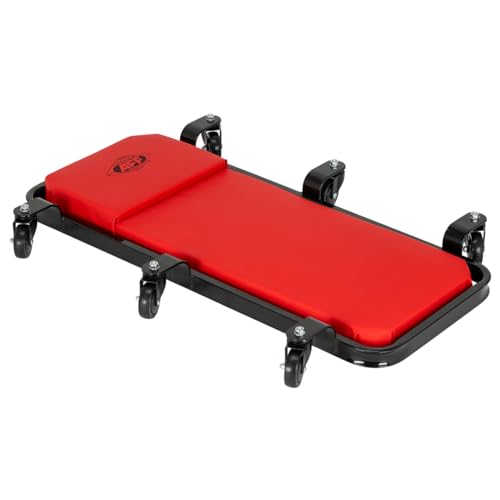
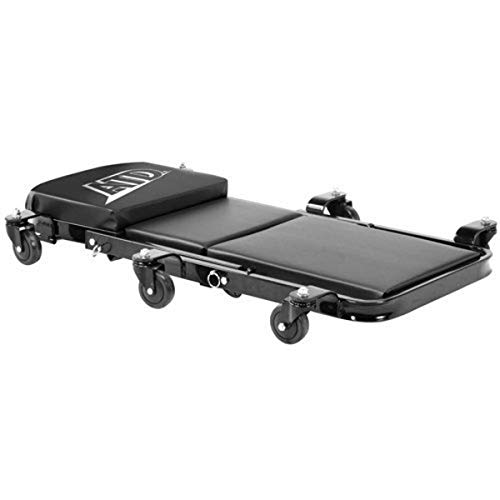
Clearance is the defining consideration for a low-profile creeper. The AFF Ultra Low Profile Mechanic Creeper 3922 lists 1.5 inches of ground clearance, while the ATD Tools 81046 lists 1/2 inch. The Lisle 97102 lists 7/8 inch of floor clearance. Those figures are especially relevant when the vehicle has limited space beneath its chassis or when hoses, cords, and other obstructions are present.
Not every listing uses the same measurement language. The AFF Viking 42-inch model gives 2.16 inches of overground clearance, and other products describe themselves as low profile without supplying a directly comparable clearance figure. Treat those measurements as listing-specific rather than assuming that every stated height represents the open space beneath the deck. Before selecting, compare the creeper’s documented clearance with the vehicle’s available working room.
Match capacity and construction to the job
The best low-profile garage shop creepers should provide a capacity appropriate for the user and the tools carried during work. The Omega 91452 and ATD Tools 81049 each list a 450-pound capacity. The AFF Viking lists 440 pounds, while the AFF 3922 lists 400 pounds. Molded models such as the Lisle 97102, BESTOOL, MichaelPro, and Toolsempire list capacities from 300 to 350 pounds.
Construction affects handling as well as support. Steel-frame options can provide a rigid platform, with the AFF 3922 specifying a 3/4-inch tubular steel frame and the Performance Tool W85014 specifying a heavy-duty tubular steel frame. One-piece polyethylene or HDPE bodies, including the Lisle 97102, AFF Viking, and MichaelPro, may be easier to carry. The MichaelPro listing gives an approximate weight of 10.14 pounds, and the Lisle listing gives about 11.5 pounds. Check the stated capacity and construction together rather than judging durability from material alone.
Consider caster size and floor conditions
Caster details help explain how each creeper is intended to move. Six swivel casters are common across the selected products, but sizes vary. The Performance Tool W85014 uses 5-inch casters, the AFF 3922 lists 3-inch swivel casters, and the MichaelPro uses two 4-inch casters with four 3-inch casters. The V-shaped Omega and ATD designs also document six casters.
Larger wheels may be worth considering when the shop floor includes thresholds or small surface irregularities, but the supplied evidence does not establish comparative rolling performance. Material and resistance details are useful for maintenance environments: the AFF 3922 lists oil-resistant PU casters, the AFF Viking lists oil-, grease-, and chemical-resistant casters, and the MichaelPro lists casters resistant to oil, chemicals, and grease. The Lisle’s urethane rollers are described as corrosion resistant.
Comfort features differ considerably. The AFF 3922 uses high-density foam padding and vinyl upholstery. The Omega 91452 and ATD Tools 81049 use padded or fully upholstered surfaces. The Performance Tool W85014 lists 2-inch-thick padding. Molded options rely more on body shaping: the Lisle 97102 lists lumbar support and a padded headrest, while the AFF Viking documents shoulder relief, molded contours, airflow channels, and a large padded headrest.
A headrest can be useful when the job requires looking upward, but the evidence does not support claims about long-term comfort beyond the listed design features. Pay attention to width and body shape as well. The AFF Viking is listed at 42 inches long and 21 inches wide, the Omega at 40 by 26 inches, and the Performance Tool frame at 45 by 25 inches. A wider deck may provide more room but can also require more clearance around the vehicle.
Look for useful shop features
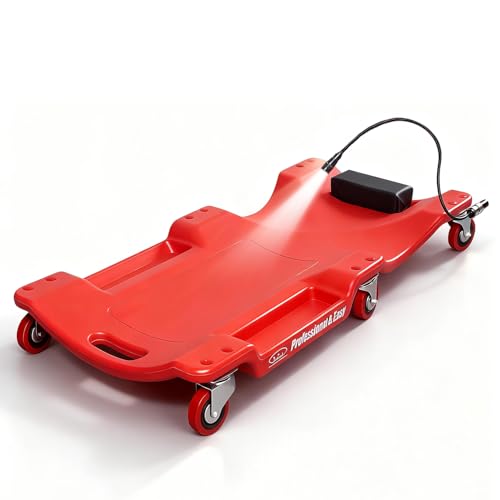
Integrated storage can reduce the need to reach away from the work area. The AFF Viking, BESTOOL, MichaelPro, and Toolsempire list trays or tool storage. Toolsempire adds magnetic surfaces in smaller trays, while BESTOOL lists dual side trays and magnetic LED work lights. The Lisle 97102 includes handles on three sides and pop-in rollers, and the MichaelPro includes a carry handle.
For garages where storage space is limited, foldability is a meaningful design distinction. The Omega 91452 uses a foldable body and adds a seated position. Toolsempire also documents a foldable frame and built-in handle. A convertible design can broaden the range of tasks, but it may be bulkier or more mechanically complex than a fixed one-piece deck. Verify the folded dimensions when storage space is a primary concern; the supplied listings do not provide them.
Compare fixed, molded, and Z-creeper designs
Fixed steel creepers emphasize a low platform and rigid frame. The ATD Tools 81046 is the most clearance-focused example in this group, while the AFF 3922 combines low clearance with padded upholstery and oil-resistant casters. Molded plastic creepers such as the Lisle 97102, AFF Viking, and MichaelPro emphasize lighter handling, shaped support, and easy-clean surfaces.
Z-creepers add another position. The Omega 91452 and ATD Tools 81049 document foldable or 3-in-1 layouts, allowing the user to work while lying down or seated. That flexibility is useful when a task changes height, but the frame and conversion hardware may require more room than a simple deck. Select the design that matches your usual work rather than treating one format as universally suitable.
Final Recommendation
AFF Viking 42-inch Mechanic’s Creeper ranks first overall in this specification-based comparison under the published weighted criteria.
The AFF Ultra Low Profile Mechanic Creeper 3922 is the first overall specification-based choice among these best low-profile garage shop creepers because it combines 1.5-inch ground clearance, a 400-pound tubular steel frame, padded upholstery, and oil-resistant swivel casters. It is a balanced option for users who need low access without giving up a documented heavy-duty frame.
The Omega 91452 and ATD Tools 81049 are better suited to users who specifically want a convertible Z-creeper and a 450-pound capacity. The AFF Viking is a compelling molded alternative with 440-pound support, body contours, and parts trays. For the lowest listed clearance, the ATD Tools 81046 and Lisle 97102 deserve attention, while the BESTOOL is the most feature-oriented option for dim work areas because of its dual magnetic LED lights.
Among the top low-profile garage shop creepers, the final decision should come down to clearance, capacity, body format, caster details, and storage. Confirm the relevant dimensions against the vehicle and garage before choosing.
Frequently Asked Questions
What makes the best low-profile garage shop creepers different from standard creepers?
A low-profile creeper is designed to keep the working platform close to the floor, helping provide access beneath vehicles with limited underbody space. The ATD Tools 81046 lists 1/2 inch of ground clearance, while the Lisle 97102 lists 7/8 inch and the AFF 3922 lists 1.5 inches. These measurements are listing-specific, so compare them carefully with the vehicle’s available clearance.
Are molded plastic creepers suitable for garage work?
The selected molded designs document features intended for garage use. The AFF Viking uses high-density polyethylene, lists a 440-pound capacity, and specifies resistant casters. The Lisle 97102 uses impact-resistant polyethylene, lists a 300-pound capacity, and has a solvent-, grease-, and fuel-resistant surface. The MichaelPro uses HDPE and lists a 350-pound capacity. Review the stated capacity and dimensions for your application.
When should I choose a Z-creeper?
Choose a Z-creeper when you want both a lying position and a seated position. The Omega 91452 documents a foldable body and added sitting position, while the ATD Tools 81049 is described as a 3-in-1 Z-creeper. These designs may be more versatile for mixed tasks, though they can require more storage space than fixed-body models.
Tool trays can keep small tools and parts close to the working position. The AFF Viking, BESTOOL, MichaelPro, and Toolsempire list integrated storage. Toolsempire additionally documents magnetic surfaces in smaller trays, and BESTOOL lists dual side trays. Trays are most useful when the vehicle and floor layout make frequent reaching inconvenient.
Which features help with storage and transport?
A carry handle can make a creeper easier to reposition, as documented on the Lisle 97102 and MichaelPro. Foldability is another storage feature: the Omega 91452 and Toolsempire both document foldable designs. Lightweight molded bodies may also be easier to move; the Lisle and MichaelPro listings provide approximate body weights. Check the complete dimensions and available storage area before selecting.