Buying Guide
Choosing among the best mahogany acoustic guitars starts with separating the wood used on the top from the materials used on the back, sides, and neck. Listings in this group use “mahogany” in several ways: some specify solid mahogany across the body, some identify only a mahogany top, and others pair mahogany back and sides with a spruce top. That distinction matters when comparing construction rather than relying on a model name.
Start with body construction
The clearest all-mahogany examples are the Fender Newporter Special, Fender CC-60S, Fender CD-60S, and Ibanez AW54OPN. Their supplied descriptions identify mahogany for the top and body, while the Ibanez listing also specifies a mahogany neck. These are direct matches for someone who wants the wood choice to define most of the instrument.
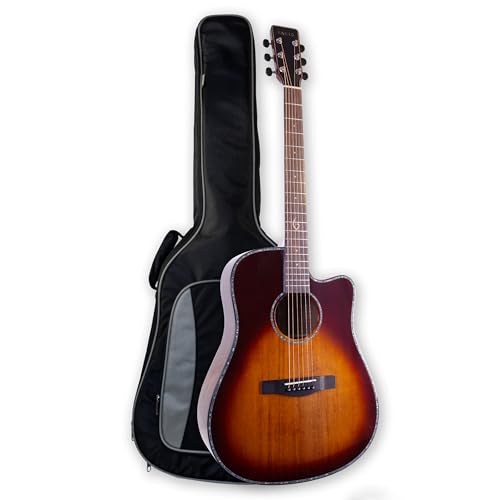
The TARIO 41-inch model takes a different approach: its top is solid Sitka spruce, while its back, sides, and neck are solid mahogany. It belongs in a broader mahogany comparison because the body includes documented mahogany, but it should not be described as an all-mahogany guitar.
Layered construction appears on the Orangewood Rey, and the Taylor GS Mini models list sapele back and sides with mahogany tops. The Martin D-X1E lists figured mahogany in its name but specifies HPL for the top and back and sides. Those details define different construction trade-offs.
Match body shape to your use
A dreadnought is the dominant full-size shape in this comparison. This format may suit players who want a traditional full-size acoustic layout. Concert and compact bodies offer different fits. The Fender CC-60S uses a concert shape, while the Taylor GS Mini and Orangewood Dana are smaller designs. The Dana is specifically described as a mini concert guitar for travelers and smaller hands.
A cutaway is another design choice. The TARIO 41-inch model and Orangewood Rey document cutaway bodies. A cutaway may help access higher frets, but it changes the body outline and should be selected for that purpose rather than treated as a universal advantage.
Consider playability details
The Fender Newporter Special lists a slim-taper C-shaped mahogany neck. The Fender CC-60S lists rolled fingerboard edges and an easy-to-play neck, while the Orangewood Rey states that each instrument receives a professional setup before shipping. These details help buyers compare neck design and setup support.
Fingerboard materials also vary. Ebony appears on both Taylor GS Mini models, and Richlite appears on the Martin D-X1E. These specifications help narrow choices, but they do not replace trying a neck in person when that is possible.
Decide whether you need electronics
If you expect to connect to an amplifier or venue system, focus first on the acoustic-electric models. The Fender Newporter Special lists a Fishman pickup/preamp system, and the Martin D-X1E and Taylor GS Mini-e are identified as acoustic-electric guitars. They are the most clearly documented choices for amplified use.
The other selected guitars are listed as acoustic guitars without onboard electronics. They may still work with external microphones or aftermarket equipment, but those options are not included in the supplied evidence. For home practice, a non-electric model may be the more focused choice; for stage or recording setups, built-in electronics reduce the number of separate components required.
Check extras and coverage
Included accessories vary. The Fender Newporter Special, TARIO, Orangewood Rey, and Orangewood Dana list gig bags, with the Rey also listing a pickguard and adjustment tools. A gig bag can make transport easier, but its presence does not establish structural quality.
Warranty information also differs. The Fender and Taylor models list manufacturer coverage, while the TARIO listing specifies a 30-day return warranty. The Orangewood listings direct buyers to contact the company for warranty information. Read current seller and manufacturer terms before purchase because coverage can be product-specific.
How this comparison was scored
The editorial scores use only supplied public listing evidence. Mahogany construction receives the largest weight because it defines the category. Body design and materials, playability features, performance versatility, and included support complete the comparison. No score uses ratings, review activity, purchase activity, marketplace badges, or customer sentiment. The result is a specification-based shortlist, not a hands-on test.
Final recommendation
Fender Newporter Special All-Mahogany ranks first overall in this specification-based comparison under the published weighted criteria.
Fender Newporter Special All-Mahogany is the first overall specification-based choice in this comparison.
Among the best mahogany acoustic guitars, it offers the broadest documented combination of solid mahogany construction, Fishman pickup/preamp electronics, slim-taper neck, distinctive Newporter body, and included gig bag.
Among the top mahogany acoustic guitars, the Fender CC-60S is a strong fit for shoppers who prefer a concert body and want an explicitly solid mahogany top with mahogany back and sides. The Ibanez AW54OPN is the straightforward traditional dreadnought choice because its listing identifies mahogany across the top, body, and neck.
Choose the Martin D-X1E or Taylor GS Mini-e when acoustic-electric capability is central. Choose the Taylor GS Mini or Orangewood Dana when compact dimensions matter more than a full-size body.
Frequently Asked Questions
What makes the best mahogany acoustic guitars different from spruce-top models?
The selected listings show that mahogany may be used for the top, back, sides, neck, or some combination of those parts. Some guitars are all-mahogany, while others use spruce tops with mahogany back and sides. Compare the exact construction rather than assuming that a mahogany model name means every major wood component is mahogany.
Which selected guitar has built-in electronics?
The Fender Newporter Special lists a Fishman pickup/preamp system. The Martin D-X1E and Taylor GS Mini-e are also identified as acoustic-electric guitars. The other selected products do not list onboard electronics in the supplied evidence.
Is a dreadnought or smaller body better for a beginner?
The evidence does not establish that one shape is universally better. Dreadnoughts provide a full-size format, while the Taylor GS Mini, Fender CC-60S, and Orangewood Dana offer smaller alternatives. Body size, reach, and comfort should guide the decision, especially for younger players or people with smaller hands.
Are all the guitars in this comparison solid mahogany?
No. The Fender Newporter Special, Fender CC-60S, Fender CD-60S, and Ibanez AW54OPN list especially complete mahogany construction. The Taylor models use mahogany tops with sapele back and sides, the Martin uses HPL components, and the TARIO uses a solid Sitka spruce top with solid mahogany back and sides. The Orangewood Rey uses layered mahogany.
What should I verify before ordering?
Confirm the exact top, back, and side materials, whether electronics are included, handedness, body size, accessories, and current warranty or return terms. These details vary across models and can affect whether a guitar fits your intended playing setup.