Buying Guide
The best meeting self-stick note pads should match the way a team captures and displays information. Large easel pads work well when the whole room must see a running agenda, process map, or brainstorm. Smaller adhesive notes are better when participants contribute separate ideas that may later be grouped, moved, or assigned. The products in this comparison are selected from public listing evidence, so the recommendations reflect documented specifications rather than hands-on testing.
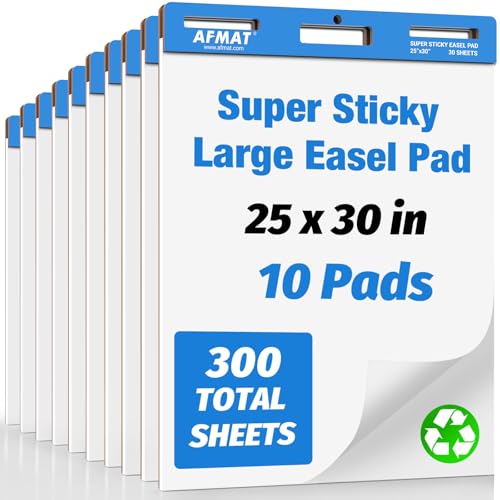
Start with the meeting surface you need. Full-size 25 x 30-inch pads from Post-it, SUNEE, AFMAT, HAUTOCO, and Universal provide a broad canvas for diagrams, timelines, workshop outputs, and presentations. These formats are especially appropriate when pages will remain visible on a wall or easel while discussion continues.
The Post-it Meeting Chart is smaller at 20 x 23 inches and includes a built-in easel stand. Nortix goes smaller still at 15 x 18 inches, which can be useful in a compact room or when several groups need separate work surfaces. Smaller does not automatically mean less useful; it simply favors focused exercises over a single wall-sized master plan.
For moveable contributions, Post-it Big Notes provide individual 11 x 11-inch sheets. WSPER’s 4 x 6-inch lined pads are more compact and easier to distribute among participants. Use these note-pad formats when the workflow depends on collecting, sorting, or color-coding separate ideas rather than filling one continuous chart.
Compare writing area and layout
Blank paper is generally the more flexible choice for sketches, arrows, diagrams, and free-form brainstorming. The blank easel pads in this list include the large Post-it 559, SUNEE, AFMAT, HAUTOCO, and Universal options. A blank surface can also accommodate a mixture of handwriting and attached sticky notes when the team is building a visual board.
Lined paper helps when the meeting has a structured output. The Post-it Meeting Chart and Post-it 561WL VAD 2PK are documented as lined, while WSPER provides lined 4 x 6-inch notes. Lines can make action items, decisions, and status updates easier to keep aligned. They may be less suitable for diagrams, mind maps, or layouts that need irregular spacing.
Sheet dimensions should be considered alongside the amount of writing. A 25 x 30-inch page offers substantially more visible working area than a 4 x 6-inch note, but it also needs more wall, table, or storage space. For a distributed meeting, a set of smaller notes may give every attendee a dedicated contribution area.
Check adhesion and surface use
Self-stick backing is central to this category, but the listings describe it in different ways. Post-it’s easel products emphasize secure sticking, repositioning, and removal without surface damage. HAUTOCO specifically lists smooth surfaces such as whiteboards, doors, walls, and cabinets. AFMAT describes repositioning across walls, glass, whiteboards, plastic, and steel surfaces. These details are useful when a meeting room has more than one possible display location.
Universal documents self-stick sheets that adhere to most surfaces and leave no messy residue. Nortix also describes repeated positioning without wall damage. These claims should still be treated as product-listing specifications, not as a guarantee for every paint finish or surface condition. If wall protection is important, use a compatible smooth surface and follow the manufacturer’s directions.
Small notes offer a different kind of flexibility. Post-it Big Notes are described as stick-and-re-stick sheets for visual collaboration. WSPER notes use on walls, whiteboards, desks, and other surfaces. These options are useful when participants must move individual items during prioritization or planning.
Consider paper and marker compatibility
Paper handling matters when a meeting uses markers or when completed pages are displayed. Post-it, SUNEE, AFMAT, and HAUTOCO describe their paper as resistant to marker bleed-through. Universal specifies 20-pound bleed-resistant paper, while WSPER specifies 80gsm paper. These are useful documented distinctions, but they do not replace testing a particular marker if the writing tool or surface is unusual.
Perforated edges can simplify removal. AFMAT and Nortix explicitly document perforated sheets, which may help when teams want to distribute completed pages or preserve the remaining pad. The Post-it Meeting Chart instead emphasizes its built-in display stand and portability. Decide whether clean tear-off is more important than an integrated display setup.
Balance supply and storage
Pack size affects both readiness and storage. SUNEE and AFMAT each document ten large pads with 30 sheets per pad, making them suited to frequent workshops, classrooms, or offices with recurring planning sessions. The trade-off is a larger storage footprint. The two-pad formats from Post-it, HAUTOCO, and Universal are easier to reserve for occasional meetings.
A multi-color small-note set can be more efficient for distributed use. WSPER includes twelve pads in six colors, allowing a team to assign colors to topics or roles. Post-it Big Notes come as one 30-sheet pad, which may be sufficient for a small workshop but offers less reserve stock than the bulk easel sets.
Match portability to the room
Handles and easel slots are helpful when pads move between conference rooms. Post-it’s Meeting Chart includes a carry handle and built-in easel stand. The Post-it 559, Post-it 561WL VAD 2PK, SUNEE, AFMAT, HAUTOCO, and Nortix listings document handles or easel slots. Universal’s supplied evidence does not document those features, so it is better treated as a straightforward adhesive chart-paper choice rather than a portability-led pick.
If the meeting is held at a desk or in a small room, the Nortix 15 x 18-inch format or individual Post-it Big Notes may be easier to position. If the goal is a wall-wide record of discussion, the larger easel pads are more appropriate.
Final Recommendation
Post-it Super Sticky Easel Pad 25 x 30 in, 2 Pads ranks first overall in this specification-based comparison under the published weighted criteria.
Post-it Super Sticky Easel Pad 25 x 30 in, 2 Pads is the highest-scoring returned product and the first overall specification-based choice. It combines a large writing area, bleed-through-resistant paper, repositionable adhesion, stand compatibility, a carry handle, and two 30-sheet pads. For structured work, the lined Post-it 561WL VAD 2PK is a strong alternative, while the Post-it Meeting Chart is appealing when a built-in stand matters more than maximum page size.
Choose AFMAT or SUNEE when a high-volume supply is central to the purchase. HAUTOCO is a useful option when the listing’s range of smooth-surface applications fits your room. Universal keeps the format simple, and Nortix reduces the footprint for smaller spaces. For participants contributing movable ideas, Post-it Big Notes or the color-coded WSPER set may be more suitable than a continuous easel page. These are among the top meeting self-stick note pads because each serves a different documented meeting workflow rather than relying on one format for every room.
The best meeting self-stick note pads are therefore the ones whose size, layout, adhesive design, paper, and pack quantity align with how your team works. Treat the rankings as a specification-based starting point, and verify the current listing details before ordering.
Frequently Asked Questions
Among the best meeting self-stick note pads, what size is best for meeting self-stick note pads?
A 25 x 30-inch easel pad is the most specification-aligned fit when a whole group needs to see and write on the same page. The 20 x 23-inch Post-it Meeting Chart and 15 x 18-inch Nortix pad are more compact alternatives. Individual 11 x 11-inch Post-it Big Notes or 4 x 6-inch WSPER notes work better when participants contribute separate ideas.
Are lined or blank pads better for meetings?
Lined pads are useful for agendas, action items, lists, and notes that need alignment. Blank pads are more flexible for diagrams, mind maps, workflows, and free-form brainstorming. The Post-it Meeting Chart, Post-it 561WL VAD 2PK, and WSPER provide lined formats in this selection; the larger SUNEE, AFMAT, HAUTOCO, Universal, and Post-it 559 options are documented as blank or unruled.
Do self-stick easel pads need a separate stand?
Not always. The Post-it Meeting Chart includes a built-in easel stand. Several other selected products document handles and slots designed to fit many or standard easel stands, but that does not necessarily mean a stand is included. Universal’s supplied evidence does not document a stand, so check the listing if freestanding display is required.
What should I look for when using markers?
Look for documented bleed-through resistance and consider the paper specification. Post-it, SUNEE, AFMAT, and HAUTOCO describe resistance to marker bleed-through, and Universal specifies 20-pound bleed-resistant paper. The supplied evidence does not establish performance with every marker, so test an inconspicuous page when the writing tool is important.
Are smaller sticky notes useful for group meetings?
Yes. Smaller notes can give each participant a separate contribution that can be moved or color-coded. Post-it Big Notes provide larger individual sheets for brainstorming, while WSPER’s lined 4 x 6-inch pads are suited to action items and categorized notes. They are complementary to large easel pads rather than direct replacements for a room-wide writing surface.