Buying Guide
The best microfiber dish drying mats are soft, flexible pads designed to catch water beneath dishes, cookware, produce, or a dish rack. Unlike rigid rack systems, they fold or roll for storage and can add a cushioned surface between wet tableware and the counter. The products in this comparison are selected from listing specifications rather than hands-on testing or customer sentiment. That means the useful questions are practical ones: how much area the mat covers, what construction is documented, how it should be cleaned, and whether its design fits the counter.
Start with the available counter space
Measure the area beside the sink before choosing a mat. An 18-by-24-inch option such as the Cuisinart, GORILLA GRIP, S&T INC., FRESHMINT, Vodbne, or Kwlegh model provides a broad drying zone for plates, mugs, pots, and pans. These larger formats can also sit beneath a rack, but they need enough uninterrupted counter space to lie flat.
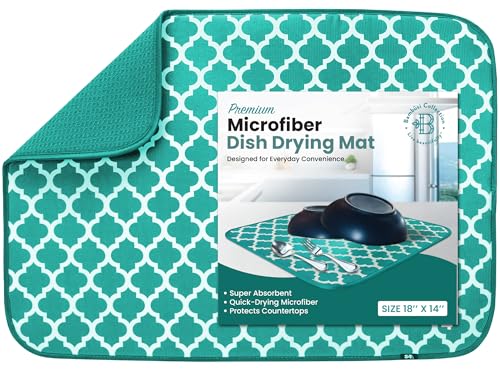
Mid-size mats are easier to fit into divided or crowded work areas. Topsky measures 20 by 15 inches, Kitsure uses two 20-by-14-inch pieces, and SUBEKYU supplies two 19.2-by-15.8-inch mats. These formats may be easier to place beside a sink rather than across the entire counter. Bambüsi’s 18-by-14-inch design is narrower still and is described for sink areas, coffee bars, and appliance use.
Its size may suit large counters, while the hand-wash and hang-dry instructions require more deliberate care. The selected products offer a more balanced mix of coverage and maintenance for this comparison.
Compare microfiber and inner-layer construction
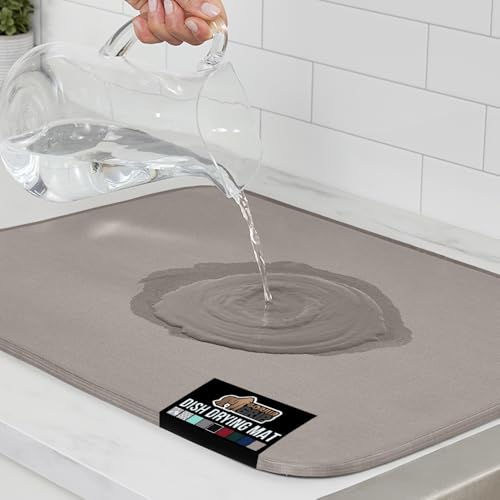
Microfiber is the common absorbent surface across the selected products, but the listings describe different supporting layers. GORILLA GRIP specifies thick foam construction and a rapid-dry mesh surface. Vodbne and Kwlegh describe absorbent microfiber around a composite sponge middle. Kitsure identifies a microfiber and foam core, while FRESHMINT specifies a three-ply structure with microfiber and composite sponge layers.
These descriptions are useful for understanding design intent, not for predicting an exact drying time. A layered or padded mat may provide more cushioning beneath glassware, while a mesh surface may encourage air circulation. The listings also use stated absorption figures for several products, commonly up to four times the mat’s weight. Those figures are product specifications, not independent test results, so they should be read as a comparison point rather than a guarantee of household performance.
Look for protection where you need it
A drying mat does more than catch drips. Several listings describe cushioning intended to protect counters from scuffs, scratches, water spots, or contact with dishes. GORILLA GRIP is the clearest choice when a non-slip underside is important because its listing specifically describes hundreds of grip dots. SUBEKYU also documents an anti-slip back. Other selected mats focus more on soft padding, reversibility, or flexible placement than on a stated grip system.
Place the mat on a clean, level counter and keep its edges clear of standing water. A pad can catch drips, but it is not a substitute for wiping a saturated surface or following the product’s care directions. If your dishes are especially delicate, look for documented cushioning, such as the foam or composite-sponge constructions listed for several selections.
Check washing and drying instructions
Care instructions vary enough to affect the buying decision. Cuisinart, GORILLA GRIP, S&T INC., FRESHMINT, Topsky, Kitsure, Vodbne, Kwlegh, and Bambüsi document machine-washable care in their listings, although some specify cold water, a gentle cycle, or low tumble drying. SUBEKYU says to machine wash but not use the dryer, recommending hang drying with its lanyard. That distinction matters if you want a mat that can move quickly from the laundry to the counter.
Hanging loops or tabs appear on several designs, including Cuisinart, Kitsure, Vodbne, Kwlegh, SUBEKYU, and Bambüsi. Foldable construction is also common, making these mats suitable for drawers, cabinets, RVs, dorm rooms, or other compact spaces. Before storing one, allow it to dry according to its instructions rather than folding it while wet.
Decide whether one mat or two works better
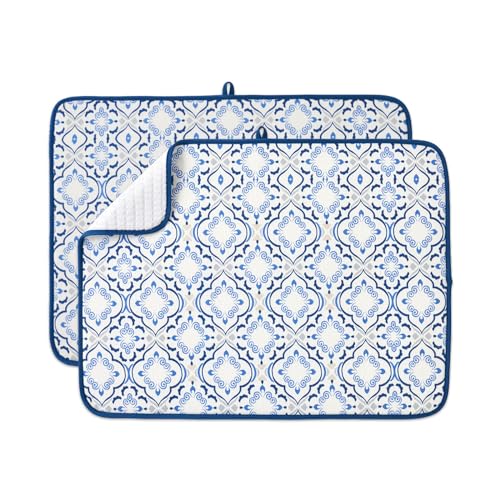
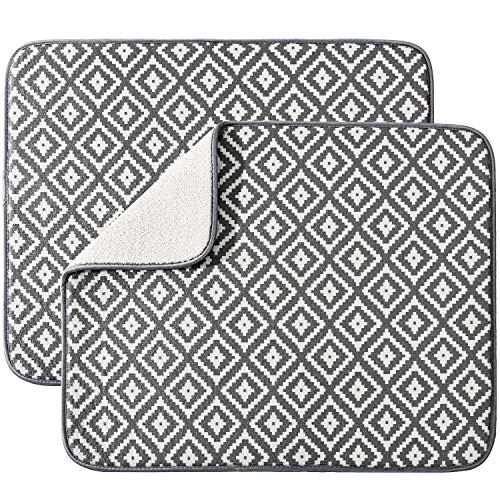
A single XL mat is simple and gives you one continuous drying area. A two-pack can be more flexible: keep one beside the sink and one near a coffee station, combine two pieces for broader coverage, or use one while the other is being cleaned. Cuisinart’s two full-size mats are suited to rotation, while Kitsure specifically documents separate or combined use. Topsky and SUBEKYU provide two mid-size mats for divided layouts.
Two-packs may also be useful for households that regularly wash several loads of dishes. However, the number of mats does not automatically mean more total usable area; compare each piece’s dimensions and the shape of your counter. A single 18-by-24-inch mat may be easier to position than two smaller pads if you prefer a seamless surface.
Consider reversible and decorative designs
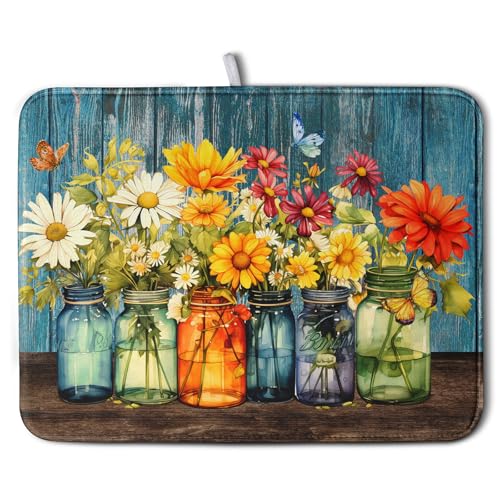
Reversibility can mean two usable sides, a patterned side and a solid side, or a mat that can be flipped after one side becomes damp. Topsky, S&T INC., Vodbne, Kwlegh, FRESHMINT, and Bambüsi document reversible designs. Decorative choices include Vodbne’s sage-green pattern, Kwlegh’s daisy-and-vase design, and FRESHMINT’s Moroccan tile pattern. These options can coordinate with a kitchen instead of leaving a plain gray pad on display.
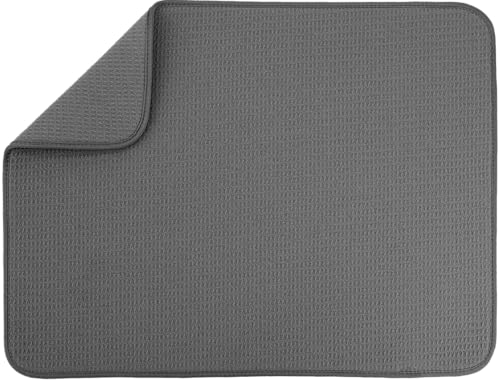
A pattern is a style feature, not proof of better absorption or durability. Prioritize dimensions, construction, and care instructions first, then choose the appearance that fits your space. For a neutral look, GORILLA GRIP, Topsky, Kitsure, S&T INC., and SUBEKYU use gray or charcoal color descriptions in the supplied data.
Match the mat to secondary uses
Many selected listings describe uses beyond drying dishes, including under coffee makers, blenders, pet bowls, or rinsed produce. These uses can make a flexible microfiber pad more useful in a small kitchen. Bambüsi is explicitly positioned for coffee bars and appliances, while GORILLA GRIP, Vodbne, Kwlegh, FRESHMINT, and Kitsure describe produce or pet-related uses.
Use these secondary applications only when the mat remains clean and appropriate for the task. A pad used beneath a pet bowl should be washed before returning it to tableware duty. Likewise, a mat used under an appliance should be sized so the appliance remains stable and does not overhang the edges.
Final Recommendation
GORILLA GRIP Ultra Water Absorbent Mat ranks first overall in this specification-based comparison under the published weighted criteria.
Cuisinart 2-Pack XL Dish Drying Mats is the first overall specification-based choice among these best microfiber dish drying mats. Its two 18-by-24-inch mats, documented microfiber construction, cushioning, machine-wash care, flat storage, and hanging loops create a well-rounded setup for regular kitchen use. GORILLA GRIP is the stronger alternative when a thick foam build, mesh surface, and specifically described grip-dot backing matter most. S&T INC. is a straightforward single-mat pick, while Topsky, Kitsure, and SUBEKYU are better suited to smaller or divided counters.
For appearance-led shopping, FRESHMINT, Vodbne, and Kwlegh provide patterned reversible designs without leaving the core drying-mat category. Bambüsi is useful when the mat needs to share duties with a coffee station or appliance area. The top microfiber dish drying mats are therefore not one identical style: choose XL coverage for full loads, a two-pack for rotation, a compact format for limited counters, or a decorative surface when the mat will remain visible.
Frequently Asked Questions
Among the best microfiber dish drying mats, are microfiber dish drying mats better than a rigid dish rack?
They serve different purposes. A mat folds flat and provides a cushioned place for dishes or a rack, while a rigid rack creates raised channels and fixed organization. The selected listings document mats for direct dish placement and under-rack use, so a mat can supplement a rack or replace it when flexible storage matters. The best microfiber dish drying mats are especially practical when counter space is limited or when you want to store the drying surface in a drawer after use.
What size dish drying mat should I buy?
Measure the counter beside the sink and compare it with the mat’s stated dimensions. An 18-by-24-inch design gives broad coverage for cookware and a full dish load, while 20-by-14-inch, 20-by-15-inch, 19.2-by-15.8-inch, or 18-by-14-inch formats are easier to fit into narrower spaces. Two smaller mats can also divide tasks between a sink and a coffee station, but check whether their combined footprint fits your counter.
Can these microfiber mats go in the washing machine?
Most selected listings document machine washing, but instructions differ. Some specify cold water, a gentle cycle, or low tumble drying. SUBEKYU specifically says not to use a dryer and recommends hanging the mat from its lanyard. Always follow the instructions for the exact product, and let the mat dry before folding it for storage.
Do dish drying mats have non-slip backing?
Some do, but the evidence varies by product. GORILLA GRIP documents hundreds of slip-resistant dots, and SUBEKYU specifies an anti-slip back. Other listings emphasize cushioning, layered construction, or reversible use without describing a dedicated non-slip backing. If movement is a priority, choose a product whose listing explicitly identifies a grip or anti-slip feature.
Can a drying mat be used under a coffee maker or pet bowl?
Several selected listings document multipurpose uses such as coffee machines, blenders, appliances, produce, or pet bowls. Bambüsi specifically describes coffee-bar, appliance, and pet-bowl applications, while Kitsure and GORILLA GRIP list additional countertop uses. Clean the mat appropriately between uses, and make sure the appliance or bowl sits securely within the mat’s dimensions.