Buying Guide
The best microwave-safe serving bowls should do more than tolerate reheating. A useful set also needs a capacity that matches the food you serve, a shape that helps contain or present it, and care instructions that fit your routine. The products above vary considerably: some are wide pasta bowls, some are deep ceramic vessels, one includes storage lids, and another offers three graduated sizes.
Start with the intended serving task
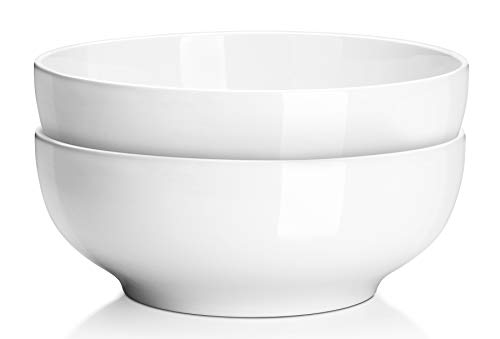
For shared salads, fruit, soups, or party dishes, prioritize capacity and stability. DOWAN lists 90-ounce bowls, while Amazon Basics lists a largest bowl holding up to 100 ounces. Mfacoy, MALACASA, getstar, and the 56-ounce option from MALACASA also provide generous room for family-style foods. Large capacity can be useful when mixing or serving, but it also usually means a larger footprint in the cabinet and on the table.
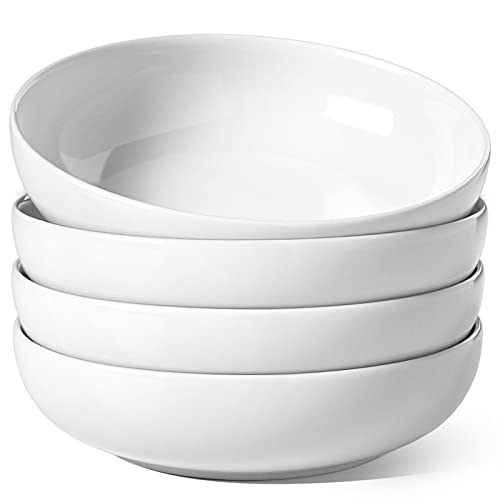
For individual meals, pasta, cereal, soup, or ramen, a medium-large bowl may be more practical. LE TAUCI lists 45-ounce bowls with a 2.4-inch depth, while Corelle lists 46-ounce meal bowls. Sweese’s 42-ounce format sits in a similar everyday range. These sizes can provide room for a complete meal without committing to the dimensions of a centerpiece bowl.
Compare wide and deep profiles
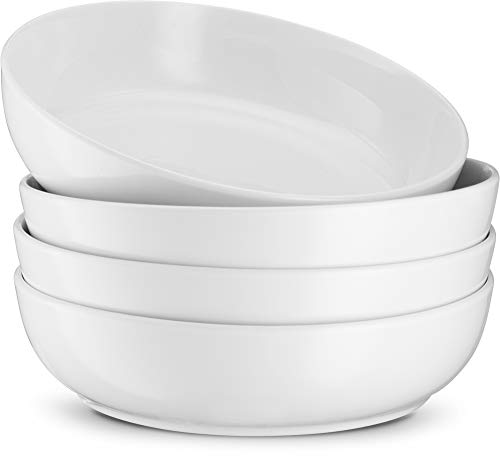
Shape affects both presentation and handling. KooK’s 40-ounce bowls are described as wide and shallow, allowing them to function as low bowls or deep plates. This profile can suit pasta, sandwiches, desserts, and plated foods. MALACASA also uses a 10-inch wide and shallow design, with a 2.1-inch depth.
Deeper designs can be helpful for soups, ramen, salads, and foods that need stirring. Mfacoy describes its bowls as deeper and wider, with a flat bottom intended to stand firmly. LE TAUCI identifies its 2.4-inch depth as useful for stirring. DOWAN’s large bowls are described as deep, making them more oriented toward shared dishes than flat presentation.
Evaluate the material claims
Most selections here are ceramic, porcelain, stoneware, or glass. Porcelain appears in Mfacoy, Sweese, LE TAUCI, and MALACASA listings, while KooK uses ceramic and Amazon Basics uses glazed stoneware. Corelle uses triple-layer-strong glass. The listings variously mention high firing, chip resistance, scratch resistance, non-porous surfaces, and lead- or cadmium-free materials.
These claims are useful for comparing documented construction, but they are not a substitute for handling the bowls yourself. Ceramic and stoneware may offer a substantial table presence, while Corelle’s listing emphasizes lightweight glass. If weight matters, review the supplied specifications and consider how the bowl will be handled when hot.
Every selected product is listed as microwave safe, but the supporting details differ. DOWAN provides a stated 446°F limit for microwave and dishwasher use. The KooK lidded set adds an important instruction: open the lid vent before heating. Other listings identify microwave compatibility alongside oven, freezer, refrigerator, or dishwasher use without supplying a specific temperature limit.
The phrase best microwave-safe serving bowls describes a shopping category, not a guarantee that every use is identical. Follow the product’s own care instructions, especially when heating food with lids, moving hot ceramic or glass, or switching between cold storage and reheating. Microwave-safe claims also do not mean that a bowl or lid should be used in every appliance or at every temperature.
Look at cleaning and storage
Stackability is especially valuable when serving bowls have wide rims or large diameters. Mfacoy, LE TAUCI, Sweese, DOWAN, Corelle, and Amazon Basics all document stackable or nestable storage. The KooK lidded set nests its four sizes, while the three Amazon Basics sizes nest together. These features can reduce the cabinet space needed, although the actual footprint depends on the bowl shape and shelf height.
For cleanup, the listings commonly document dishwasher safety and smooth or glazed surfaces. Corelle specifically describes a non-porous surface, while Mfacoy and LE TAUCI mention smooth glazed interiors. If you prefer hand washing, rounded edges and a manageable size may matter more than the dishwasher claim alone.
Decide whether lids are useful
The KooK nesting set is the only selected design centered on serving, storing, and transporting with included lids. Its four sizes cover small portions through a 47-ounce bowl, and the lids are described as leak proof with steam vents. That makes it a practical choice for leftovers and meal prep, but the vent must be opened for microwave heating. A lidded set also introduces another component to wash and store.
If your priority is a presentation bowl for the table, a lid may add little value. If you regularly refrigerate leftovers and reheat them in the same container, it can reduce transfers between storage and serving.
Match set size to your household
Two-piece sets such as Mfacoy, DOWAN, and getstar are useful for shared dishes or smaller households. Four-piece sets from Sweese, MALACASA, LE TAUCI, KooK, and Corelle provide more matching coverage for family meals. Amazon Basics takes a different approach with three sizes rather than four matching bowls. Consider whether you need identical place settings, several capacities, or one or two large vessels.
Final Recommendation
Mfacoy 60-Ounce Ceramic Serving Bowls, Set of 2 ranks first overall in this specification-based comparison under the published weighted criteria.
Mfacoy is the highest-scoring returned product and the first overall specification-based choice among the best microwave-safe serving bowls. Its 60-ounce capacity, deep and wide profile, flat bottom, stackable construction, and documented microwave, dishwasher, and freezer compatibility make it a well-rounded option for everyday serving.
For a four-piece family set, Sweese and LE TAUCI provide balanced capacities and broad care documentation. Choose MALACASA or DOWAN when large shared portions are the priority, and consider Amazon Basics when three graduated sizes are more useful than matching bowls. KooK’s lidded set is the more practical storage-oriented option, while Corelle suits shoppers who specifically prefer lightweight glass. Together, these are the top microwave-safe serving bowls for different serving, storage, and presentation needs.
Frequently Asked Questions
What should I check before buying the best microwave-safe serving bowls?
Check the listing’s microwave-safety statement, any temperature limit, whether lids require venting, and whether the bowl is also dishwasher or freezer safe. Capacity and diameter matter as much as the microwave claim because a bowl must fit both your meal and your cabinet. DOWAN documents a 446°F limit, while KooK’s lidded set specifies that its vents should be opened before heating.
Are wide or deep bowls better for serving?
Neither profile is universally better. Wide, shallow bowls such as the KooK 40-ounce set and MALACASA’s 56-ounce set can present pasta and salads across a broad surface. Deeper bowls such as Mfacoy and LE TAUCI may be more convenient for soup, ramen, stirring, and foods with more liquid. Choose according to the dishes you serve most often.
Which selected bowls are best for large gatherings?
DOWAN’s 90-ounce bowls and Amazon Basics’ largest listed 100-ounce bowl provide the biggest documented capacities. MALACASA’s 56-ounce four-piece set and Mfacoy’s 60-ounce two-piece set are also suitable for substantial portions. Larger bowls may need more cabinet space, so measure your shelves before choosing.
Can ceramic serving bowls go from the freezer to the microwave?
Several selected listings, including Mfacoy, Sweese, LE TAUCI, getstar, and the KooK lidded set, document both freezer and microwave compatibility. However, follow the product’s specific instructions rather than assuming every temperature transition is suitable. For lidded bowls, check the venting guidance before reheating.
Which set is most useful for leftovers?
KooK’s four ceramic nesting bowls include matching plastic lids and are explicitly described for storing, transporting, and reheating food. The bowls cover several capacities and nest for storage. The lids add utility, but they also require separate cleaning and must be vented before microwave use.