Buying Guide
Choosing the best monocrystalline solar panels starts with the system rather than the marketing headline. A panel must fit the available mounting area, battery voltage, charge controller, wiring plan, and expected load. The products in this comparison range from compact 100W modules to multi-panel packages rated for hundreds or thousands of watts. They are not interchangeable simply because each uses monocrystalline cells.
Match wattage to the installation
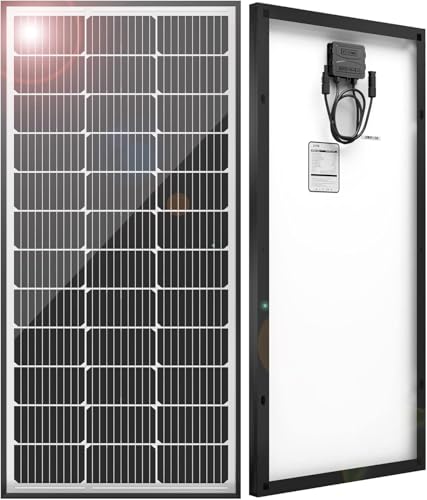
Wattage is the panel’s rated power under stated test conditions, not a guarantee of daily energy in every location. A 100W panel such as the JJN 10BB model is aimed at smaller 12V applications, including modest RV, boat, gate-opener, or maintenance loads. A 200W panel can provide more capacity without the size of a full array, while the Renogy ShadowFlux and AeternaSol options add higher-efficiency N-type designs in that range.
For larger fixed systems, a single 435W Livosun module, two 425W JJN modules, or eight 450W SGPWATT modules can reduce the number of individual panels needed. Large modules also require more roof, rack, or ground space and may need careful handling during installation. Check the actual module dimensions before selecting a package based only on total wattage.
Compare cell and busbar technology
Several selected products use N-type cells, including the Renogy ShadowFlux, Renogy 400W, Callsun, AeternaSol, Livosun, JJN 850W, and ECO-WORTHY 400W products. The supplied listings state efficiencies up to 25% for many of these designs. Higher stated efficiency can help when the mounting area is limited, but it should be compared with the panel’s physical dimensions and the rest of the system.
Busbar counts also vary. The selected panels document 10BB, 16BB, and 18BB designs. These specifications are useful indicators of the cell architecture described by the manufacturer, but they do not by themselves establish actual field output.
Consider bifacial placement
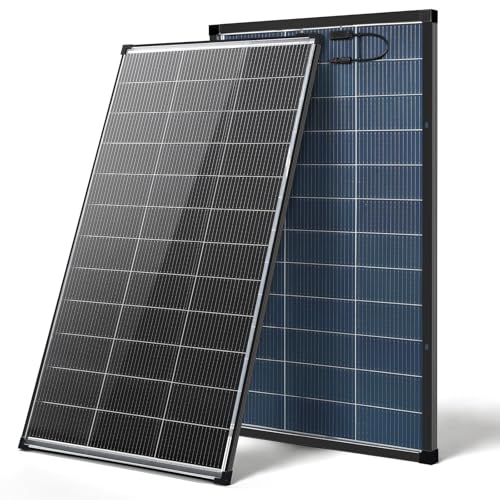
Bifacial panels can capture light from the front and rear sides. AeternaSol, Livosun, JJN, and ECO-WORTHY document bifacial designs. This feature is most relevant when the rear of the panel can receive useful reflected or indirect light, such as above an open ground rack or a suitable elevated structure. A tightly mounted rooftop may offer less opportunity for rear-side generation.
Bifacial construction should therefore be treated as an installation-dependent feature, not an automatic output increase. Review the mounting height, surface beneath the panel, shading, and wiring arrangement. If the rear side will be blocked, a conventional panel may be a simpler match even when its headline specifications look similar.
Check voltage and controller compatibility
A panel’s nominal voltage and electrical characteristics must match the charge controller, battery bank, inverter, and series-or-parallel wiring plan. The selected Renogy 400W panel states compatibility with 12V and 24V battery systems. Callsun identifies 12V and 24V system use, while the SGPWATT package describes configurations for 12V, 24V, 36V, and 48V batteries. Those statements do not remove the need to check voltage limits and controller requirements.
The JJN 850W package is described for 12V, 24V, and 48V systems, making it a candidate for larger arrays. The small JJN 100W panel is more directly suited to compact 12V projects. Before purchase, compare the panel’s voltage at maximum power, open-circuit voltage, operating current, and short-circuit current with the controller’s limits. The product listings do not provide every electrical value for every panel, so obtain missing specifications before finalizing a system.
Evaluate outdoor protection and long-term claims
Outdoor construction details include tempered glass, corrosion-resistant aluminum frames, waterproof junction boxes, and stated wind or snow-load ratings. Callsun documents IP68 protection and 2400 Pa wind and 5400 Pa snow ratings. The ECO-WORTHY 400W set also lists IP68 junction boxes, while Renogy ShadowFlux specifies an IP67-or-better rating. JJN’s 100W panel lists an IP65 junction box and IP67 connectors.
These ratings apply to the specified component and do not guarantee that the complete installation will resist every condition. Mounting hardware, cable routing, seals, drainage, and frame attachment also matter. Long output periods are commonly listed, but they are manufacturer commitments rather than results independently verified in this guide.
Plan the physical installation
Measure the roof, rack, vehicle, or boat surface and leave room for wiring and mounting hardware. Compact modules such as the Callsun 100W panels can provide more layout flexibility than a single 435W or 450W panel. Conversely, fewer large panels may reduce the number of mounting points and connections.
Weight matters as well. The JJN 850W package consists of two large modules, so buyers should confirm the structure can support the finished array. Confirm whether the supplied weight refers to one module or a package, and verify the structure’s capacity. Frameless STAR panels may need mounting hardware suited to their design, while most framed products identify pre-drilled holes.
How this comparison was scored
This is a specification-based editorial comparison using the supplied public listing fields. Conversion efficiency received the largest weight because it is directly relevant when space is limited. Power and system fit reflect stated wattage, voltage use, and application range. Weather and output durability consider documented protection, loading, temperature behavior, and output commitments. Cell and output technology covers N-type, bifacial, half-cell, busbar, and anti-shading details. Installation practicality considers dimensions, weight, connectors, mounting holes, and modular format.
No hands-on tests or customer-opinion summaries were used. The listings sometimes contain incomplete or inconsistent measurements, so buyers should verify the final electrical and physical specifications with the manufacturer or seller.
Final recommendation
Callsun 200W N-Type 16BB 2-Pack ranks first overall in this specification-based comparison under the published weighted criteria.
The final choice among the best monocrystalline solar panels depends on the documented features that match your intended use.
Callsun 200W N-Type 16BB 2-Pack is the highest-ranked specification-based choice in this comparison. It combines stated 25% efficiency, N-type 16BB cells, IP68 protection, heat-performance information, and a compact two-module format. Renogy ShadowFlux 200W N-Type Panel is an alternative for compact systems with documented anti-shading technology. The Renogy 400W N-Type 16BB Panel is aimed at Class B vans that need higher output from a space-conscious design.
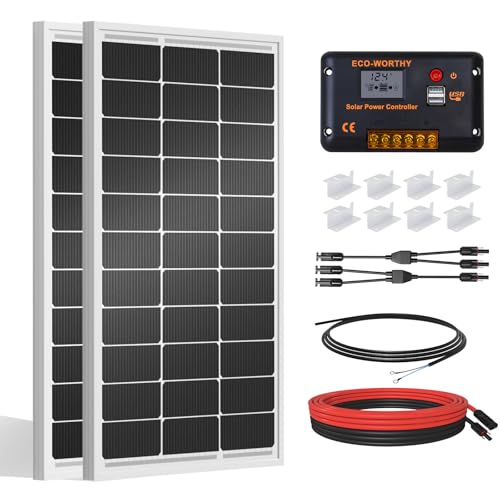
For open racks where rear-side light is available, AeternaSol 200W 18BB N-Type Bifacial Panel and Livosun 435W N-Type Bifacial Panel provide documented bifacial designs. Larger arrays can use the JJN 850W set, SGPWATT 450W package, or STAR 990W set, while the ECO-WORTHY four-pack offers modular installation flexibility.
The right choice among the top monocrystalline solar panels depends on system voltage, usable surface, controller limits, and whether the installation can take advantage of bifacial or anti-shading features. Confirm those details before ordering rather than selecting by wattage alone.
Frequently Asked Questions
What makes monocrystalline panels different from other solar panels?
Monocrystalline panels use cells made from monocrystalline silicon. In this comparison, listings describe additional designs such as N-type cells, PERC cells, half-cell layouts, and multiple busbars. Those details can affect the stated efficiency, physical format, or intended application, but the listing specifications should be checked individually.
Are the best monocrystalline solar panels always the highest-wattage models?
No. A high-wattage panel may be unsuitable if the roof, RV, boat, rack, or controller cannot accommodate it. Compact 100W or 200W panels can be more practical for small batteries or limited mounting areas, while large multi-panel packages make more sense for higher-capacity arrays.
When should I choose a bifacial panel?
Choose a bifacial design when the rear surface can receive meaningful reflected or indirect light. The AeternaSol, Livosun, JJN, and ECO-WORTHY selections document bifacial construction. A tightly mounted panel with a blocked rear surface may not benefit as much from that design.
Can these panels charge a 12V or 24V battery?
Some listings state 12V and 24V use, and the SGPWATT and JJN packages describe broader system ranges, but compatibility depends on the charge controller and the complete electrical specifications. Check operating voltage, open-circuit voltage, current, wiring configuration, and controller limits before connecting a panel.
What should I verify before installing a solar panel?
Verify the panel dimensions, weight, operating and open-circuit voltage, current, controller limits, mounting method, connector type, cable routing, and structural capacity. Also check whether the stated weather rating applies to the panel, junction box, connectors, or the completed installation.