Buying Guide
The best outdoor artificial trees are chosen less by a single headline feature than by how their construction matches the intended location. A tall cedar pair can frame a doorway, while a compact boxwood ball may work better inside a planter. The listings in this comparison document several different approaches: heavy pots, ground spikes, UV-oriented foliage, weather-resistant materials, adjustable branches, and foldable storage.
This is a specification-based comparison using public listing information. It is not a hands-on test, and it does not summarize customer opinions. Because outdoor exposure varies by climate and placement, treat terms such as UV-resistant, waterproof, weather-resistant, and suitable for outdoor use as the product claims supplied in the listings rather than as a guarantee of identical performance in every location.
Match tree height to the setting
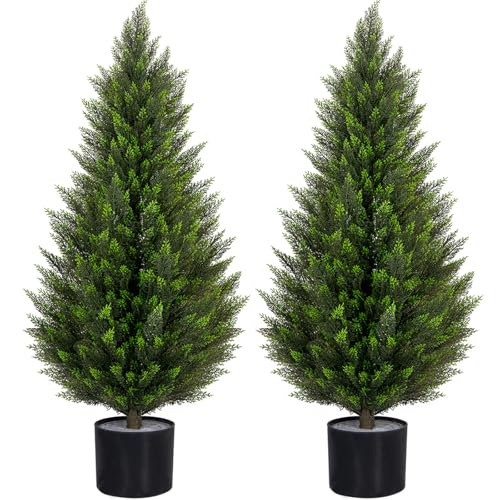
Start with the available vertical and floor space. The six-foot Chillchard cedar pair and Suntee areca palm pair are the most prominent selections here. They can create a stronger visual frame beside a large entrance, along a patio, or at the edge of a broad outdoor seating area. Their height also means they need enough clearance from ceilings, railings, branches, and door swings.
The four-foot Keeplush palm and FANSXIVITA camellia pair occupy a middle range. They can add definition without the footprint of a taller floor tree. The five-foot Kzztkz bougainvillea sits between compact topiary and tall palms, making it a useful option when a flowering accent is wanted but seven-foot scale is unnecessary.
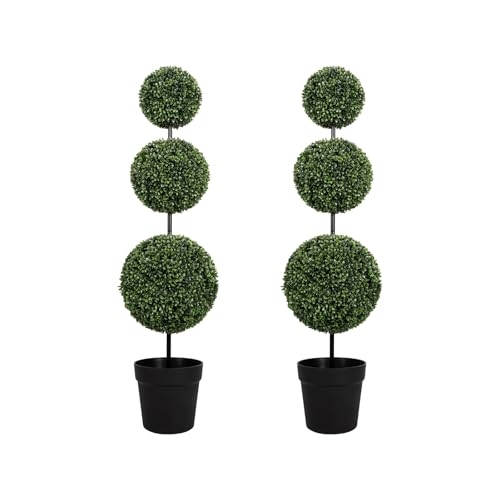
For smaller porches, balconies, planters, and narrow entryways, consider the three-foot VIVATREES cedar or triple-ball boxwood designs. HyeFlora’s 26-inch topiaries are smaller still and are intended more as decorative accents than as independent focal trees. Check the listed width as well as height: a rounded canopy can need more lateral room than a narrow upright form.
Choose the right mounting method
Placement hardware is one of the clearest practical differences among artificial trees. Spike-mounted products can be pushed into soil, lawn, or a planter, giving more freedom than a permanently potted tree. They may need a decorative container when used on a hard surface, and the soil or planter must provide enough resistance for the intended location.
The Chillchard pair includes heavy pots, while Suntee describes concrete-filled planters. Those features are relevant when you want a ready-to-place display and do not want to source a separate container. VIVATREES’ triple-ball boxwood also documents weighted planters. A weighted base can be convenient, but it may make seasonal relocation more difficult than moving a lightweight spike-mounted tree.
Pre-potted products are generally simpler for a finished look. FANSXIVITA arrives in stable black planters, and Caxchiling includes both a black planter and a cotton basket. Keeplush includes a sturdy base. For every product, confirm whether the supplied base is suitable for an exposed site or whether a sheltered porch, wall, planter, or other added support is preferable.
Prioritize outdoor material claims
Sun exposure and moisture are central considerations. GZFDY, Chillchard, FANSXIVITA, Kzztkz, VIVATREES, and HyeFlora describe UV-resistant, UV-inhibited, fade-resistant, weather-resistant, or weatherproof materials in their supplied evidence. Chillchard also specifically lists waterproof construction. These details make such products more directly suited to outdoor comparison than a faux tree whose listing only describes indoor decor.
The FANSXIVITA camellia is specifically positioned for covered outdoor areas, including covered patios, balconies, and porches. Caxchiling’s evidence documents indoor-outdoor use but does not specify UV resistance or waterproofing. That makes it a sensible candidate for a protected transition area, while a fully exposed site may call for a product with more explicit weather-related documentation.
Even when foliage is UV resistant, the container, trunk connections, and placement system still matter. Review the complete listing for the exact version you plan to buy, especially if the product is sold in multiple colors or configurations. Avoid assuming that an indoor-focused model has the same outdoor documentation as a model explicitly marketed for gardens or patios.
Compare foliage and decorative style
Evergreen cedar and boxwood designs provide a restrained green backdrop. Chillchard, GZFDY, and VIVATREES offer cedar or cedar-topiary forms, while the triple-ball VIVATREES design creates a more formal silhouette. These shapes work well when matching a pair on either side of a door or walkway is more important than adding flowers.
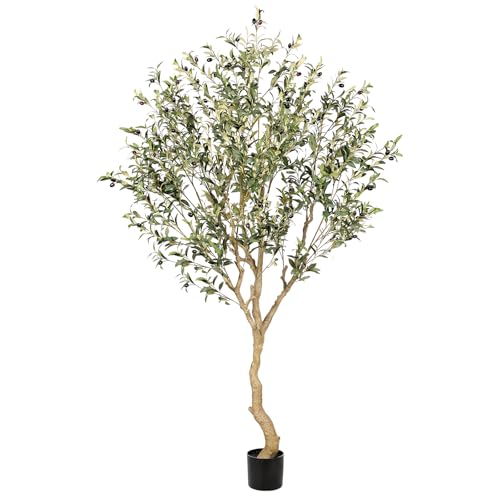
Palms create a different visual effect. Keeplush and Suntee use tropical palm styling, with adjustable leaves documented on both products. Suntee is the taller paired option, while Keeplush is a smaller single accent. The Caxchiling eucalyptus has dense leaves and a natural-trunk description, giving it a softer leafy profile than a rigid geometric topiary.
For color, the Kzztkz bougainvillea and FANSXIVITA camellia add flowers, while HyeFlora combines boxwood with lavender crowns. These products can complement neutral walls and plain patios, but their color is a more noticeable design commitment. If you want a background plant that works across changing decor, green cedar, eucalyptus, palm, or boxwood is usually the less specialized visual direction based on the supplied designs.
Account for setup and storage
Artificial trees still commonly need shaping after delivery. GZFDY says leaves may need to be snapped back into place, while HyeFlora and other topiary listings call for fluffing or bending branches. Kzztkz is disassemblable, Caxchiling is described as assembling in one minute and storing compactly when disassembled, and VIVATREES products document foldable construction. These details matter if the tree will be moved, stored seasonally, or placed in a multipurpose area.
A ready-to-display planter can shorten setup, but flexible branches may still need adjustment for the intended silhouette. Leave room to open the canopy, check the base, and position the tree without blocking a walkway. For spike-mounted products, decide whether the tree will remain in soil or move between containers before arranging the branches.
Final recommendation
Chillchard 6FT Artificial Cedar Tree, 2-Pack ranks first overall in this specification-based comparison under the published weighted criteria.
Chillchard 6FT Artificial Cedar Tree, 2-Pack is the first overall specification-based choice among these best outdoor artificial trees. Its six-foot height, paired format, UV-resistant and waterproof material claims, fade resistance, and heavy pots create the best-documented combination for a prominent outdoor display. Suntee is a suitable alternative for a tropical look, particularly when concrete-filled planters are useful. GZFDY is better for flexible spike mounting, while the VIVATREES triple-ball pair suits formal entryways and compact commercial-style displays.
Among the top outdoor artificial trees, the most suitable choice depends on the site: select a tall cedar or palm for presence, a spike-mounted topiary for adaptable placement, or a flowering design for color. Confirm the available dimensions, exposure, mounting surface, and storage needs before ordering.
Frequently Asked Questions
What are the best outdoor artificial trees for a large porch?
The Chillchard six-foot cedar pair and Suntee six-foot areca palm pair are the most specification-aligned large-format options in this comparison. Both provide two tall trees, while Chillchard documents heavy pots and Suntee documents concrete-filled planters. Choose cedar for an evergreen appearance or areca palm for a tropical style.
Are artificial trees with ground spikes better for garden soil?
A ground spike can be useful when the tree will be placed in soil, grass, or a planter. GZFDY and HyeFlora document spike-mounted designs. They offer placement flexibility, but the surrounding soil or container still needs to hold the spike securely. Spike-mounted products may be less convenient on concrete or other hard surfaces without a suitable planter.
Which best outdoor artificial trees work in smaller spaces?
The VIVATREES three-foot cedar pair, VIVATREES triple-ball boxwood pair, and HyeFlora 26-inch topiaries have more compact listed dimensions than the six- and seven-foot trees. HyeFlora is particularly suited to planters and garden beds, while the three-foot VIVATREES options can provide a more noticeable entryway accent.
Do outdoor artificial trees need maintenance?
They do not need watering, pruning, fertilizing, or sunlight according to the supplied product descriptions. They may still need occasional dusting and branch shaping after unpacking. Outdoor placement also requires checking the base, planter, or spike and choosing a location appropriate to the product’s documented weather-related claims.
Are flowering faux trees suitable for outdoor decor?
The Kzztkz bougainvillea and FANSXIVITA camellia are both described for outdoor or covered outdoor settings. They add pink or yellow floral color rather than plain evergreen foliage. FANSXIVITA specifically emphasizes covered patios, balconies, and porches, so use that documented placement guidance when deciding where to display it.