Buying Guide
The best pencils are easier to choose when you separate the writing mechanism from the point size and pack format. The selected products fall into two main designs: wood-cased pencils that need sharpening and mechanical pencils that advance replaceable lead. Neither design is universally better. Wood-cased models are straightforward and often sold in large classroom quantities, while mechanical models remain ready to write and offer more control over lead size.
Wood-cased versus mechanical pencils
Wood-cased pencils are a practical choice when you want a familiar #2 or HB format with an attached eraser. Ticonderoga, Amazon Basics, Bostitch, and Taja document wood-cased construction, and each is sold pre-sharpened. That readiness matters for classrooms and shared drawers. The trade-off is that the tip eventually requires a sharpener, and the supplied listings do not identify a sharpener included with these four selections.
Mechanical pencils avoid sharpening by advancing lead through the barrel. BIC Xtra Smooth, Paper Mate Clearpoint, Nicpro, and the other mechanical picks use this format. BIC Xtra Smooth documents replaceable lead and erasers, while Nicpro includes lead refills, erasers, and a case. These features can make mechanical pencils convenient for repeated use, but they also mean the buyer must keep compatible lead available.
Choose the right lead size
Point size affects the type of line the listing is designed to produce. A 0.5 mm point, as used by BIC Xtra-Precision, is the finest documented mechanical point in this group. It is a reasonable fit for compact notes, drafting-style work, and users who prefer fine lines. A 0.7 mm point is the middle ground: BIC Xtra Smooth, Paper Mate Clearpoint, Nicpro, and Paper Mate Write Bros. use it for everyday writing, schoolwork, or sketching.
The 0.9 mm BIC Xtra Strong is the broadest standard mechanical point selected. Its listing specifically identifies a thick point, so it is better matched to shoppers who prefer broader marks than to those seeking fine detail. Wood-cased #2 HB and medium-soft lead options provide another familiar middle ground. Ticonderoga documents a thick graphite core and broad consistent lines, while Amazon Basics describes its HB lead as medium-soft and versatile.
Match the pencil to the task
For standardized tests and ordinary schoolwork, look for #2 or HB lead. Several selected mechanical products identify No. 2 lead as compatible with most standardized tests, including BIC Xtra-Precision, BIC Xtra Strong, and Paper Mate Clearpoint. The wood-cased Ticonderoga, Amazon Basics, Bostitch, and Taja options also use #2 HB formats. This does not replace checking a particular test’s instructions, but it makes the documented lead designation an important buying filter.
For drawing and sketching, consider the point and grip rather than pack quantity alone. Nicpro is explicitly positioned for sketching, drafting, template work, and technical users, with a sculpted silicone grip and metal body. Amazon Basics and Taja describe their wood-cased pencils for drawing or sketching as well as writing. The evidence supports these intended uses, but it does not establish a tested artistic performance level.
Consider grip and barrel shape
Grip design can affect how a pencil feels during extended use, although the supplied listings do not provide hands-on comfort testing. Paper Mate Clearpoint documents a soft grip and side lead advance. Paper Mate Write Bros. documents a comfort grip for longer writing tasks. Nicpro lists sculpted silicone contours and anti-slip ridges. These are meaningful specification differences for shoppers who want a more deliberately shaped writing tool.
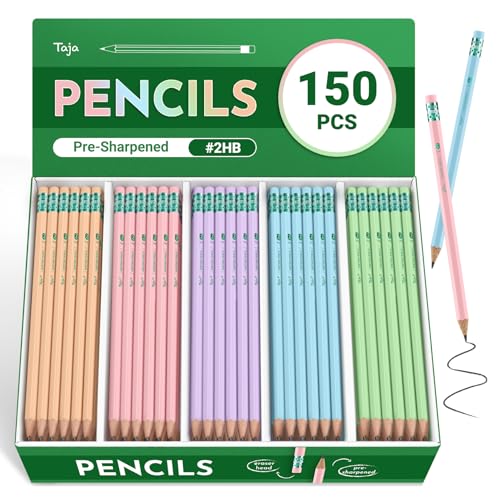
Wood-cased barrels vary in the evidence provided. Taja documents a classic hexagonal barrel that helps prevent rolling and supports a non-slip grip. Ticonderoga documents premium wood selected for even sharpening and minimal breakage. Bostitch identifies American cedar wood. Amazon Basics provides dimensions and lead information but less detail about its barrel construction. Use the more specific construction claims when choosing between otherwise similar wood-cased packs.
Think about erasers and refills
An attached eraser is useful for school notes and forms, but the listings describe these systems differently. Ticonderoga and Amazon Basics specify latex-free erasers. Bostitch also specifies a latex-free eraser, while Paper Mate Clearpoint uses a jumbo twist eraser. Mechanical pencils can offer a longer-term correction system when replacement erasers are available: Nicpro includes eraser refills, and BIC Xtra Smooth states that its eraser can be replaced.
Lead refills are another distinction. Nicpro includes multiple HB lead tubes, and BIC Xtra Smooth is explicitly refillable. The remaining mechanical pencils are supplied ready to use, but their listings do not describe included refill tubes. If you are building a reusable desk setup, confirm the compatible lead size before buying additional refills.
Evaluate pack size and storage
Pack size should match how many people will use the pencils. Ticonderoga’s 72-count pack, Bostitch’s 60-count pack, and the 24- or 40-count mechanical packs are suitable for household, office, or classroom replenishment. Amazon Basics and Taja each provide 150 pencils for larger shared-supply needs. Nicpro is a smaller three-pencil set, but it adds a case and refill supplies rather than maximizing pencil count.
A large pack is useful only if the design matches the task. For a single writer, a smaller mechanical set may reduce unused inventory. For teachers, offices, or families with several writers, bulk wood-cased packs are more convenient to distribute. Color can also be a practical preference: Taja offers yellow and macaron styles, while Paper Mate Clearpoint and Paper Mate Write Bros. list assorted barrel colors.
How this comparison was scored
This is a specification-based comparison using public listing data, not a hands-on test and not a summary of customer opinions. Products were scored on writing consistency, lead control and precision, correction system, readiness and convenience, build and grip design, and pack utility. The criteria reflect the evidence available for pencils: lead designation and point size, pre-sharpening or advancement, erasers and refills, barrel or grip details, and quantity. Marketplace ratings, review information, purchase activity, and retail labels were not used in the published scores.
Final recommendation
Ticonderoga Wood-Cased #2 HB, 72 Count ranks first overall in this specification-based comparison under the published weighted criteria.
Ticonderoga Wood-Cased #2 HB, 72 Count is the highest-scoring returned product and the first overall specification-based choice. Its documented graphite formula, thick core, pre-sharpened format, eraser, wood construction, and 72-count supply make it a balanced option for ordinary school, office, and form-filling work.
The final choice among the best pencils depends on the features that match your intended use. Choose Amazon Basics Wood-Cased #2 HB, 150 Count when quantity is the priority, or Bostitch Office Premium #2 HB, 60 Pack when American cedar construction matters more. Taja is a colorful bulk alternative with a hexagonal barrel.
Among mechanical designs, BIC Xtra Smooth is a practical medium-point supply pack, Paper Mate Clearpoint adds side advancement and a soft grip, and Nicpro is a feature-rich set for drafting and sketching. For the top pencils by line size, choose BIC Xtra-Precision for a fine 0.5 mm point or BIC Xtra Strong for a thicker 0.9 mm point. Paper Mate Write Bros. fills the everyday 0.7 mm comfort-grip role.
Frequently Asked Questions
What are the best pencils for standardized tests?
Look for a clearly identified #2 or HB lead and follow the test administrator’s rules. BIC Xtra Smooth, BIC Xtra-Precision, BIC Xtra Strong, Paper Mate Clearpoint, and Paper Mate Write Bros. document No. 2 or HB lead for school-related use. The wood-cased Ticonderoga, Amazon Basics, Bostitch, and Taja options also use #2 HB formats.
Should I buy wood-cased or mechanical pencils?
Buy wood-cased pencils if you want a pre-sharpened traditional format and large supply pack. Choose mechanical pencils if avoiding sharpening, selecting a specific point size, or replacing lead is more important. Nicpro and BIC Xtra Smooth are the clearest refill-oriented choices in this selection.
Which best pencils have a fine point?
BIC Xtra-Precision has the smallest documented mechanical point at 0.5 mm. It is designed for fine writing and drafting-style use. The 0.7 mm options provide a broader everyday line, while BIC Xtra Strong’s 0.9 mm point is intended for users who prefer a thick point.
Are pre-sharpened pencils worth choosing?
Pre-sharpening is useful when pencils will be distributed immediately or stored for classroom and office use. Ticonderoga, Amazon Basics, Bostitch, and Taja all document pre-sharpened wood-cased pencils. Mechanical pencils do not need sharpening, but they require compatible replacement lead when the supplied lead is exhausted.
Which selected pencil is best for sketching?
Nicpro is the most specifically equipped option for sketching and drafting because its listing documents a metal body, sculpted silicone grip, anti-slip ridges, HB refills, erasers, and a storage case. Amazon Basics, Taja, and the other wood-cased models are also described for drawing or sketching, but their listings provide fewer specialized set features.