Buying Guide
The best phillips socket screwdriver bits are selected by matching the socket drive, Phillips size, construction, and access requirements to the fastener. Public listings use several formats: dedicated bit sockets, multi-size socket sets, adapters that connect bits to square drives, and compact ratchet kits. These formats are not interchangeable in every job, so start by identifying how the tool will be driven.
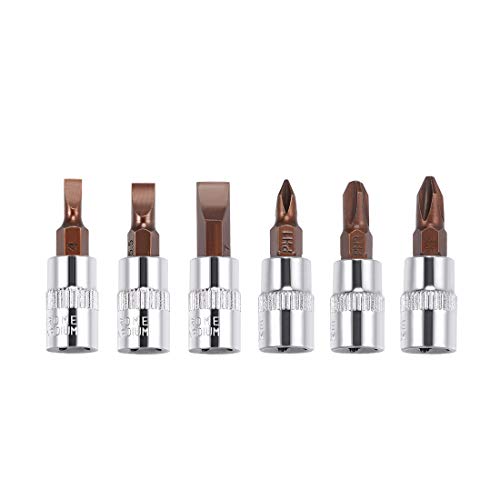
The Performance Tool W38860 and GEARWRENCH 80577 use a 3/8-inch drive, as do both TEKTON sockets and the FOCMKEAS PH2 pair. A 1/4-inch drive appears on the uxcell, CoCud, and Generic PH1-PH4 options, while the TEKTON SHB21204 uses a 1/2-inch drive.
A smaller drive can suit compact ratchets and lighter assembly work, while a larger drive may fit a heavier-duty ratchet. The evidence does not establish a universal torque limit for any product. The drive on the socket must match the square-drive tool or adapter being used. The Generic PH1-PH4 kit is different because its listing presents it as an adapter for connecting screwdriver bits to a 3/8-inch square-drive wrench or impact tool.
Choose the Phillips sizes you use
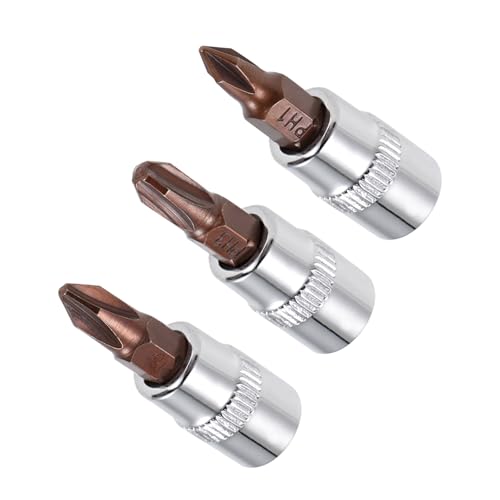
Phillips coverage varies substantially. The Performance Tool W38860 lists #0, #1, #2, and #3 Phillips sockets. The CoCud and uxcell sets list PH1, PH2, and PH3. The Generic kit extends that range through PH4. These are useful choices when a toolbox needs several common sizes.
Single-size products make more sense when the required fastener is already known. The TEKTON SHB11202 is a P2 socket, while the TEKTON SHB21204 is a P4 socket. FOCMKEAS focuses on PH2 and supplies two pieces. A single-size socket avoids carrying unused sizes, but it does not provide flexibility if a project includes different Phillips heads.
A Phillips tip in a general screwdriver kit is not necessarily the same as a Phillips bit socket. The Klein Tools 32303HD includes #0 through #3 Phillips tips as part of a broader impact-driver and nut-setter system. OSDUE also combines Phillips bits with sockets and a ratchet. Both can be useful, but their listings do not present them as collections of separate dedicated Phillips bit sockets in the same way as Performance Tool or GEARWRENCH.
Compare bit and socket materials
Several listings identify S2 steel bits and chrome vanadium, or CR-V, sockets. Performance Tool lists S2 bits and heat-treated chrome vanadium sockets. FOCMKEAS, uxcell, and CoCud also specify S2 bits with CR-V sockets. These details distinguish the bit material from the socket body.
TEKTON describes its S2 steel bit as press-fit into the socket and presents that construction as a permanent connection. The sockets have chrome-plated finishes. GEARWRENCH lists heat treatment and S2 steel bits but does not provide the same individual material detail for its socket bodies. The Generic adapter kit states chrome steel construction, while OSDUE identifies chromium vanadium steel for its ratchet mechanism.
Material names alone do not prove performance in every application. The supplied information supports comparing documented construction, not claiming a particular service life, torque capacity, or impact result. For impact-driver work, select a product whose listing explicitly describes impact use, such as the CoCud impact bit sockets or the Klein Tools set.
Consider reach and access
Length and profile matter when a fastener sits inside a recess or behind an obstruction. The FOCMKEAS sockets are listed at 1.9 inches overall, the uxcell set at 1.5 inches, and the CoCud set at 38 mm. The Generic adapters are listed at 60 mm. Those figures are listing dimensions, not a guarantee that any product will clear a particular obstruction.
Chamfered edges are called out on the Performance Tool, CoCud, and uxcell listings. The stated benefit is easier insertion or smoother entry into the fastener head. The OSDUE set takes a different approach: its low-profile mini ratchet format is aimed at confined spaces. Klein Tools 32303HD stores its bits in the handle.
Look for markings and retention features
Size identification saves time when several sockets look similar. Performance Tool includes a steel clip rail, GEARWRENCH lists hard-stamped markings, and both TEKTON products use clear die-stamped size markings. These are stronger organization signals than a listing that simply states the number of pieces.
Retention details also vary. TEKTON lists four detent grooves and, on the P2 model, a drilled through-hole for a retaining pin. OSDUE describes a magnetic bit holder, but that feature belongs to its ratcheting bit system rather than proving retention for every socket. Confirm whether the intended ratchet or driver uses a detent ball, retaining pin, magnetic holder, or another connection method.
Final recommendation
Performance Tool W38860 8-Piece Bit Socket Set ranks first overall in this specification-based comparison under the published weighted criteria.
The Performance Tool W38860 is the first overall specification-based choice for the best phillips socket screwdriver bits because it explicitly covers four Phillips sizes, uses a 3/8-inch drive, lists S2 and heat-treated chrome vanadium construction, and includes a clip rail. It is a sensible starting point for a general workshop where size coverage matters more than having one specialized socket.
Among the top phillips socket screwdriver bits, the Klein Tools 32303HD is the most versatile integrated option, adding nut setters and several other tip families. Choose the uxcell or CoCud sets when PH1 through PH3 coverage is the priority in a 1/4-inch format. The TEKTON SHB11202 and SHB21204 are better matched to known P2 and P4 requirements. For a focused PH2 choice, FOCMKEAS supplies two sockets, while the Generic adapter kit offers PH1 through PH4 reach in a longer adapter format.
Frequently Asked Questions
What should I check first when choosing the best phillips socket screwdriver bits?
Check the square-drive size and Phillips size before comparing materials or piece counts. A socket must connect to the intended ratchet, driver, or adapter, and the tip must match the fastener head. The Performance Tool W38860 uses 3/8 inch and lists #0 through #3 Phillips sizes, while uxcell and CoCud use 1/4-inch drives and list PH1 through PH3.
Are Phillips bit sockets the same as standard 1/4-inch insert bits?
No. A bit socket combines a Phillips tip with a socket body designed for a square-drive tool. Standard insert bits usually use a 1/4-inch hex shank and require a compatible holder. The Klein Tools 32303HD and OSDUE sets combine different tool formats, so read the listing to determine whether the Phillips component is a separate bit, an integrated socket, or part of a ratchet system.
Is a 3/8-inch or 1/4-inch drive better?
Neither is universally better. A 1/4-inch drive can suit compact tools and smaller fasteners, while a 3/8-inch drive is a common workshop and automotive format. The comparison includes both formats, plus the 1/2-inch TEKTON P4 socket. Select the drive that matches the ratchet or driver already in your toolbox and the space around the fastener.
Which selected product covers the most Phillips sizes?
The Generic PH1-PH4 socket adapter kit explicitly lists four Phillips sizes, PH1 through PH4. Performance Tool also lists four Phillips sizes, #0 through #3, in a dedicated 3/8-inch drive socket set. Their ranges differ, so choose based on the fastener sizes you encounter rather than piece count alone.
It identifies how the listing describes the bit and socket components. Several selected products specify S2 steel bits and CR-V or chrome vanadium sockets, including Performance Tool, FOCMKEAS, uxcell, and CoCud. That information supports construction comparisons, but it does not by itself establish service life, maximum torque, or suitability for every impact application.