Buying Guide
The best plastic rail planters should be chosen by matching the container to the railing, plant load, drainage needs, and available growing space. Listing data can identify useful differences, but it cannot confirm how a planter behaves on a particular deck or how much weight a railing can safely support. Check the railing itself before ordering, especially when a box will be filled with wet soil.
Measure the railing first
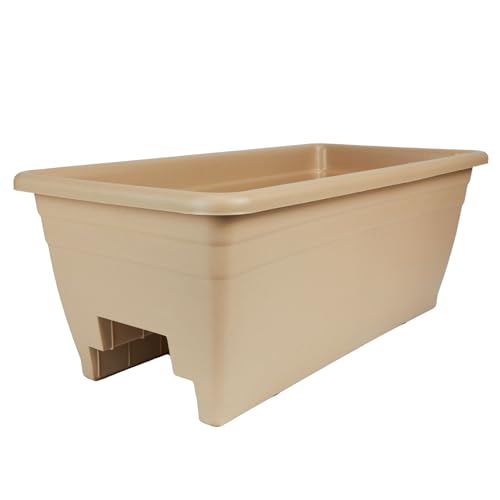
Rail compatibility is the first filter. The Bloem Finley accepts stated rail sizes from 3 to 6 inches, while the Veradek Pure Series bracket is listed for 1 to 6 inches. Those broad ranges may suit more installations than a fixed-width design. The Bloomers models fit 1.25 to 3.875 inches, and the Root & Vessel Countryside is intended for flat 3.5- or 5.5-inch rails. Compact bracket sets such as the YAHKBTEN and Sunexinlo models cover narrower ranges around 1.6 to 3.7 inches.
Measure the rail width and note its shape before comparing boxes. A flat wood rail, metal rail, fence top, and window sill may require different support contact. Adjustable brackets provide more flexibility, but they do not automatically make every installation suitable. Also check whether the planter hangs inward or outward. Veradek specifically documents inward-facing use, so its mounting restriction should be treated as part of the buying decision.
Compare planting length and capacity
Long boxes provide more continuous planting space. The Veradek measures 36 inches, while several Bloomers, Bloem, Root & Vessel, and The HC Companies options measure about 24 inches. These formats suit rows of flowers, herbs, or several small plants. The Pure Garden model offers a different layout: two sections of 3 gallons each, with a listed total capacity of 6 gallons.
Capacity is not simply a benefit. Wet growing media is heavy, and a large box can place more load on the railing than a small one. The Pure Garden listing gives a total soil-weight figure, which is useful evidence for planning, but the railing’s own construction and limits still matter. Smaller sets such as the YAHKBTEN and Sunexinlo boxes distribute plants across multiple positions and may be easier to arrange, though each container offers less planting room.
Choose a drainage approach
Drainage systems vary considerably. Removable plugs on the Bloem Finley, The HC Companies planter, and Root & Vessel Countryside allow the owner to open or close drainage points. This can be useful when moving a planter between indoor and outdoor locations, but closed holes should not be treated as a substitute for careful watering.
The Bloomers standard model uses drainage holes, while the Bloomers self-watering grow box uses a reservoir insert and includes a mulch cover. The Pure Garden planter has elevated removable inserts that collect excess water below the planting area. The YAHKBTEN and Sunexinlo sets pair drainage holes with removable trays. These designs can help manage drips, but the supplied evidence does not establish that any system eliminates overwatering in every condition.
If the planter will sit above a walkway, look for a tray or a controllable plug and consider where runoff will go. For outdoor use, open drainage may be more appropriate than retaining water, depending on the plants and local weather. For indoor or protected use, a closed plug or collection tray may be more practical.
Evaluate plastic and resin construction
The selected products use plastic or resin in several forms. UV-resistant plastic appears in The HC Companies model, while the Bloem Finley uses 100% recycled plastic and lists UV protection. The Bloomers products use weatherproof resin, and Root & Vessel describes lightweight, fade-resistant plastic. Veradek lists high-grade plastic with resistance to cracks, scratches, UV, and fading.
These statements describe supplied materials and claimed design features, not independent durability testing. Even weather-resistant plastic can be affected by installation, impact, temperature, and prolonged exposure. A lightweight box is easier to place and reposition, but it still becomes heavier after soil and water are added. Inspect brackets, contact points, and fasteners periodically.
Consider installation and spacing
Some designs simply rest on a compatible rail. The Bloem Finley and Root & Vessel emphasize tool-free placement, while the Bloomers products include stabilizer fasteners. Bracketed products such as the Veradek, YAHKBTEN, and Sunexinlo provide adjustable mounting hardware. The Emsco Group three-pack supplies separate planters, allowing them to be spaced along a railing rather than concentrated in one location.
A multi-pack can be useful for symmetry or for separating herbs and flowers. It also creates more installation points to check. Look for locking screws, rubber pads, or stabilizers when movement is a concern. Follow the supplied instructions and avoid drilling into a rail or planter unless the product documentation specifically supports that approach.
For one broad, traditional box, the Bloem Finley and The HC Companies planter are sensible starting points. For water-reservoir features, consider the Bloomers self-watering grow box. For a divided interior, Pure Garden is the more specific fit. Compact paired or four-box systems, including YAHKBTEN and Sunexinlo, suit smaller planting stations. The Veradek is the distinctive choice when a 36-inch inward-facing display is appropriate.
Final Recommendation
Bloem Finley 24-Inch Deck Rail Planter ranks first overall in this specification-based comparison under the published weighted criteria.
The final choice among the best plastic rail planters depends on the documented features that match your intended use.
The Bloem Finley 24-Inch Deck Rail Planter is the highest-scoring returned product and the first overall specification-based choice. Its 3- to 6-inch rail fit, 7.5-gallon capacity, recycled plastic construction, optional drainage, and tool-free placement create the most balanced feature set in this comparison. Among the top plastic rail planters, it is the most specification-aligned general-purpose pick for a compatible deck or balcony.
Choose the Bloomers Self-Watering Rail Grow Box when the reservoir and mulch-cover design matter most. Select Veradek for an extra-long inward-facing display, Pure Garden for two planting compartments, or YAHKBTEN and Sunexinlo when several smaller boxes fit your layout better. Before buying, verify rail dimensions, mounting direction, drainage needs, and the expected filled weight.
Frequently Asked Questions
What should I measure before buying the best plastic rail planters?
Measure the rail width, identify whether it is wood or metal, and check whether its top is flat enough for the product’s support system. Compare those measurements with the planter’s stated range. Also measure the available length and confirm whether the planter must face inward or outward.
Are plastic rail planters suitable for herbs?
The supplied listings identify flowers, herbs, vegetables, and small plants as suitable uses for several selected products. Choose a container with enough planting depth and capacity for the intended herbs, and use the documented drainage system appropriately. The Bloem Finley, Bloomers models, The HC Companies planter, and Pure Garden model all list uses that include herbs or similar small plants.
Is a self-watering rail planter better than one with drain plugs?
Neither design is universally better. The Bloomers self-watering model documents a reservoir, aeration, and mulch cover, while drain-plug models such as the Bloem Finley and The HC Companies planter provide more direct control over drainage openings. The better choice depends on the plant, weather exposure, watering routine, and whether runoff must be contained.
Can a large rail planter overload a deck railing?
It may. Soil and water add substantial weight, particularly in larger models such as the Bloem Finley, Pure Garden, Veradek, and 24-inch boxes. Confirm that the railing and mounting method can support the filled planter, and distribute multiple boxes carefully rather than assuming a product’s lightweight empty weight represents its installed load.
Do multi-packs improve a railing display?
They can provide spacing flexibility and let you separate plants. The Emsco Group three-pack uses separate 24-inch planters, while YAHKBTEN and Sunexinlo offer multiple smaller boxes. Multi-packs also mean more brackets, fasteners, and drainage points to inspect, so installation consistency matters.